
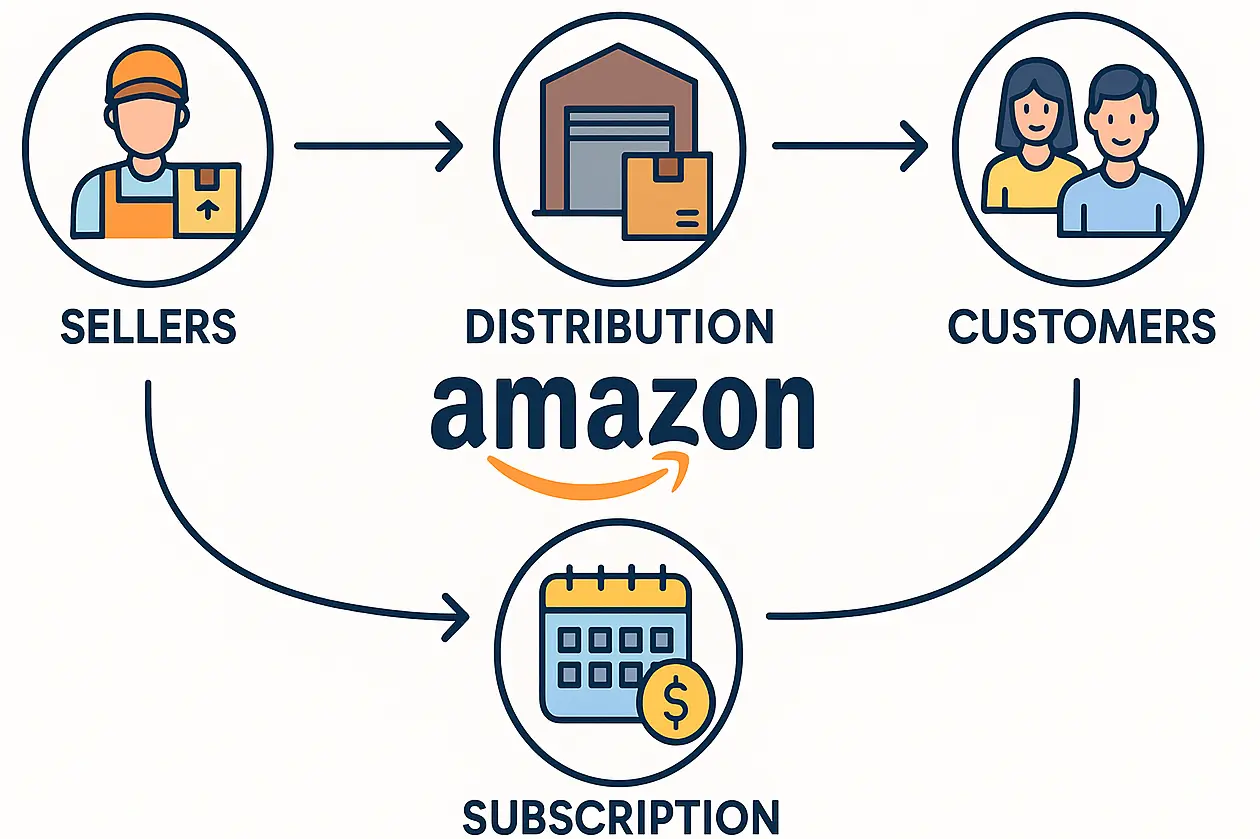
Amazon made over $500 billion in revenue in 2024. This success comes from more than just selling products online. The Amazon Business Model works as a full system that connects sellers, buyers, subscriptions, and cloud services in one place.
Amazon is not just a store. It runs a full ecosystem of marketplace sellers, logistics, cloud tools, and digital services. This business model earns from multiple revenue streams while keeping sellers supported and customers loyal through one connected platform.
Jeff Bezos built it with one clear goal: to create the most customer-focused platform in global e-commerce. Today, it includes Amazon Prime, AWS, Kindle, ads, and a strong fulfillment network across the world.
In this blog, you’ll learn how Amazon earns money, how sellers operate, and what makes this model successful. We’ll cover internal revenue sources, seller-side models, business strategy, and where Amazon is headed next.
What Is the Amazon Business Model?
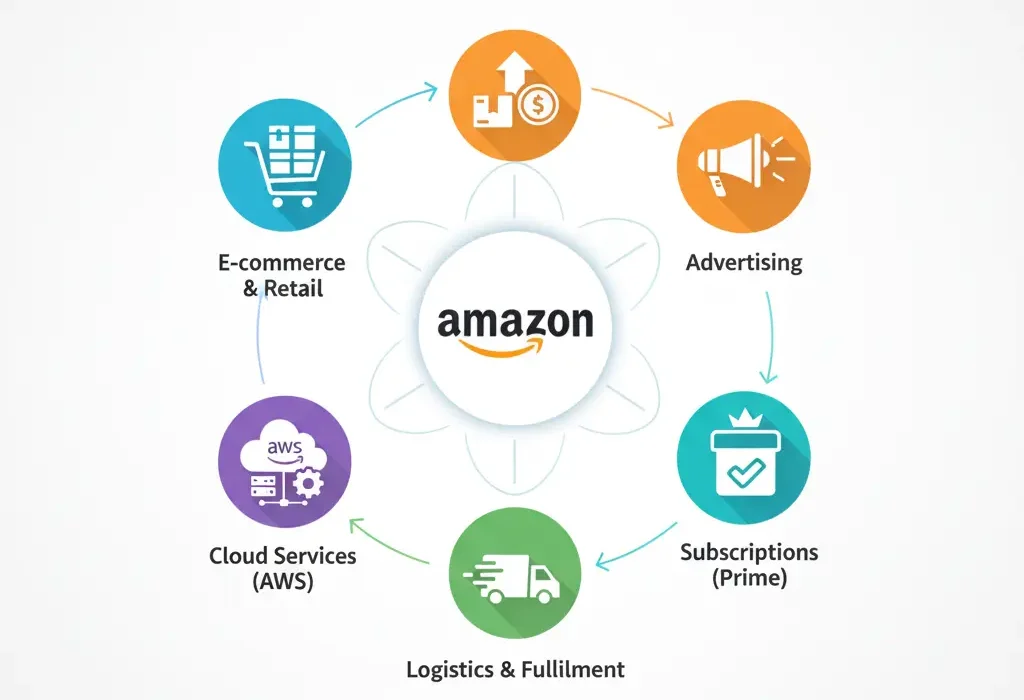
The Amazon Business Model is a system that earns money from many services, not just online shopping. It works like a platform where Amazon connects buyers, sellers, and service users in one place. Instead of only selling products, Amazon also runs ads, offers cloud tools, and sells subscriptions like Prime.
Amazon started in 1994 as a small online bookstore led by Jeff Bezos. Over time, it grew into a global e-commerce platform that now covers retail, streaming, logistics, and tech services. Each part adds a stream of income and strengthens how the platform works.
Today, Amazon runs a customer-centric strategy that keeps users coming back through speed, trust, and convenience. This model mixes e-commerce, technology, and digital tools into one connected system. That’s how Amazon went from one store to a massive digital ecosystem trusted by millions worldwide.
How Amazon Generates Revenue Across Its Ecosystem
Amazon doesn’t rely on one source to make money. It earns through different channels that work inside one powerful ecosystem.
Here are some key revenue resources below:
| Revenue Stream | How It Makes Money |
|---|---|
| AWS (Cloud Services) | Amazon charges businesses to use its servers, storage, and computing tools in the cloud |
| Sponsored Ads | Sellers pay to show ads on Amazon’s website through the Amazon advertising platform |
| Amazon Prime | Millions pay recurring subscription income for faster shipping, movies, and exclusive deals |
| Seller Fees | Amazon takes a cut from each sale through referral fees and fulfillment (FBA) services |
| Logistics Services | Amazon earns by handling shipping, storage, and last-mile delivery for sellers and partners |
| Kindle and Devices | Revenue comes from device sales and digital content like books, games, and media apps |
Each part of Amazon’s business adds a steady stream of income that supports its global platform. For example, AWS brings in billions by powering websites, apps, and tools for companies around the world.
In addition, Prime earns recurring subscription income while building customer loyalty through fast shipping and streaming.
Amazon also profits from its traffic by selling ad space through the Amazon advertising platform. Meanwhile, seller fees and FBA charges help Amazon grow its marketplace while managing shipping and storage services.
Even devices like Kindle and Echo earn money through paid content, not just through product sales.
Amazon Business Model Canvas Explained
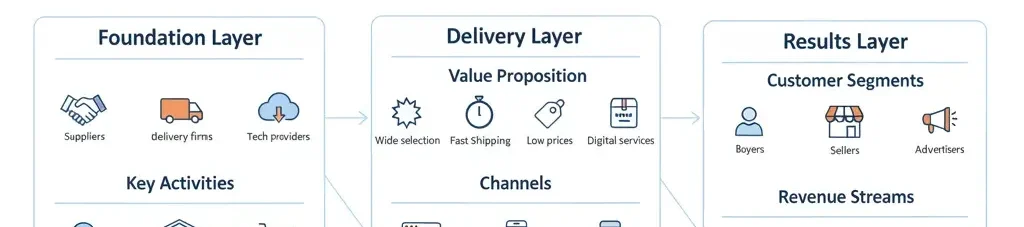
Amazon doesn’t just make money in many ways. It connects everything into one system that actually works. Most businesses fail to grow because their pieces don’t fit well together. Amazon solves this by using a smart structure behind the scenes.
Let’s break it down using three key layers.
Foundation Layer:
Amazon works with thousands of partners like suppliers, delivery firms, publishers, and tech providers. Its main activities include cloud hosting, order fulfillment, and running a massive e-commerce platform.
Key resources are its warehouses, customer data, logistics network, and cloud infrastructure. These pieces keep Amazon’s system fast, scalable, and reliable.
Delivery Layer:
Amazon’s value proposition is clear. It offers a wide selection, fast shipping, low prices, and trusted digital services like Prime and Kindle. Channels include the Amazon website, mobile app, smart devices, and Alexa.
Amazon builds strong customer relationships by offering fast support, loyalty perks, and smooth order tracking.
Results Layer:
Amazon serves buyers, sellers, developers, and advertisers across the globe. Its revenue comes from cloud services, product sales, subscription fees, and ad placements. Main costs include logistics, tech development, content licensing, and customer service.
We help businesses build the right Amazon Business Model with clear product strategy, pricing, fulfillment, and growth planning.
From setup to optimization, our service helps you create a stronger Amazon presence and scale with confidence.
7 Proven Business Models for Amazon Sellers
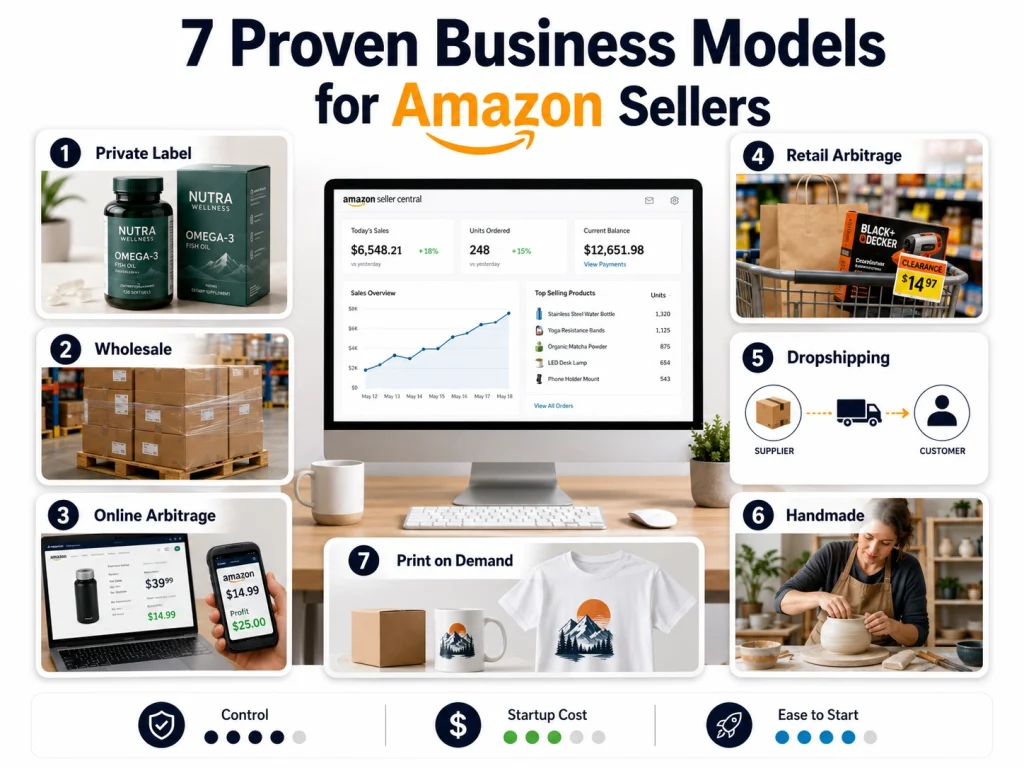
Most new sellers ask the same question: what’s the best way to start a business on Amazon? The answer depends on your budget, time, and how involved you want to be in daily tasks. Amazon supports several selling models. Each model has its own steps, benefits, and challenges.
Some options cost more but give you more control. Others are quicker to start and easier to manage. In the next sections, you’ll explore seven proven models real sellers use every day. These include private label, dropshipping, wholesale, handmade, and more.
Each model below covers what it is, how it works, pros and cons, and the tools you need to start.
1. Private Label
Private label is a model where you sell a product under your own brand name on Amazon. You do not invent something new. Instead, you choose a product that already sells well and improve it with better packaging, quality, or design.
To start, you research what products people are buying. Then, you find a supplier who can make that item for you. After that, you add your branding and ship the inventory to Amazon’s warehouse. Amazon handles the storage, delivery, and customer service through FBA.
This model gives you full control over pricing, product quality, and your brand. It also helps build a long-term business. But it needs more time, planning, and money upfront compared to other models. You are responsible for design, quality, and inventory.
2. Retail Arbitrage
Retail arbitrage means buying products from local stores at a low price and reselling them on Amazon. Many sellers use this model to start small, especially if they don’t want to order in bulk or manage suppliers.
You find items on clearance or discount at big-box stores like Walmart or Target. Then, you check if the item is profitable on Amazon using tools like the Amazon Seller app. If it meets your margin goals, you list the product, send it to Amazon FBA, and sell it under the original brand name.
This model is fast to start and doesn’t need a large budget. You can begin with just a few products and grow from there. But it requires constant store visits, deal hunting, and checking item restrictions.
To get started, all you need is a seller account, a barcode scanner app, and shipping supplies. Many sellers use tools like Scoutify or SellerAmp to speed up the scanning and pricing process in-store.
3. Online Arbitrage
Online arbitrage is buying products from websites and reselling them on Amazon at a higher price. You search online stores like Walmart, Walgreens, or eBay for discounted items. Then, you compare prices on Amazon to find profitable gaps.
This model lets you work from home without visiting stores. It gives access to more products and runs with less physical effort. But it can be competitive, and some websites may limit how much you can buy.
To get started, you need a seller account and a simple shipping setup. Tools like Tactical Arbitrage and RevSeller help find deals faster. Many sellers also use Google Sheets or BuyBotPro to track profits and product limits.
4. Wholesale
Wholesale is buying products in bulk directly from brands or distributors and reselling them on Amazon. You sell items under their original brand name, not your own.
To start, you contact brands or suppliers and request permission to sell their products. After approval, you place large orders and ship the items to Amazon’s warehouse using FBA.
This model offers a stable supply and less risk of running out of stock. You don’t need to create a brand or design packaging. But you need a larger budget and approval to sell many products.
Useful tools include InventoryLab for profit tracking and ScanUnlimited for supplier lists. Many sellers also use Keepa to check product sales history and price trends.
5. Dropshipping
Dropshipping means you list a product on Amazon, but you don’t keep it in stock yourself. When someone buys, you order the item from a third-party supplier, who ships it directly to the customer.
You don’t need to buy inventory upfront or manage a warehouse. This makes it low-cost and easy to start. But it comes with risks like slow shipping, poor product quality, and account issues if the supplier fails to deliver on time.
To start, you need a reliable supplier and a system to manage orders quickly. Popular tools include AutoDS and DSers. Some sellers also use spreadsheets to track orders and handle customer service quickly.
6. Handmade
Handmade is for sellers who create their own products and list them in the Amazon Handmade marketplace. These items can include jewelry, home décor, clothing, and other custom or crafted goods.
You must apply and get approved before listing your handmade items. Once accepted, you create product listings and ship orders directly or use FBA for storage and delivery. Each item must be made or finished by hand.
This model works well for artists and creators who want to sell unique products. It gives more control over quality and pricing. But it also takes more time, skill, and effort to produce inventory.
Useful tools include Etsy for ideas and Canva for simple product label designs.
7. Kindle Publishing (KDP)
Kindle Direct Publishing (KDP) lets you publish and sell digital books on Amazon without printing or shipping. You upload your manuscript, choose a price, and Amazon handles delivery through Kindle devices and apps.
This model works well for writers, educators, or anyone who can create helpful or entertaining content. You earn royalties for every book sold. It doesn’t require inventory, warehouses, or customer support.
KDP is free to join and easy to use. But success depends on your content, keywords, and marketing. You’ll also need a good cover and title to stand out.
Helpful tools include Canva for design, Publisher Rocket for keyword research, and Grammarly for editing your book before uploading.
Pros and Cons of Each Amazon Model
Some models look easy at first, but come with hidden risks that slow your business down. That leads to wasted time, money, or both. Each Amazon model has strengths, but also weaknesses you must understand before jumping in.
Look at the pros and cons below to choose a model based on your time, cost, and control.
| Model | Pros | Cons |
|---|---|---|
| Private Label | Full control, high margin, builds brand, scalable for long-term growth | High cost, slow start, product research and supplier risks |
| Retail Arbitrage | Low startup cost, fast to start, great for testing products | Limited supply, low brand control, time-consuming store visits |
| Online Arbitrage | Work from home, wide product access, no store trips | High competition, lower margins, account risk from restricted products |
| Wholesale | Stable supply, high volume, easier to scale with systems | Requires approval, upfront bulk costs, brand relationships needed |
| Dropshipping | No inventory, low risk, easy to launch | Low margins, shipping delays, little control over product or quality |
| Handmade | Creative freedom, strong customer connection, niche appeal | Slower to scale, time-heavy, product limits |
| KDP | No inventory, passive income, easy to publish | Success takes time, content must be strong, heavy focus on marketing |
Which Amazon Model Is Right for You?
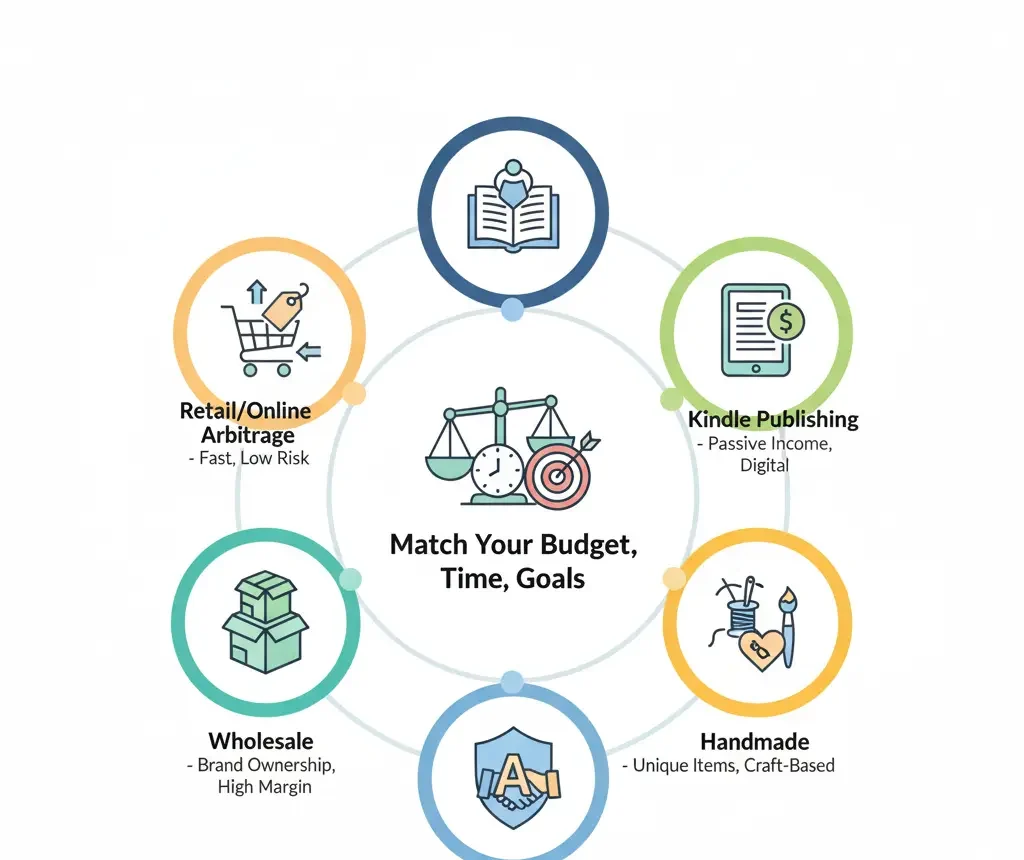
Your budget, time, and goals should guide which Amazon model fits you best. Some sellers need quick cash flow. Others want to grow a brand, earn passively, or build around a hobby.
If you want to start fast with low risk, retail or online arbitrage can be a great match. These models need less money upfront and allow you to test products without heavy setup or risk.
Writers and digital creators may prefer Kindle Publishing. It lets you earn passive income without managing physical products or inventory. Once a book is uploaded, it can continue earning while you focus on new ideas.
Creative sellers who enjoy making unique items can explore the Handmade model. This path gives more control over your product quality and suits part-time or craft-based sellers.
Private labels are best for those who want brand ownership and full control. You’ll need more budget and time, but it gives higher margins and long-term growth potential.
Wholesale fits sellers who like bulk orders and a stable supply. It works well if you enjoy handling logistics and supplier deals.
So, the best fit depends on what you’re building, not just how fast you start. Match the model to your lifestyle.
Mistakes Amazon Sellers Should Avoid
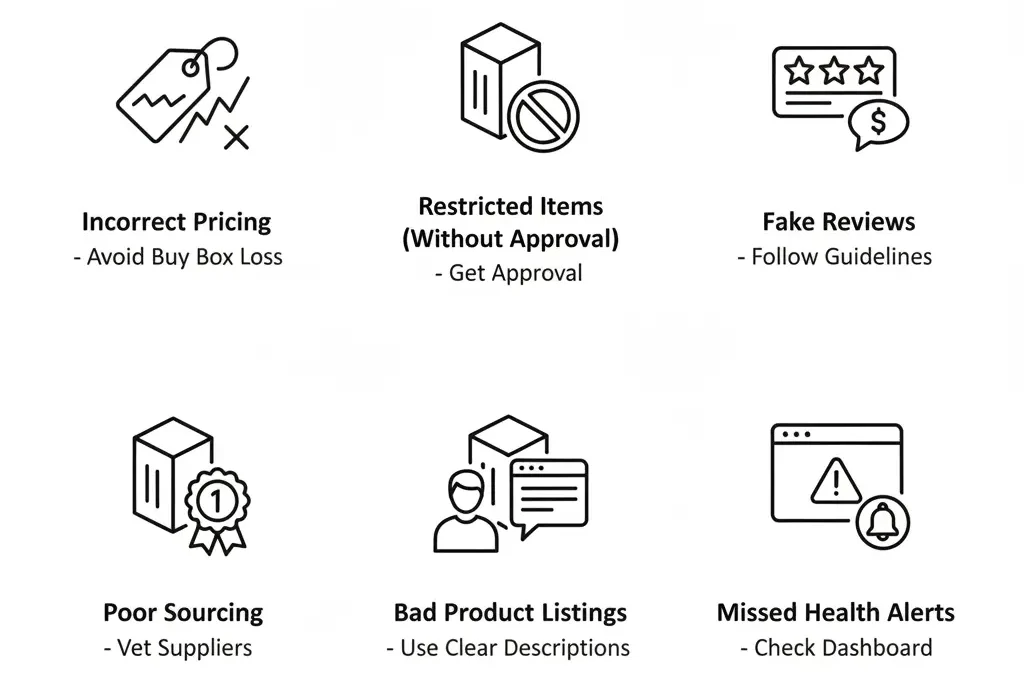
One small mistake can ruin weeks of progress. Some sellers lose listings or even their accounts due to preventable issues. If you understand the most common risks, you can avoid suspension, protect your metrics, and grow faster.
- Incorrect product pricing causes Buy Box loss or suppression. Use RepricerExpress to stay within Amazon’s pricing rules.
- Restricted items sold without approval may lead to warnings or even Amazon suspension. Always check the updated policy pages.
- Fake review rewards or biased language will trigger review abuse flags. Follow Amazon’s messaging rules to stay compliant.
- Poor sourcing often leads to high return rates, low quality, and fake review problems. Vet all suppliers and test your samples.
- Bad product listings confuse buyers and increase returns. Use honest descriptions, clear bullets, and your own photos.
- Missed health alerts can cause serious damage to your account. Check the dashboard weekly and fix flagged issues fast.
Why Amazon Dominates Global E-commerce?
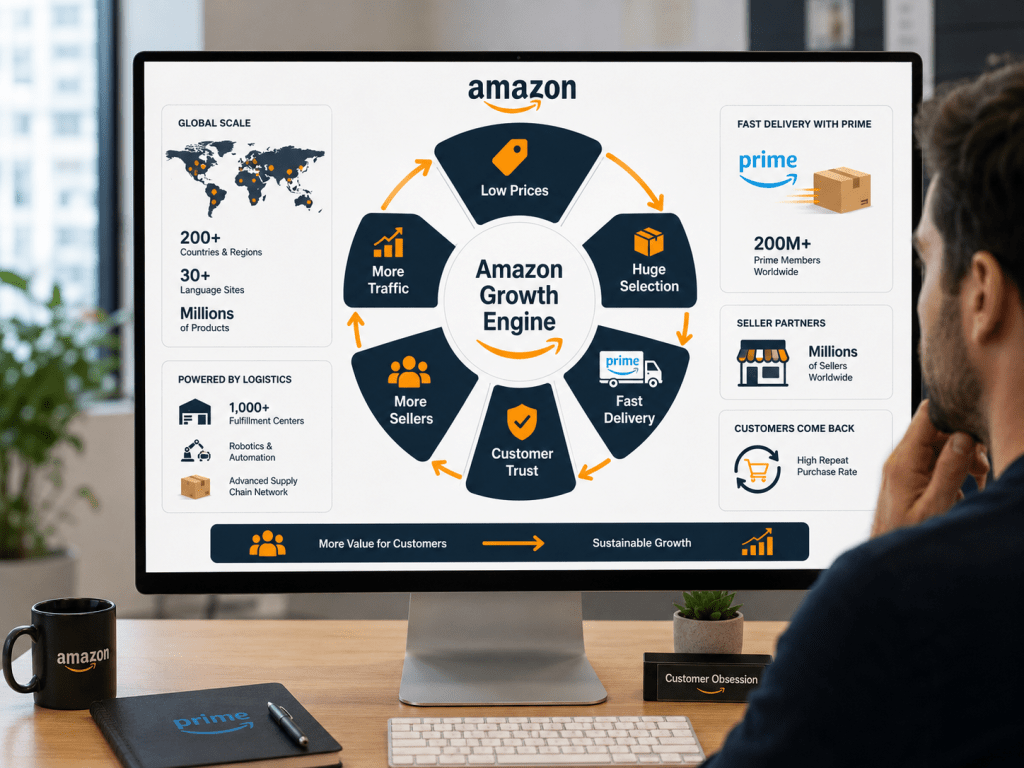
Most platforms grow slowly because their systems are scattered. Amazon connects everything in one model that multiplies results. Its structure works like a flywheel business model, where each part builds momentum for the next.
1. Prime builds loyalty and repeat sales
Prime members stay active longer and buy more often. Its fast shipping promise and video perks keep customers coming back. This reflects Amazon’s deep customer obsession and focus on lifetime value.
2. Amazon Logistics ensures faster delivery speed
Amazon owns trucks, planes, and local warehouses. It also invests in drone delivery to push faster last-mile shipping. These tools give Amazon more speed control than Shopify, Walmart, or Alibaba.
3. AWS supports Amazon’s tech and scale
Amazon Web Services handles cloud storage, website speed, and backend support. It earns billions that fund new features. This gives Amazon an edge in both technology and reinvestment.
4. AI powers the recommendation engine
Amazon’s recommendation engine uses shopping habits to suggest what buyers want next. This improves conversions and keeps buyers engaged longer. More data means smarter targeting and better product visibility.
5. Scale fuels growth and speed
More sellers bring more choices across every category. That attracts more buyers, which boosts traffic and sales. More orders lead to better data, faster fulfillment, and higher customer satisfaction across the platform.
The Future of Amazon’s Business Model
Brands often focus on speed, not sustainability, which limits future impact and expansion. Amazon plans for the next decade by investing in technology, speed, and sustainability. Its future model mixes AI, automation, and green fulfillment to stay ahead globally.
- Amazon uses Anthropic and Bedrock to expand its generative AI strategy.
- AI chips and Project Rainier speed up data flow and system control.
- Drone delivery helps Amazon reduce last-mile shipping delays.
- Warehouse robots improve fulfillment speed and lower labor costs.
- Green centers and electric vans support Amazon’s sustainability plan.
- Amazon Business grows by serving more global B2B buyers.
Amazon’s future model relies on tech expansion to stay faster, smarter, and cleaner. AI and robotics improve how products move and decisions get made.
At the same time, Amazon focuses on ESG goals to meet global standards while growing Amazon Business across more countries. This mix of smart tech and sustainability helps Amazon build for the future without slowing down.
Amazon’s 1P vs 3P Marketplace Model: How Amazon Sells and Monetizes Sellers
Amazon’s business model works through two core retail systems: 1P and 3P. In the 1P model, Amazon buys products from brands or vendors, owns the inventory, and sells those products directly to customers. Amazon records this revenue as product sales when it sells from its own inventory.
In the 3P marketplace model, independent sellers list products on Amazon, while Amazon provides the platform, traffic, checkout system, advertising tools, and fulfillment options. Amazon says it is not the seller of record in these transactions and earns revenue from commissions, fulfillment fees, shipping fees, and other seller services.
This is why Amazon is more than an online store. It is also a marketplace infrastructure business. Sellers bring product selection, while Amazon monetizes the transaction, logistics, ads, and customer access.
Amazon Revenue Breakdown: Which Business Units Make the Most Money?
Amazon’s largest revenue stream is still online stores. In 2025, Amazon reported $269.3 billion from online stores, making it the biggest revenue category in the company’s business model.
Third-party seller services are the next major revenue driver. In 2025, this category generated $172.2 billion, showing how powerful Amazon’s marketplace fees, referral fees, fulfillment fees, and seller-related services have become.
AWS is smaller than online stores and third-party seller services by revenue, but it is Amazon’s most profitable segment. In 2025, AWS generated $128.7 billion in net sales and $45.6 billion in operating income, more than North America and International operating income combined.
Amazon also earns heavily from advertising, subscriptions, and physical stores. In 2025, advertising services produced $68.6 billion, subscription services produced $49.6 billion, and physical stores produced $22.6 billion.
FBA vs FBM vs Seller-Fulfilled Prime: How Fulfillment Changes the Amazon Business Model
Fulfillment is a major part of Amazon’s business model because it affects speed, Prime eligibility, seller fees, customer trust, and profit margins. With FBA, sellers send inventory to Amazon, and Amazon handles storage, picking, packing, shipping, customer service, and returns.
FBM gives sellers more control. Under Fulfilled by Merchant, sellers manage inventory, packing, shipping, and order handling themselves. This can reduce Amazon fulfillment costs, but sellers must maintain delivery speed, tracking quality, and account health.
Seller-Fulfilled Prime sits between FBA and FBM. Sellers fulfill orders themselves but can display the Prime badge after proving they can meet Amazon’s fast and reliable delivery standards.
The key difference is control versus scale. FBA gives Amazon more control over the customer experience and creates more fee revenue. FBM gives sellers more operational flexibility. Seller-Fulfilled Prime gives sellers Prime visibility, but only if they can meet Amazon-level fulfillment performance.
Frequently Asked Questions (FAQs)
Many new and experienced sellers have questions that go beyond choosing a business model or fulfillment method. Below are answers to common issues real Amazon sellers face as they grow their business.
Reviews are extremely important for building trust and increasing sales. Use Amazon Vine, request reviews through messages, and focus on great service to collect feedback that helps improve product visibility and buyer confidence.
Inventory may go missing between warehouses. You can view your inventory ledger, open a support case, and request reimbursement. Always track inventory performance and respond quickly to avoid long-term losses or account health issues.
Use product research tools like Jungle Scout or Helium 10. Look for steady demand, low competition, and strong margins. Avoid seasonal items and focus on everyday products with consistent sales across different categories.
Yes. Many sellers run Amazon businesses part-time. Start with low-maintenance models like Kindle Publishing or online arbitrage. Set daily tasks, automate where possible, and scale only when you’re ready for a full-time commitment.
Amazon will request that you remove the inventory. You can submit a removal order and choose return or disposal. If you don’t act in time, storage fees may apply or products may be removed at Amazon’s discretion.
Building an Amazon Brand? Brand’s Bro Can Help
A lot of sellers launch fast but miss the systems that drive real results over time. No optimized listings, no content plan, no sales system. Just chaos. That’s why most fail to grow or get buried by better-prepared competitors.
Brand’s Bro helps you fix the foundation. From amazon listing optimization to storefront design, SEO, and A+ content, we build the structure that supports growth. Our team also manages PPC, targeting, and ads to help you scale smart and profitably.
You bring the product. We build the model around it.