
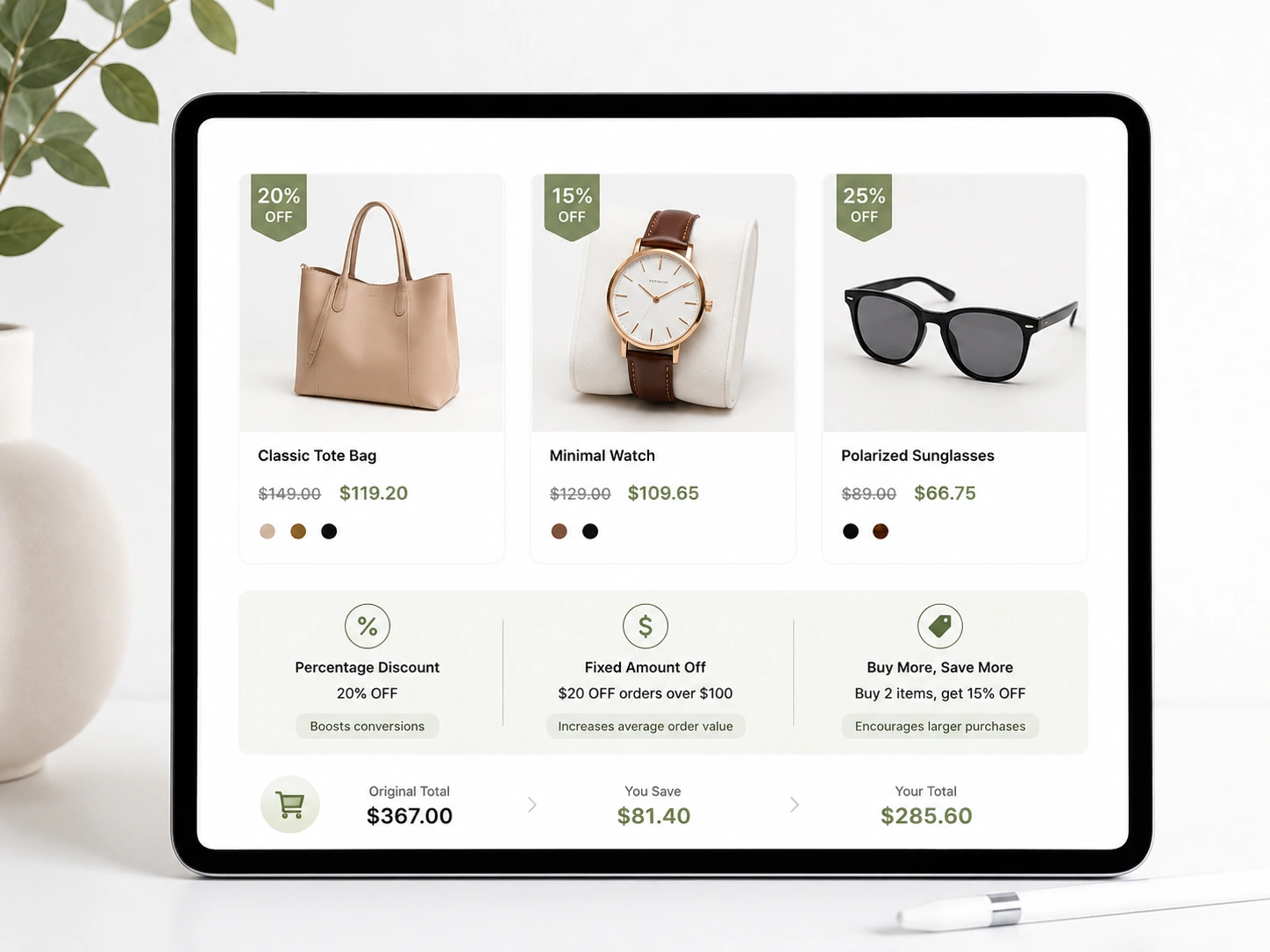
Discounts can increase Shopify sales fast, but random price cuts can also destroy profit. A 20% discount means nothing if your margins are weak, your offer is unclear, or customers only buy when prices drop. Smart discount pricing is not about being cheaper. It is about giving customers a reason to buy now without weakening your brand value.
At Brand’s Bro, we have spent over 11 years helping Shopify and ecommerce brands build pricing, offer, and conversion strategies that actually protect profit while increasing sales. Our team has worked with 350+ Shopify businesses across the USA, Canada, the UK, and Australia, including brands in fashion, beauty, home essentials, electronics, lifestyle products, and health-focused ecommerce.
We have seen Shopify stores lose money because they used discounts blindly. Some brands offered sitewide sales too often. Some gave coupon codes without tracking profit. Others reduced prices but failed to improve product pages, bundles, upsells, or cart value. In one Shopify fashion project, we rebuilt the discount structure with bundle offers, first-order incentives, and cart-based discounts. Within 75 days, average order value increased by 42%, and monthly revenue grew by 168%.
For a home essentials brand, we replaced flat discounts with tiered pricing and limited-time offers. The result was stronger checkout urgency, better product movement, and a 231% increase in campaign-driven sales without depending on constant markdowns.
Shopify discount pricing works best when it is planned around customer behavior, profit margin, product demand, and purchase timing. The wrong offer attracts bargain hunters. The right offer turns visitors into buyers and increases repeat sales.
In this guide, we’ll break down the most effective Shopify discount pricing strategies to increase sales, including bundle discounts, tiered offers, first-order coupons, seasonal promotions, and cart-value incentives.
If your Shopify store is running discounts but not seeing real profit growth, Brand’s Bro can help you build a smarter pricing strategy that increases sales without damaging your margins.
To discuss your brand’s growth plan, you can book a meeting with us today.
Pricing Psychology for Shopify Stores: How Buyers Decide
After auditing the backends of hundreds of scaling Shopify stores, one thing is clear. Pricing is a behavioral economics problem. Most merchants treat their price list as a logical calculation of costs plus a margin.
However, high-velocity brands know that customers react to emotional triggers, not spreadsheets.
We’ve seen that the most successful stores don’t just “slash prices”; they architect an environment where customers feel they are making the smartest possible financial move.
If you want to increase sales without appearing desperate or devaluing your brand, you must tap into the specific neurochemistry of the buyer’s journey.
Trigger | Consumer Action | Business Result |
The Oxytocin Hit | Feeling of “winning” | Higher customer satisfaction |
Anchoring | Comparing new price to old | Increased perceived value |
Loss Aversion | Fear of missing out | Faster checkout times |
Deadlines and Limited Offers Drive Faster Buying
Through our constant A/B testing of promotional mechanics, we’ve confirmed that the pain of losing out is twice as powerful as the joy of gaining. In the e-commerce space, this is the difference between a “browsing” session and a “buying” session.
When a deal feels permanent, there is zero urgency to convert. In our strategic frameworks, we move beyond generic discounts. Instead of a static “10% off” banner, we’ve found a time-bound offer.
Such as “10% off for the next 120 minutes” triggers an immediate shift in the brain. You aren’t just lowering a price, but creating a closing window. This leverages the biological fear of being left behind, forcing a decision now rather than later.
Percentage vs Fixed Discounts (Dollar Value Perception): The Rule of 100
Should you offer $10 off or 10% off? The answer depends on your price. This is called the Rule of 100. It is a simple trick to make your discount look as big as possible.
- If your product is under $100, use percentage discounts. 25% off a $20 shirt sounds better than $5 off.
- If your product is over the $100 threshold, use a fixed amount off. $50 off a $500 grill sounds much better than 10% off.
Both are the same math. But one feels like a steal. Use this to change how people see your value.
Why Discounts Feel Good (and Still Protect Your Profits): The Oxytocin Effect
Finding a bargain releases a chemical called oxytocin. It makes people feel happy and relaxed. It makes them trust you. When a customer uses a coupon, their heart rate actually slows down.
But wait. You cannot just give away the farm. You want them to feel that high while you maintain profit margin protection. The goal is a win-win. They get the chemical hit. You get the sale and a healthy margin.
How Original Price Points Influence Value Perception
Your first price is the anchor. It stays in the customer’s mind. This is why price anchoring works. When you see a $100 price crossed out and replaced by $70, the $70 looks cheap.
Without the $100 anchor, the $70 might look expensive. Always show the original price. It gives the brain a baseline. It proves the discount is real.
BrandsBro helps Shopify stores build smart discount pricing strategies that protect profit while increasing conversions.
From bundle offers to limited-time deals, we plan pricing systems that attract buyers without damaging your brand value.
7 Best Shopify Discount Types for Higher Conversion Rates

Now let’s get into the gears of your store. You need a toolkit. Not every sale needs a 20% off code. Some sales need a nudge. Others need a sledgehammer.
These shopify discount pricing strategies are designed to move the needle on your revenue. Each one serves a different goal. Use them wisely.
1. Bundling and Volume-Based Discounts (Increase AOV)
If you want to grow, you need your customers to spend more each time they visit. This is where product bundles come in. Instead of selling one bottle of soap, sell three.
And for the customer, the deal is simple. They buy more and save more. You save on shipping. They save on the unit price. Your AOV goes up. Your shipping costs stay relatively flat. This is how you scale a brand without spending more on ads.
2. Tiered Discounts: The "Spend More, Save More" Framework
This is a game for your shoppers. “Spend $50, get 10% off. Spend $100, get 20% off.” It pushes people to add “just one more thing” to their cart.
It turns your store into a challenge. Customers will browse more pages to hit the next tier. This increases your time on site. It also increases the total value of every order you ship.
3. Strategic Flash Sales: Using Scarcity as a Catalyst
A flash sale is a short burst of energy. It usually lasts only a few hours or one day. It is loud. It is fast. And it works.
But keep it rare. If you have a flash sale every Tuesday, people will stop caring. Use a time-sensitive approach. Make it an event. This drives high-velocity sales and clears out inventory fast.
4. Shopify Cart Abandonment and Discount Recovery Strategies
Almost 70% of people leave your store without making a purchase. They get distracted. The dog barks. The phone rings. You need to bring them back.
Send a recovery email with a small nudge. Maybe it is free shipping. Maybe it is a 5% discount. This is the highest ROI email you will ever send. It turns a “no” into a “yes” while you sleep.
5. Buy X Get Y (BXGY) for Inventory Clearance
Do you have boxes of old stock in your warehouse? Use BOGO offers. Buy one, get one free. Or buy one, get one 50% off.
This is great for inventory turnover. It is better to move the product at a discount than to let it sit and gather dust. It keeps your cash flow moving.
6. Seasonal and Event-Based Promotions (BFCM & Beyond)
You cannot ignore the big dates. BFCM Shopify sales are the biggest events of the year. You need a plan for Black Friday and Cyber Monday.
But don’t stop there. Think about “National Coffee Day” or “First Day of Summer.” These events give you a reason to reach out to your list. Adopting expert search-engine focused strategies makes sure your event pages are visible to shoppers exactly when their intent to buy is highest.
7. Loyalty and Membership-Only Offers for Retention
It costs five times more to find a new customer than to keep an old one. Use loyalty programs. Give your best customers a reason to stay.
Exclusive discounts make people feel like they belong to a club. They don’t just buy from you. They become fans. This is the secret to long-term success.
Technical Implementation: Mastering Shopify Discount Functions
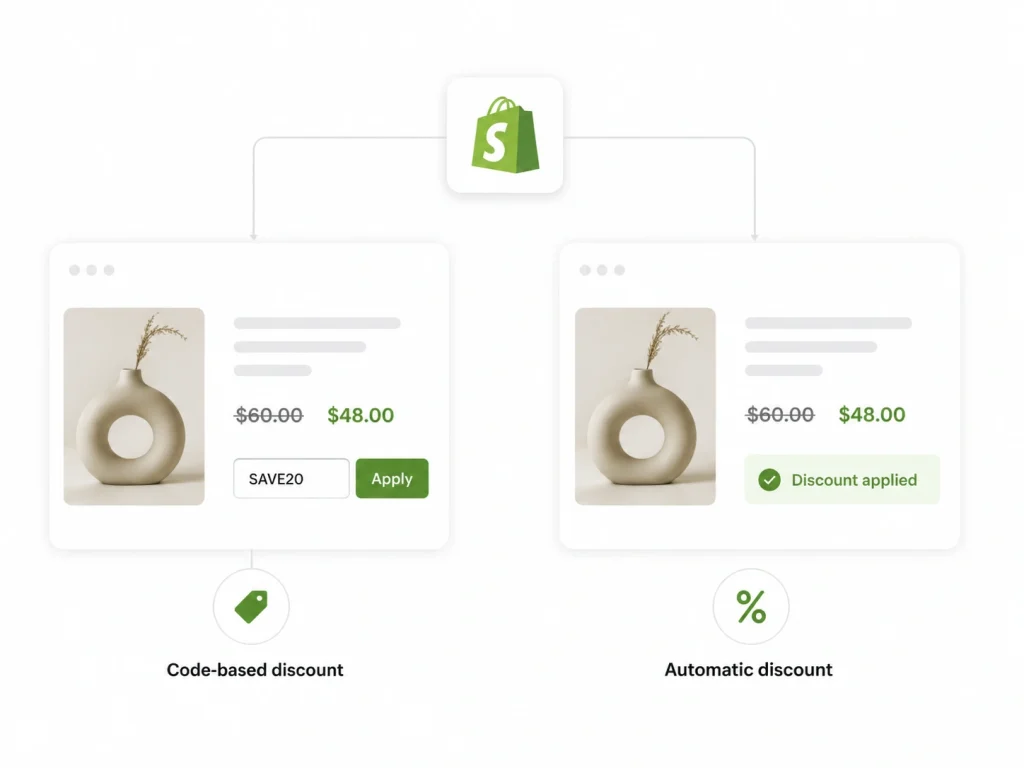
Setting up the tech is where many owners get stuck. Shopify makes it easy, but you have to choose the right path. Do you want them to type in a code? Or do you want the price to change on its own?
Automatic Discounts vs. Manual Discount Codes
Automatic discounts are great for conversion. The customer sees the savings right away. There is no friction. They don’t have to remember a word like “SAVE20.”
But manual discount codes are better for tracking. You can see exactly which influencer or which email drove the sale. Use codes for marketing campaigns. Use automatic deals for store-wide events.
Leveraging Shopify Functions for Custom Pricing Logic
If you want to get fancy, use Shopify Functions. This lets you build unique rules. Maybe you want to give a discount only to people in a certain city. Or only to people who have bought from you three times.
Applying these complex rules usually requires specialized technical customization to keep your store running smoothly and without errors during high-volume traffic spikes
Personalization and Behavioral Targeting at Scale
You can now offer personalized offers based on what people do. If someone looks at a pair of shoes three times, send them a code for those exact shoes.
This isn’t creepy. It’s helpful. You are giving them a reason to finish the journey they already started.
When Discounts Hurt Profit Margins (And What to Do Instead)
Listen closely. Discounts are like salt. A little bit makes the meal better. Too much ruins it. If you discount too often, you fall into the discount trap.
Avoiding the "Discount Trap" and Customer Price Training
If you always have a sale, your “regular” price becomes a lie. Customers will never pay full price again. You have done price training. You taught them to wait.
Break this cycle. Offer value instead of just lower prices. Give a free gift. Give early access. Protect your brand’s worth.
Calculating Break-Even Points for Every Sale
Before you launch a sale, do a break-even analysis. You must know your COGS (Cost of Goods Sold). If you sell a $100 item for $70, but it costs you $50 to buy it and $15 to ship it, you only made $5.
Is $5 enough to cover your ads? Usually, no. Use a spreadsheet. Know your numbers before you click “Save.”
Data-Driven Optimization: KPIs for Your Discount Strategy
If you don’t measure it, you can’t manage it. You need to look at more than just the “Total Sales” number. You need to see the “Total Profit” number.
Metric | Why it Matters | Target Benchmark |
ROAS | Measures ad efficiency | 3.0x or higher |
LTV:CAC | Long-term health | 3:1 ratio |
AOV | Size of the basket | Increase by 15% |
Customer Lifetime Value (LTV) vs. Acquisition Cost (CAC)
Your LTV: CAC ratio tells the truth about your business. If it costs $50 to get a customer (CAC), but they only ever spend $40 (LTV), you are going out of business.
Use discounts to increase the LTV. Get them to come back for a second and third purchase. That is where the real money is made.
Analyzing Margin Leakage and Attribution
Margin leakage happens when you give away more than you need to. Maybe you gave a 20% discount to someone who would have bought at 10%.
Use discount attribution to see which codes work. Stop using the ones that just eat your profit without bringing in new shoppers.
Case Studies: Real Results from the Trenches
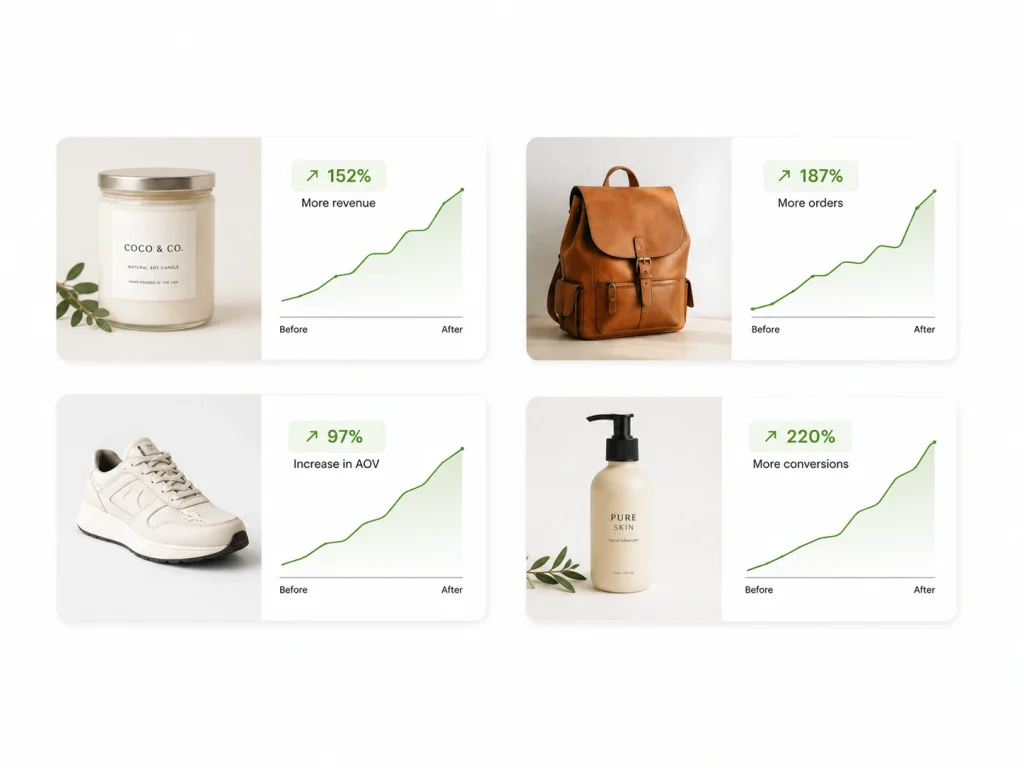
Data is great. But real stories are better. Here are four brands that used these strategies to change their future.
Specialty Power & Automotive Solutions: The Conversion Skyrocket
This brand was doing okay. They had a ROAS of 5.26x. That is healthy. But they hit a wall. Their conversion rate was stuck at 3.54%. They were winning the click but losing the sale.
We focused on trust. We used social proof and automated review requests. We made the landing page feel like a premium experience.
- The Result: Conversion rate jumped to 8.74%.
- The Big Win: Blended ROAS climbed to 8.33x.
Innovative Home & Kitchenware: The Creative Refresh
This brand had a great product, but nobody saw it. Their CTR was 0.16%. Their ads were boring. They were paying $1.01 per click.
We switched to UGC-style videos. We made the ads look like real people using the products. This lowered ad fatigue and boosted engagement.
- The Result: CTR quadrupled to 0.72%.
- The Big Win: CPC dropped by nearly 50% to $0.52.
Shopify Discount Apps That Help Increase Revenue
You can’t do this all by hand. You need the right tools. The Shopify App Store is full of options. Here are the ones that actually move the needle.
- For Bundles: Look at apps like Bundler or Bold Bundles. They make it easy to set up “frequently bought together” sections.
- For Scarcity: Use Hextom or similar bars to show countdown timers. This makes the “Limited Time” feel real.
- For Upsells: Use ReConvert. It allows you to offer a discount on the thank-you page. The customer just bought. Their credit card is in their hand. It is the best time to ask for one more thing.
Before You Launch Your Next Shopify Sale
Don’t rush. One mistake can cost you thousands. Follow this list every time.
- Check your COGS: Are you still making money after the discount?
- Test the Code: Does it work on mobile? Does it work on desktop?
- Set an End Date: Don’t let a “weekend sale” run for three weeks.
- Sync your Ads: Does your Facebook ad match the price on the site?
- Audit Inventory: Do you have enough stock to handle the rush?
Shopify Discount Codes vs Automatic Discounts: Which One Should You Use?
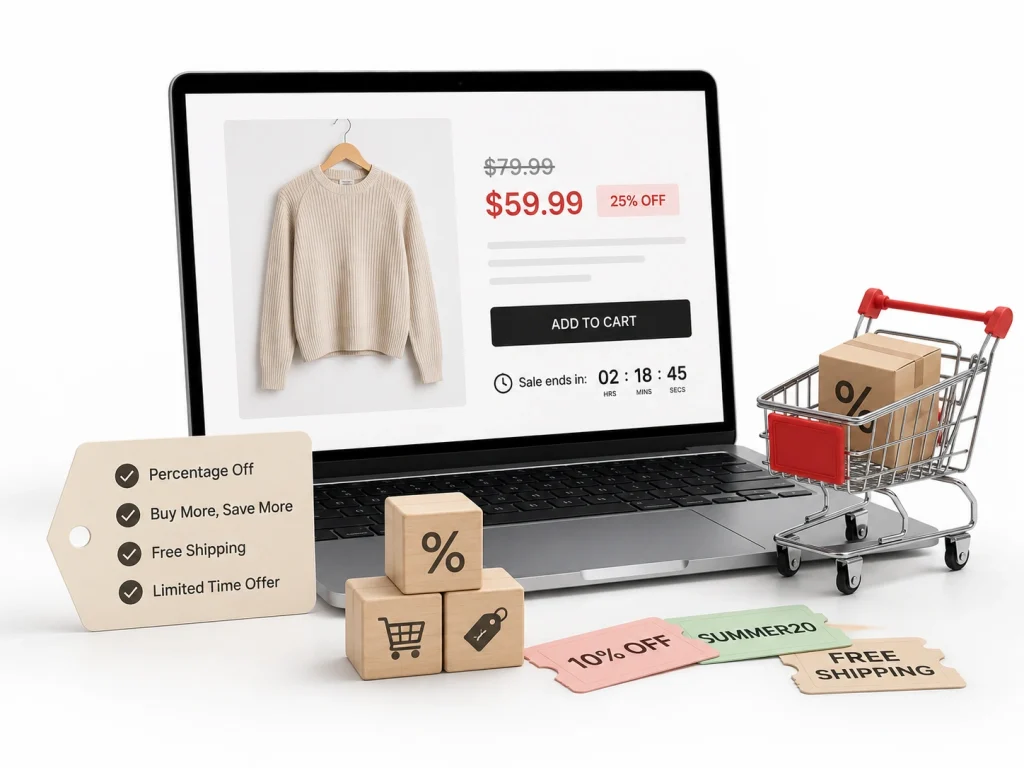
Shopify discount codes are best when you want controlled promotions. Customers enter a code at checkout, such as WELCOME10 or SAVE15, to receive the offer.
Automatic discounts are better when you want a smoother checkout experience. The discount applies automatically when the customer meets the rule, such as minimum spend, product quantity, or eligible collection.
Use discount codes for email campaigns, influencer promotions, seasonal deals, and customer-specific offers. They help you track which channel or campaign is driving sales.
Use automatic discounts when your goal is higher conversion. Since shoppers do not need to remember or type a code, there is less friction before checkout.
The best choice depends on your goal. For tracking and control, use discount codes. For faster checkout and fewer abandoned carts, use automatic discounts.
How to Set Minimum Spend Discounts Without Losing Profit
Minimum spend discounts encourage customers to increase order value, but the offer must protect your margin. A bad discount can increase sales while quietly reducing profit.
Start by checking your average order value. If your average order value is $45, you can set a discount threshold at $60 or $70 to push customers slightly higher.
Do not set the minimum spend too low. For example, offering 15% off over $30 may hurt profit if many customers already spend that amount.
A better strategy is to connect the discount to your margin. High-margin products can handle stronger discounts, while low-margin products need smaller offers.
For Shopify stores, a safe minimum spend discount should increase basket size, cover product costs, protect shipping costs, and still leave a clear profit after ad spend.
Bundle Discount Strategy for Shopify Products
Bundle discounts work well when products naturally fit together. Instead of selling one item, you sell a complete set, which increases average order value.
A good Shopify bundle should solve one clear customer need. For example, a skincare store can bundle cleanser, serum, and moisturizer as a daily routine kit.
Avoid bundling random products just to clear inventory. Customers can spot weak offers quickly, and poor bundles often reduce trust instead of increasing sales.
Use percentage discounts for simple bundles, such as “Buy 3 and save 15%.” Use fixed-price bundles when you want the offer to feel more concrete, such as “Complete kit for $49.”
The strongest bundle strategy combines relevance, savings, and convenience. Customers should feel they are getting a better deal and a better shopping experience at the same time.
Frequently Asked Questions (FAQs)
Managing pricing and profit margins can be challenging. Here are simple answers on how to use discounts wisely to grow sales without hurting long-term brand value:
Plan your year around major holidays and seasonal shifts. Avoid random sales; instead, map out themes like “Summer Kickoff” or “Holiday Prep.” This organized approach ensures you have adequate stock and consistent cash flow while preventing the “discount fatigue” that occurs with constant, unplanned promotional events.
Bundling encourages customers to buy multiple items at once by offering a small incentive. By grouping complementary products, you increase the total basket size and maximize shipping efficiency. This moves more inventory while providing the shopper with high perceived value, making it a highly effective growth strategy.
Focus on value-added promotions rather than flat price cuts. Offer free gifts, exclusive early access, or “buy more, save more” deals. This maintains your price integrity while providing customers a rewarding shopping experience. These tactics drive sales while protecting your brand’s luxury positioning and long-term worth.
Follow the “Rule of 100.” If items are under $100, percentage discounts feel more significant. For items over $100, flat dollar amounts carry more weight. Both methods drive sales, but human perception determines the final conversion rate. Use this psychological trick to maximize your store’s promotional impact.
Consistency is key, but over-discounting kills profits. Aim for major promotions every four to six weeks. This keeps your brand relevant and creates excitement without conditioning your audience to wait. Remember, scarcity is a powerful tool for driving immediate customer action and maximizing your store’s total revenue.
A “Welcome” discount of 10% to 15% is usually the sweet spot. It provides enough incentive to overcome the initial risk of trying a new brand without training the customer to expect massive, margin-killing sales. This keeps your acquisition costs low while maintaining healthy profit margins.
Ready to Use Pricing Secrets That Win on Shopify
Most store owners think discounts are just about lowering prices. It feels like an easy way to get quick sales. But that approach can hurt your brand more than it helps, you know.
The real secret behind Shopify discount pricing strategies to increase sales is balance. You want customers to feel like they are getting value, not just a cheaper deal.
Use discounts with purpose. Clear slow-moving stock when needed. Reward loyal customers who keep coming back. Bring back shoppers who abandoned their carts. But don’t rely on discounts because you’re unsure about your product’s value.
When your pricing strategy supports your brand instead of weakening it, you don’t just increase sales. You build trust, and over time, that becomes something much bigger than a single transaction.
