
When we started comparing Semrush and Ahrefs in 2020, the difference was clear. Semrush was the link analysis powerhouse. Ahrefs was the all-in-one marketing suite.
Six years and 350+ client campaigns later, that picture is far more nuanced. The stakes are also much higher. Choosing the wrong tool means wasted months, broken workflows, and sunk costs.
Most Semrush vs. Ahrefs guides are written by publishers with affiliate partnerships. In many cases, the recommendation aligns closely with whichever platform generates the highest commission. This guide takes a different approach.
Our team at Brand’s Bro paid for both tools out of our own operating budget. We have no affiliate incentive influencing this comparison in any way. Our only goal is to help you avoid expensive platform decisions that disrupt your workflow.
We have 11+ years of SEO experience across the USA, Canada, the UK, and Australia. We have managed SEO campaigns for clothing brands, retailers, and global e-commerce stores. Both tools were tested on actual client campaigns with real revenue on the line.
We managed and optimized campaigns with more than $150 million in combined marketing investment. That scale gives us an ROI perspective that most review sites simply lack.
Over a six-month window, we ran both platforms side by side. A USA clothing brand used Ahrefs for backlinks and Semrush for keyword research. With the data we gathered, we implemented effective SEO strategies that helped organic traffic grow 187% over eight months.
A Canadian home appliance brand used both tools to find competitor keyword gaps. However, they couldn’t come up with the best solution without a strong SEO plan.
We took a complete SEO-based approach and used those tools to find gaps that had been overlooked by most competitors in the space. Due to our targeted approach, local search visibility jumped 312% in under four months on that account.
A UK law firm hit the Google Maps top three positions in 90 days. We rebuilt their keyword strategy entirely using Semrush’s local SEO toolkit. These are live campaigns with real clients, not sandbox screenshots.
This guide gives you verified 2026 data and an honest side-by-side analysis. Many competitor articles have key database statistics completely wrong – we corrected them. You will leave with a clear, specific recommendation for your situation.
We evaluated both tools across these core criteria:
- Keyword research depth and database coverage
- Backlink analysis accuracy and data freshness
- Site audit capability and reporting quality
- Rank tracking accuracy and update frequency
- Competitor intelligence and PPC data availability
- Local SEO toolkit and reporting depth
- Pricing, free trial access, and total stack value
Neither tool is universally better than the other. The right tool matches your workflow, your team’s skills, and your SEO goals. Ready to pick up the best SEO tool for your business?
The SEO Tool Market in 2026: Why This Decision Matters More Than Ever
The global SEO industry market hit $84 billion in 2025 and keeps growing. Semrush and Ahrefs dominate the professional tier of that market. 6sense’s 2026 market data shows Semrush holds 6.16% of the SEO and SEM software category.
Ahrefs holds 14.38% of that same category, and it is the second most adopted platform. Those numbers reflect very different user types and business use cases.
Semrush serves over 10 million users, with about 117,000 paying customers. Ahrefs serves around 49,000 paying organizations globally.
Both tools made major AI investments throughout 2025 and 2026. Semrush launched AI Visibility tracking, ContentShake AI, and deeper suite integrations. Ahrefs released Brand Radar, AI Content Helper, and a $29 Starter plan.
Quick Verdict: Ahrefs vs. Semrush
For pure organic SEO, backlink analysis, and link building, Ahrefs edges ahead. Its data is fresher, and its interface is significantly cleaner. Its Domain Rating is the industry’s most recognized authority metric.
Semrush wins for agencies and multi-channel teams who need broader coverage. When you need PPC, content tools, and local SEO together, nothing matches its breadth. Its backlink database is actually larger – a fact most comparisons get completely wrong.
Here is where each tool stands across the metrics that matter most.
COMPARISON TABLE
Feature | Semrush | Ahrefs | Winner |
Keyword Database | 27.9 billion+ keywords | 28.7 billion+ keywords | Ahrefs (slightly larger) |
Backlink Database | 43+ trillion backlinks | 35+ trillion live backlinks | Semrush (larger index) |
Backlink Update Speed | Every 2-4 weeks | Every 15 minutes | Ahrefs (far fresher) |
Site Audit | 140+ checks, AI health score | Always-on crawl, clean UI | Tie |
Rank Tracking | Daily updates included | Daily updates cost extra | Semrush |
Competitor Analysis | SEO + PPC + content | SEO only | Semrush |
PPC Tools | Yes, comprehensive | No | Semrush |
Content Tools | AI writer, brief generator | Content Explorer only | Semrush |
Local SEO Tools | Full toolkit included | Not available | Semrush |
Interface | Steeper learning curve | Cleaner, faster, simpler | Ahrefs |
White-Label Reporting | Included in plan | Paid add-on | Semrush |
Free Version | Yes, 10 searches/day | Ahrefs Webmaster Tools (limited) | Tie |
Free Trial | 7-day trial available | No free trial | Semrush |
Starting Price | $139.95/month | $99/month | Ahrefs (lower entry) |
Best For | Agencies, multi-channel teams | Link builders, organic SEO | Depends on workflow |
One key correction to most competitor articles: Semrush holds the larger backlink database. Per Semrush’s official data page, they index 43+ trillion backlinks. On the other hand, Ahrefs tracks 35 trillion external backlinks. However, the real Ahrefs advantage is the update speed, not the size.
What Is Semrush? The All-in-One SEO and Marketing Platform

Semrush was founded in 2008 and became one of the world’s most widely used marketing platforms. It covers SEO, PPC, content marketing, social media management, and competitor analysis. All of this runs from one dashboard and subscription.
Semrush’s keyword database holds 27.9 billion keywords across 142 databases. Its backlink index holds 43+ trillion backlinks across 808 million domains. Semrush’s crawlers process up to 17 billion URLs every single day.
By 2025, Semrush reached $471 million in Annual Recurring Revenue. It supports over 10 million users and 117,000 paying customers globally. The platform offers 50+ tools under one single subscription.
Semrush works best for the following types of teams:
- Digital marketing agencies managing SEO, PPC, and content for multiple clients simultaneously
- In-house teams that need both organic SEO and paid search data in one workflow
- E-commerce brands using Shopify, WooCommerce, or BigCommerce that need large-scale keyword tracking
- Content teams producing SEO-optimized content at scale using AI writing tools
What Is Ahrefs? The Organic SEO Specialist
Ahrefs was founded in 2010 and built its reputation entirely on backlink analysis. It has since grown into a full organic SEO suite. Backlinks remain the core of what Ahrefs does best, even today.
Ahrefs’ crawler processes 8+ billion pages every 24 hours. That makes it the most active SEO crawler globally, second only to Google. Its backlink index updates every 15 to 30 minutes. No other SEO tool comes close.
Ahrefs generated $149.1 million in annual revenue in 2024, a 49% year-over-year increase. It serves approximately 49,000 paying organizations globally across all plan tiers. About 57% of its paying user base is located in the USA.
Ahrefs works best for the following teams:
- Link builders and SEO specialists who need the freshest, most granular backlink data available
- Content strategists using Content Explorer for link prospecting, content ideation, and content gap analysis
- In-house SEO teams focused entirely on organic SEO without needing PPC or social media tools
- Budget-conscious teams who want a lower entry price with strong organic SEO depth
Semrush vs. Ahrefs: 8 Key Features Compared

Feature listings alone do not tell you which tool wins in practice. What matters is how each platform performs during live campaign work. Here is what six months of side-by-side testing revealed across seven categories.
1. Keyword Research: Database Coverage and Strategic Workflow
Ahrefs holds 28.7 billion keywords sourced from 217 locations and 10 search engines. Those engines include Google, YouTube, Amazon, Bing, and Baidu. Semrush holds 27.9 billion keywords across 142 geographic databases focused primarily on Google.
Ahrefs’ multi-platform data gives it an edge for content-first strategies across platforms. If your content targets YouTube or Amazon, Ahrefs has keyword data there. Semrush focuses more heavily on Google search data by design.
Semrush’s Keyword Magic Tool leads in semantic clustering and workflow integration. It groups related keywords automatically by topic and search intent label. Keyword difficulty scores and question-based suggestions all appear in one single view.
The practical difference comes down to execution speed and workflow needs. Semrush connects keyword research directly to content briefs and PPC planning. Ahrefs provides richer cross-platform data for pure organic keyword research.
Winner: Ahrefs – for database breadth and cross-platform keyword data. Semrush wins for workflow integration with PPC and content production.
2. Backlink Analysis: Index Size, Data Freshness, and Accuracy
Backlink analysis is the most consequential category for most SEO teams. Most comparison articles get a critical fact here completely wrong. As mentioned earlier, Semrush indexes 43+ trillion backlinks across 808 million domains.
Based on Ahrefs Search Engine Statistics 2026, Ahrefs indexes 35 trillion external backlinks – so Semrush holds the larger total index. But size is not the primary metric for active link builders. Freshness is what drives real campaign decisions on a daily basis.
Ahrefs updates its backlink index every 15 to 30 minutes. Semrush operates on a multi-day crawl cycle for discovering new links. If a competitor earns a link today, Ahrefs shows it within the hour.
In Semrush, you may wait several days to see that same new link. Ahrefs also shows more granular referring domain data and anchor text breakdowns. Domain Rating is the most recognized authority metric in the SEO industry.
A 2022 AIRA study found 64% of SEO professionals trust Ahrefs’ link data most. Semrush’s Backlink Gap Analysis is a genuine strength in its own right. It compares your backlink profile against up to four competitors simultaneously.
Winner: Ahrefs – for data freshness and granularity. Semrush wins on total index size and gap analysis workflow.
3. Site Audit: Technical SEO Depth and Crawl Intelligence
Both tools run strong technical SEO audits across all major site issues. They surface broken links, missing meta tags, slow pages, and duplicate content. The key difference is in reporting depth and how often data refreshes.
Semrush runs 140+ technical checks and generates an AI-powered site health score. Historical trend data shows whether your technical SEO is improving over time. White-label report formats make Semrush the stronger choice for client-facing agencies.
Ahrefs uses an always-on crawl model that refreshes continuously, not on a schedule. The interface is significantly cleaner and faster to navigate for all users. New users typically become productive inside Ahrefs much faster than inside Semrush.
Winner: Tie – Semrush leads on audit depth and reporting. Ahrefs leads in continuous crawling and interface simplicity.
4. Rank Tracking: Daily Updates and SERP Feature Visibility
Rank tracking is a clear Semrush advantage at every plan tier. E-commerce brands using Shopify or BigCommerce often require keyword tracking on a larger scale.
Daily updates are included at every Semrush plan level from Pro upward. With Ahrefs, daily rank tracking costs extra through a paid add-on.
At higher usage volumes, the Ahrefs add-on cost compounds very quickly. Semrush also tracks SERP features directly alongside keyword position data.
Featured snippets, local packs, and image results all appear in the same view. This is crucial for platforms like WooCommerce.
This unified view is critical for understanding your true search visibility. Ahrefs does track SERP features, but with less detail and context. For agencies monitoring rankings daily across many accounts, Semrush is more cost-effective.
Winner: Semrush – daily rank tracking included at no extra cost, with richer SERP feature coverage.
5. Competitor Analysis: SEO-Only vs. Full Marketing Intelligence
Competitor analysis is one of the widest gaps between these two platforms. Semrush covers SEO, PPC, display advertising, content strategy, and traffic analytics. Ahrefs covers organic SEO competitor intelligence only – nothing more.
If a competitor runs Google Ads, Semrush shows their ad copy and targeting. It also shows estimated ad spend for any competitor you choose to analyze. Ahrefs shows none of this paid search competitor data whatsoever.
Semrush’s Traffic Analytics estimates competitor web traffic and top traffic sources. It also surfaces audience overlap between your site and competitors. No comparable feature exists anywhere inside the Ahrefs platform.
Winner: Semrush – covers SEO, PPC, and content intelligence. Ahrefs covers organic SEO only.
6. Content Tools: Research vs. Full Production Workflow
Semrush has a complete content marketing suite built directly into the platform. It includes SEO Writing Assistant, topic research, ContentShake AI, and a brief generator. These tools connect in a single workflow from keyword to optimized draft.
You can go from keyword cluster to finished draft without leaving Semrush. Ahrefs has AI Content Helper, which is excellent for finding top-performing content in any niche. But it stops at research – it does not help you write or optimize.
For teams producing content at scale, the Semrush workflow saves significant time. Ahrefs users need external writing tools to act on the insights surfaced by Content Explorer. That means additional subscriptions, additional logins, and additional context-switching for content teams.
Winner: Semrush – full content production workflow from research to optimized draft. Ahrefs is research-only in this category.
7. Local SEO and AI Visibility Tracking: A Semrush Exclusive
Local SEO is a Semrush-only category between these two platforms. Semrush’s local SEO toolkit covers Google Business Profile management and citation tracking. It also handles listing distribution across 70+ directories and map pack rank tracking.
Ahrefs has no local SEO tools of any kind. Semrush’s AI Visibility feature, added in 2025, tracks brand presence across AI platforms. It monitors your visibility in ChatGPT, Perplexity, Google AI Overviews, and Gemini.
This is a forward-looking feature that no competitor currently matches in scope. White-label reporting with automated PDF delivery is included at the Guru tier. Ahrefs offers reporting, but white-label formatting requires a separate paid add-on.
Winner: Semrush – the local SEO toolkit is exclusive to Semrush. AI visibility tracking is a category-defining new feature.
8. Pricing: Which Tool Costs Less Per Feature in 2026?
Pricing is the most misunderstood category in almost every comparison article. Ahrefs Lite at $129/month is $10.95 cheaper per month than Semrush Pro. But comparing sticker prices in isolation is the wrong approach entirely.
If your team pays separately for a rank tracker and content optimizer, Semrush consolidates both. The combined savings often make Semrush cheaper per feature overall.
For teams only needing organic SEO, Ahrefs is the more cost-efficient choice. Both platforms offer significant annual discounts – Semrush saves roughly 17%. The Semrush 7-day free trial is a genuine advantage that Ahrefs does not offer.
PRICING TABLE
Plan Level | Semrush | Ahrefs |
Entry Level | Pro: $139.95/mo – Annual: $117.33/mo | Lite: $129/mo – Annual: ~$108/mo. Starter: $29/mo |
Mid Tier | Guru: $249.95/mo – Annual: $208.33/mo | Standard: $249/mo – Annual: ~$209/mo |
Agency/Advanced | Business: $499.95/mo – Annual: $416.66/mo | Advanced: $449/mo – Annual: ~$379/mo |
Free Version | 10 searches/day (free plan) | Ahrefs Webmaster Tools (own site only) |
Free Trial | 7-day full access trial | No free trial available |
Annual Savings | ~17% off monthly price | ~16% off monthly price |
Winner: Ahrefs for lower starting price. Semrush wins on total value for multi-channel teams, replacing multiple tool subscriptions.
User Interface, Data Freshness, and Support Compared
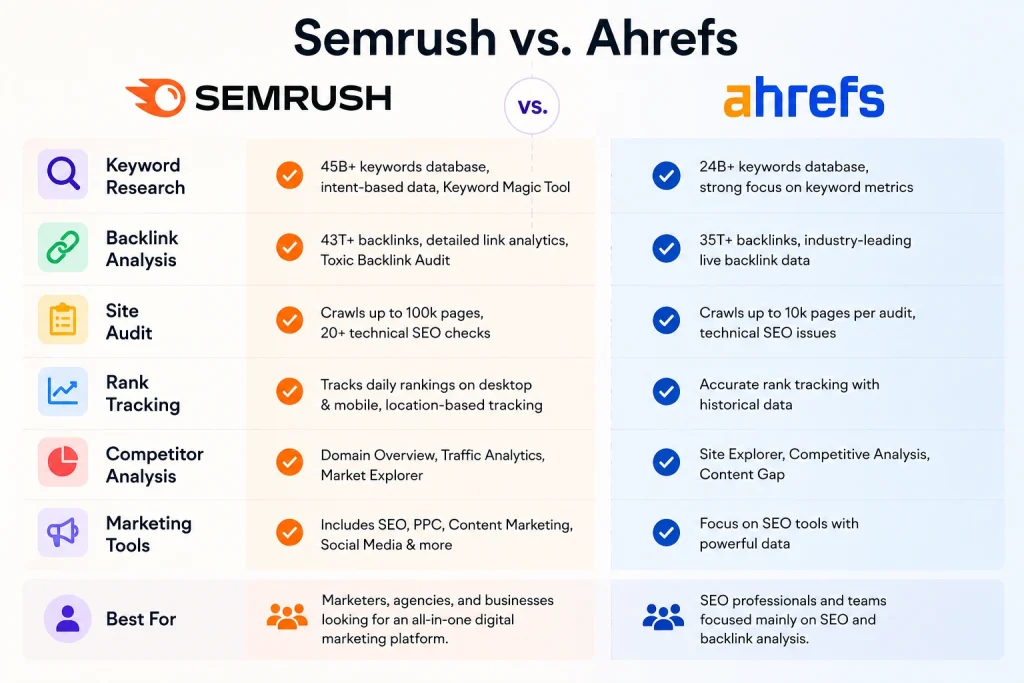
Feature comparisons do not capture what it actually feels like to use a tool daily. These three categories determine whether a platform improves your workflow or creates friction.
Learning Curve and Daily Usability
Semrush has a noticeably steeper learning curve than Ahrefs. Dozens of tools sit across multiple dashboard sections and submenus. New users typically need 2 to 4 weeks to navigate it confidently.
Ahrefs has a cleaner, more focused interface that is easier to learn. Navigation is faster for users primarily focused on SEO data. Without dedicated training or an experienced lead, Ahrefs is the more practical entry point.
Backlink Data Freshness vs. Total Index Size
Semrush holds 43+ trillion backlinks – the larger total index between the two tools. Ahrefs holds 35 trillion but updates its index every 15 to 30 minutes. Although Semrush now has the larger backlink index, most SEO professionals will care more about update frequency than raw size.
Knowing a competitor earned a major link today is actionable intelligence. Knowing the same thing four days later is far less valuable. This is the real, practical operational advantage that Ahrefs holds.
For historical research and broad index audits, Semrush’s larger database adds genuine value. For real-time link building and competitor monitoring, Ahrefs’ update frequency wins decisively.
Integrations and Marketing Stack Compatibility
Semrush integrates with Google Analytics 4, Google Search Console, and Looker Studio. It also connects with multiple CMS platforms and social media scheduling tools. For teams building a connected marketing stack, Semrush fits in more cleanly.
Ahrefs integrates with Google Search Console via Ahrefs Webmaster Tools primarily. Its integration ecosystem is narrower by intentional design. Teams using a connected marketing technology stack will find Semrush easier to integrate.
Customer Support and Response Quality
Semrush offers live chat support and a dedicated customer success team. The customer success team is available at Guru tier and above. Agency and enterprise accounts receive priority response times across all support channels.
Ahrefs provides support primarily through email and its online help center. Response times from Ahrefs support can vary significantly. For agencies needing fast resolution during live campaigns, Semrush’s support is more reliable.
Is Semrush the Right Fit for Your Team?
Semrush is the better fit for most teams doing more than organic SEO. It is particularly strong for workflows touching paid search, content production, or reporting.
If any of the following describe your situation, Semrush is likely the right call:
- You manage both SEO and PPC campaigns. Ahrefs has zero paid search features. You will need a second tool without Semrush.
- You need white-label reporting with automated PDF delivery and branded dashboards included in your plan.
- Your clients expect competitor analysis that covers display ads, content strategy, and keyword gaps – not just organic backlinks.
- You run a digital marketing agency where all-in-one reporting is a core part of the service you sell to clients.
- You need local SEO tools including map pack tracking, citation management, and Google Business Profile optimization.
- You build content at scale and need AI content tools, brief generators, and optimization workflows in one platform.
- You want to track AI search visibility across ChatGPT, Perplexity, and Google AI Overviews for your brand and clients.
Semrush consolidates paid search, content marketing, and local SEO toolkit management in one subscription. For agencies and multi-channel teams, that consolidation typically saves more than the price difference.
Is Ahrefs the Right Fit for You?
Ahrefs is the better fit for SEO specialists and link builders. They need the freshest backlink data available and a focused interface. It is also stronger for those who do not need multi-channel marketing tools.
If any of the following describe your situation, Ahrefs is likely the right call:
- You run active link-building campaigns and need backlink data updating every 15-30 minutes, not every few days.
- Domain Rating is your primary authority metric. You need the standard that your clients and outreach targets already recognize.
- You prefer a cleaner, faster interface without the cognitive overhead of a multi-channel marketing suite.
- Your work is focused entirely on organic search. PPC tools and social media monitoring are not part of your workflow.
- You use Content Explorer regularly for link prospecting, content ideation, and competitive content gap analysis across multiple niches.
- You want a lower monthly starting price without paying for tools you will not use in a pure organic SEO workflow.
Ahrefs wins for teams where backlink analysis and organic keyword research dominate daily work. Faster data, a cleaner interface, and a lower price are all major advantages. It remains the most practical specialist tool for pure organic SEO workflows.
Can You Run Both Semrush and Ahrefs at the Same Time?
The honest answer is yes – and many professional SEO teams do exactly this. Ahrefs handles deep backlink research and link-building campaigns. Semrush handles keyword strategy, PPC, content marketing, and client reporting.
The combined entry-tier cost is roughly $269 per month. That is $139.95 for Semrush Pro plus $129 for Ahrefs Lite. For agencies billing $2,000+ per month per client, this is a small fraction of revenue.
A practical dual-tool workflow looks like this. Use Ahrefs Site Explorer for competitor backlink analysis and referring domain research. Use the Semrush Keyword Magic Tool for content keyword strategy and PPC campaign planning.
Use Ahrefs Content Explorer for link prospecting and content gap opportunities. Use Semrush for rank tracking, client reporting, and local SEO management.
Running both tools generally becomes cost-effective once monthly SEO revenue reaches roughly $3,000–$5,000. Below that threshold, choose the one tool that covers your primary use case. Supplement with free tools from Google to fill any remaining gaps.
Which Plan Fits Your Team Size and Budget?
Choosing the right tier matters as much as choosing the right tool. An overprovisioned plan wastes budget every single month. An underprovisioned plan creates workflow bottlenecks that slow your entire team down.
TEAM SIZE TABLE
Team Size | Semrush Plan | Ahrefs Plan | Recommendation |
Solo Freelancer | Semrush Pro ($139.95/mo) | Ahrefs Lite ($129/mo) | Ahrefs wins on price |
Small Team (2-5) | Semrush Guru ($249.95/mo) | Ahrefs Standard ($249/mo) | Nearly identical cost |
Growing Agency | Semrush Guru + seats | Ahrefs Standard + seats | Semrush for PPC clients |
Large Agency | Semrush Business ($499.95/mo) | Ahrefs Advanced ($449/mo) | Semrush for reporting depth |
Enterprise | Semrush Enterprise (custom) | Ahrefs Enterprise (custom) | Discuss with the sales team |
Both platforms offer annual billing that saves 16 to 17% versus monthly rates. Annual billing is worth considering once you have validated that the tool fits your workflow.
One frequently missed detail: Ahrefs’ Lite plan uses a monthly credit system. Exceeding your credits locks out key features until the next billing cycle. Semrush Pro operates on daily request limits, which are more forgiving for variable usage.
Not Ready for a Paid Plan Yet? Free Alternatives That Actually Work
Paid tools are not a requirement to start building your SEO foundation. Several free options can cover the fundamentals while your business grows. Use them to build your SEO foundation before investing in a paid platform.
Start with Google Search Console and Google Analytics 4 – both are completely free. They connect to your actual search data, making them more accurate than any third-party tool. Google Search Console shows the keywords your site ranks for and the pages driving clicks.
Ahrefs Webmaster Tools is free for verifying and monitoring your own site. It provides backlink data, keyword positions, and site audit findings for your own domains. It does not cover competitor research or external keyword database lookups.
Semrush’s free tier allows 10 searches per day across its core tools. This is enough for initial keyword research and basic competitor checks. It also lets you get familiar with the platform before committing.
Google Keyword Planner is useful for paid search volume estimates at no cost. Screaming Frog’s free version handles basic technical audits for up to 500 URLs. Moz’s free Domain Authority checker works well for quick authority benchmarking.
Your 90-Day SEO Quick-Start Plan with Ahrefs and Semrush
Most teams underutilize their SEO tool for the first few months. The reason is almost always a lack of a structured launch plan. Here is a 90-day framework that gets results faster than trial and error.
Month 1: Build Your Foundation
Run a full technical SEO audit on your site using your chosen tool. Fix all critical errors first: broken internal links, missing canonical tags, and slow pages. Missing meta descriptions should also be addressed before moving to any other tasks.
Set up rank tracking for your 20 to 30 most important target keywords. Include your top competitors in the tracking view from day one. This creates the performance baseline you will measure all future progress against.
Connect Google Search Console to your SEO tool as a priority step. This unlocks actual search traffic data alongside the tool’s estimated data. It improves the accuracy of every recommendation you act on going forward.
Month 2: Keyword Strategy and Content Development
Run a content gap analysis against your top three competitors. Identify keywords they rank in the top 10 for that you do not yet target. Prioritize by keyword difficulty score and search volume data in your tool.
Build or optimize 4 to 6 pages around your highest-priority keyword clusters. Semrush users should use the SEO Writing Assistant for content optimization. Ahrefs users should use Content Explorer findings to guide their page structure.
Set up local SEO tracking if your business serves specific geographic markets. Semrush users have direct access to map pack rank tracking in-platform. Ahrefs users should supplement with a dedicated local SEO tool for this purpose.
Month 3: Link Building, Analysis, and Scale
Run a Backlink Gap Analysis to find high-authority sites linking to competitors. Build an outreach list of 30 to 50 qualified link targets from that data. These targets are pre-qualified because they already link to sites like yours.
Review your rank tracking data from Month 1 versus current keyword positions. Double down on pages showing upward movement in the rankings. Diagnose and fix pages that have stalled without meaningful position changes.
By Month 3, your technical foundation should be clean and fully addressed. Your content is aligned with target keywords, and your link building has direction. This is the point where compounding organic growth typically begins to show.
5 Mistakes That Lead to the Wrong SEO Platform Choice

Most teams that pick the wrong tool do so for one of five reasons. We have seen each of these patterns across many client consultations. Each one is avoidable with the right information before you commit.
Mistake 1: Comparing Raw Database Numbers Instead of What Matters
Most comparison articles report that Ahrefs has more backlinks than Semrush. This is factually incorrect in 2026.
Semrush holds 43+ trillion backlinks – the larger database by a clear margin. Ahrefs holds 35 trillion external backlinks but refreshes its index every 15 to 30 minutes. For active link building, freshness beats a larger but slower-updating database every time.
Mistake 2: Choosing Based on Sticker Price Alone
Ahrefs Lite at $129/month appears cheaper than Semrush Pro at $139.95/month. But if Semrush replaces your rank tracker and content optimizer, the total cost reverses. Calculate your full tool stack cost before comparing any single subscription in isolation.
Mistake 3: Underestimating the Semrush Learning Curve
Semrush is feature-dense and complex across dozens of interconnected tool categories. Without dedicated onboarding, teams often use only 20% of what the platform can do. That makes it expensive relative to the value your team actually extracts from it.
If your team is new to SEO tools, Ahrefs’ simpler interface gets you results faster. You can always migrate to Semrush once your workflow is fully established.
Mistake 4: Not Using the Semrush Free Trial
Semrush offers a 7-day free trial with full platform access included. Most teams skip this entirely – it is a major evaluation opportunity wasted. The trial lets you test your actual workflow inside the real platform before paying.
Ahrefs does not offer a free trial of any kind. You commit money first, then request a refund within 7 days if needed. The Semrush trial is a meaningful, underused advantage in the buying decision.
Mistake 5: Ignoring Team Workflow Integration
The best SEO tool is the one your team actually uses every day. A tool that sits underused because the interface overwhelms your team is wasted spend. A tool whose features do not match your daily workflow is equally wasteful.
Before committing, map your weekly SEO workflow in detail. Verify that the tool you choose covers each step natively. Confirm both platforms handle your two or three most-used features before deciding.
Semrush vs. Ahrefs 2026: The Final Verdict
For SEO specialists and link builders: Ahrefs wins. Its backlink data updates every 15 to 30 minutes – the industry’s fastest cycle. Its Domain Rating metric is the standard that clients and partners already use.
Its interface is cleaner, faster, and easier to navigate than Semrush. For teams focused entirely on organic SEO and link building, Ahrefs wins outright.
For agencies and multi-channel marketing teams: Semrush wins. It covers SEO, PPC, content, and local SEO in one subscription. White-label reporting and full competitor intelligence make it the top agency platform.
If you are still unsure, start with Ahrefs. The lower entry price and simpler interface give you a strong foundation fast. Upgrade to Semrush when your workflow expands to paid search or local SEO management.
Semrush vs. Ahrefs for AI Search Visibility: AI SEO Toolkit vs. Brand Radar
Semrush is better for businesses wanting AI visibility integrated with a complete SEO workflow. Its AI Visibility Toolkit tracks mentions, share of voice, competitors, sentiment, prompt performance, and AI readiness across Google AI, ChatGPT, Gemini, and Perplexity.
Ahrefs Brand Radar is stronger for broad competitive discovery. It analyzes hundreds of millions of search-backed prompts, supports instant research on almost any brand or domain, and identifies citations, mentioned pages, competitors, and AI share of voice.
Choose Semrush for guided optimization and reporting. Choose Ahrefs for large-scale market research, citation analysis, and discovering which brands or sources dominate AI-generated answers.
Unique Features You Can Only Get in Semrush or Ahrefs
Semrush’s main advantage is its connected marketing ecosystem. Users can move from AI visibility findings into keyword research, technical auditing, on-page recommendations, backlink analysis, PPC research, and content optimization.
Its AI-readiness Site Audit is especially useful because it detects blocked AI crawlers and technical barriers that may stop content from appearing in AI answers.
Ahrefs stands out through Brand Radar’s large search-backed prompt database and zero-setup analysis of any entity. It also extends visibility research beyond AI assistants into YouTube, Reddit, web visibility, and search demand.
On-Page SEO and Content Optimization: Which Tool Gives Better Recommendations?
Semrush gives better all-around on-page recommendations. Its On Page SEO Checker compares pages with current top-ranking competitors and provides strategy, semantic, backlink, user-experience, and technical ideas.
Semrush SEO Writing Assistant also evaluates readability, SEO, originality, tone, keywords, links, and images while content is being written.
Ahrefs is better for topical coverage. AI Content Helper grades content against leading pages, highlights weakly covered subtopics, and suggests improvements. Semrush wins for complete on-page execution, while Ahrefs is stronger for content-gap refinement.
Frequently Asked Questions About Semrush vs. Ahrefs
These are the most common questions we get when clients are choosing between Semrush and Ahrefs. Every answer below is based on direct campaign experience, not platform marketing pages.
Is Semrush better than Ahrefs overall?
Neither tool is universally better than the other. Semrush wins for agencies needing PPC, content tools, and local SEO together. Ahrefs wins for specialists who need fresh backlink data and a clean organic workflow.
Which has a bigger keyword database: Semrush or Ahrefs?
Ahrefs holds 28.7 billion keywords from 217 locations and 10 search engines. Semrush holds 27.9 billion keywords across 142 geographic databases.
Which tool has a larger backlink database?
Semrush holds the larger backlink database between the two at 43+ trillion backlinks. Ahrefs tracks 35 trillion external backlinks but updates its index every 15 to 30 minutes.
Does Ahrefs have a free trial?
No, Ahrefs does not offer a free trial of any kind. It offers Ahrefs Webmaster Tools for free, limited to your own verified domain only.
Which SEO tool is better for agencies?
Semrush is generally the better choice for digital marketing agencies. White-label reporting, daily rank tracking, PPC intelligence, and a local SEO toolkit are all included.
Which tool is better for beginners?
Ahrefs is easier for beginners due to its cleaner, more focused interface. Semrush has a steeper learning curve because of its much broader feature set.
Can I use Semrush and Ahrefs together?
Yes, and many professional SEO teams do exactly this. The most common split is Ahrefs for backlink analysis and Semrush for keyword research, PPC, and reporting.
What is the most important factor when choosing between them?
Your primary daily SEO workflow is the deciding factor above all others. If link building and organic research dominate your work, choose Ahrefs. If your team also manages paid search, content production, or multi-channel client reporting, choose Semrush.
The Right SEO Tool Changes Everything. The Wrong One Just Costs You Time.
Both Semrush and Ahrefs are genuinely excellent platforms at their best. Neither is a bad choice when matched to the right workflow. The question is which one fits how your specific team actually works.
If you manage multiple channels or need all-in-one client reporting, Semrush is stronger. If backlink data freshness and organic SEO depth are your priority, Ahrefs wins.
If you are still unsure, start with Ahrefs and test it for three months. Move to Semrush when your workflow demands broader marketing coverage.
Our team has run these tools across e-commerce brands, local businesses, and agency campaigns. If you want a second opinion on your SEO stack setup, we are ready to help.
