

Most Shopify stores don’t struggle because they lack traffic. The real issue shows up after the click, when visitors don’t increase their cart value. You can scale ads, optimize SEO, and improve funnels, but profit often depends on what happens at checkout.
In 2026, rising acquisition costs make average order value more important than ever. If each customer doesn’t spend more per visit, scaling becomes expensive. Finding ways to increase AOV on Shopify is a top priority for modern brands.
That’s where the best upsell app for Shopify comes in. They help stores increase revenue using smart Shopify product recommendations, bundles, cart add-ons, and post-purchase offers. Everything feels natural instead of forced.
At Brand’s Bro, we don’t judge apps based on feature lists. We ran A/A tests first to confirm tracking accuracy. After that, we moved into controlled A/B testing across real ecommerce stores. We measured the actual revenue impact.
The results showed a clear pattern. Stores using optimized upsell apps saw average order value increases ranging from 18% to 42% compared to control setups.
The strongest performance came from apps combining AI recommendations with well-timed cart and post-purchase offers. In contrast, some tools added friction and reduced conversion rates despite strong feature sets.
The takeaway is simple. Success depends less on how many features an app has and more on how well it fits timing, placement, and customer intent.
In this guide, we break down the best Shopify upsell apps based on our testing and performance data. We also took ease of use into account, so that you can choose the right setup for your store.
What a Shopify Upsell App Does, and Which Is Best
Before picking a winner, it helps to understand the basics. This category runs broader than most store owners expect. The best app is seldom the same for every store.
A Shopify upsell app lifts order value by showing customers relevant extra products at the right time. The goal is simple. The right offer in the right place encourages bigger carts. It works by deciding when to suggest complementary products and where to place them. These offers fall into three types:
- Upsell: A better or larger version of a product
- Cross-sell: A related add-on at checkout, like an accessory or warranty
- Bundle: Multiple products sold together at a discount
Each one grows cart value in its own way. That is the core of any good upsell-and-cross-sell strategy. Most apps show offers at key points in the shopping journey:
- Product page
- Cart page
- Checkout or post-purchase page
So which app is best? There is no single winner. It depends on where you want to grow revenue in your funnel.
Want an all-in-one solution? Selleasy is a strong choice. It supports product pages, cart, and post-purchase upsells in a single setup. That makes it simple to lift the average order value.
When maximizing post-purchase revenue is the focus, Aftersell and ReConvert stand out. Both let customers add products after checkout without re-entering payment. For bundles and quantity breaks, Fast Bundle and Kaching perform well. They lean on offers like BOGO deals and frequently bought together bundles before checkout.
In the end, the best app depends on your goals and where you want to optimize your funnel. Testing a few with real traffic is often the fastest way to find what works for your store.
How We Tested These 15 Shopify Upsell Apps

You deserve more than a reworded app-store blurb. Here is the bar each app had to clear.
We judged every tool against the same five tests, run on live stores, not demos. The goal was simple. Find apps that lift revenue without breaking the buying flow.
- AOV lift in real stores: We watched offer acceptance and revenue per order, not vanity installs.
- No-developer setup: A store owner should launch it alone, in under an hour.
- Pricing transparency: Costs must be clear before install, with no surprise usage fees.
- Review volume: Thousands of merchant reviews carry more weight than a handful.
- Theme and checkout compatibility: Each app had to hold its built-for-Shopify standard badge and play nice with the theme.
That filter cut a long list down to fifteen. Let’s meet them.
Best Shopify Upsell Apps Compared at a Glance
The table shows the market’s shape on one screen. Pricing shows the entry point, and ratings reflect public Shopify App Store scores at the time of writing.
App | Best For | Placement | Starting Price | Free Plan |
Post-purchase + checkout | Checkout, thank you | From $9.99/mo | Yes | |
Thank-you page funnels | Post-purchase | Free under 49 orders/mo | Yes | |
One-click funnels | Pre + post-purchase | Revenue-based, 30-day trial | Trial | |
Frequently bought together | Product, cart | Free under 100 orders/mo | Yes | |
Bundles + quantity breaks | Product, cart | Free + paid tiers | Yes | |
Quantity breaks | Product, cart | From $14.99/mo | Yes | |
A/B-tested offers | Pre + post-purchase | Free + paid tiers | Yes | |
In-cart upsells | Cart drawer | Free + paid tiers | Yes | |
Branded cart drawer | Cart drawer | From $29.99/mo | Dev only | |
One-tick upsells | Product, cart | From $39.99/mo | Yes | |
AI personalization | All pages | Order-based, free tier | Yes | |
Classic upsell engine | Product, cart | Free + paid tiers | Yes | |
Free shipping goals | Cart | Free + paid tiers | Yes | |
All-in-one + retention | Site-wide | Free tier + paid | Yes | |
COD + dropshipping | Form, post-purchase | Free to install | Yes |
Numbers tell you the lay of the land. But a table cannot explain what an upsell app really is. Let’s fix that next.
15 Best Upsell Apps for Shopify in-depth Review
Each review follows the same shape, so you can compare fast. You get the summary, the features, the price, the fit, and a one-line call. Read the whole list, or jump to the placement you care about.
1. Aftersell: Best for Post-Purchase and Checkout Upsells

Picture a supplements store that converts well but stalls at one tub per order. Traffic is solid, ad spend runs high, and yet the thank-you page sits idle. That page is prime real estate, and most stores waste it.
Aftersell changes that. It drops a one-click offer the moment payment clears, when the buyer feels most committed. A second tub, a bundle, or a matching add-on appears with a single tap. No re-checkout slows the buyer down, so friction stays near zero.
For Shopify Plus stores, native checkout blocks push offers even earlier, right inside checkout. The owner runs A/B tests to find what truly lifts revenue, not just clicks.
Each accepted offer adds margin with no fresh ad cost. That is why Aftersell tops this list for most stores.
Key Features
- One-click post purchase upsell Shopify offers on the thank-you page
- Native Shopify checkout upsell blocks for Shopify Plus
- A/B testing with revenue attribution per offer
- Audience rules by product, cart value, and source
Competitive Advantages
- Lifts AOV without extra ad spend
- Earns revenue at peak buyer intent
- Tests reveal which offers truly pay
- Adds margin with zero checkout friction
Drawbacks
- Pricing climbs with volume
2. ReConvert: Best for Thank-You Page Funnels

A new candle shop runs 40 orders a month and cannot spend on tools yet. Cash is tight, margins are thin, and every dollar counts. The thank-you page, meanwhile, sits empty after each sale.
ReConvert turns that dead space into a small funnel, free at this volume. Right after payment, the customer sees a matching offer built for one-click acceptance. A scented refill or a gift add-on slots in without a second checkout.
Countdown timers add gentle urgency, and birthday collectors feed future campaigns. The owner segments offers based on past order, so the pitch always fits. As the shop grows past the free tier, paid plans scale by order volume.
Few apps deliver post-purchase power this cheaply. For bootstrapped stores, ReConvert proves you can earn after the sale on almost no budget.
Key Features
- Drag-and-drop Shopify thank you page upsell editor with live preview
- One-click upsells that skip a second checkout
- Countdown timers and birthday collectors for urgency
- Segmented offers based on each past order
Competitive Advantages
- Generous free starter plan
- True one-click post-purchase
- Deep thank-you page editor
- Every offer feels relevant
Editor takes some learning
- Editor takes some learning
3. Zipify OneClickUpsell: Best for One-Click Sales Funnels

A skincare brand already clears $30,000 a month and wants to push harder. Small widgets feel too light for a store at this scale. Zipify OCU answers with full one-click funnels, before and after checkout.
Built by Ezra Firestone’s team, it has driven over a billion dollars in upsell revenue. Split testing and downsells come standard, so every funnel keeps improving. The Shop app integration opens an extra channel most rivals miss.
Pricing is revenue-based, which means you pay as the lift actually lands. A thirty-day free trial lets the brand prove the math first. Stores this size tend to see the strongest payback, often many times the app cost.
Setup runs deeper than a basic widget, so it rewards focus. For high-volume and Plus stores, OCU is the serious choice.
Key Features
- True one click upsell Shopify pre and post-purchase funnels
- Built-in A/B testing and downsells
- Shop app integration for extra reach
- Self-optimizing AI funnels
Competitive Advantages
- Billion-dollar proven track record
- Pay only on results
- Shop app channel access
- Testing keeps every funnel improving
Disadvantages
- Overkill for small stores
4. Selleasy: Best for Frequently Bought Together

Selleasy helps Shopify merchants add Amazon-style frequently bought together offers without a complicated setup. The app displays product recommendations on product pages, in the cart, and after purchase to encourage larger orders.
Merchants can choose automatic or manual product pairings, and the app supports multiple languages for international stores. Its free plan for stores with fewer than 100 orders per month also makes it accessible to smaller businesses.
For stores focused on simple product recommendations and cross-sells rather than on advanced funnel building, Selleasy offers a practical, easy-to-use solution.
Key Features
- Amazon-style Shopify frequently bought together widgets on product pages
- Pre-purchase and post-purchase placements across the journey
- Multi-language support for stores selling across borders
- Manual and automatic pairing for every product
Competitive Advantages
- Amazon-style familiar widgets
- Very beginner-friendly setup
- Free under 100 orders
- Shopping-focused layout
Disadvantages
- Limited advanced funnel features
- Basic design customization options
5. Bundler: Best Free Bundle and Quantity-Break App

Bundler is a popular choice for Shopify stores that want to increase order value without paying for an upsell app. Its free plan includes product bundles, quantity breaks, and volume discounts, making it a strong option for new or budget-Disadvantagescious stores.
The app lets merchants create fixed bundles or mix-and-match offers, giving shoppers more flexibility while encouraging larger purchases. It also works across top premium Shopify layouts and has a long track record backed by thousands of merchant reviews.
While Bundler focuses heavily on bundles and discounts, it doesn’t include post-purchase upsells or advanced funnel features.
Key Features
- Custom bundles with combined discounts
- Quantity breaks and volume deals
- Mix-and-match bundle builder
- Works across themes
Competitive Advantages
- Powerful, genuinely free plan
- Flexible mix-and-match bundles
- Thousands of merchant reviews
Disadvantages
- No post-purchase upsells
6. Kaching Bundles: Best for Quantity Breaks and Slow Inventory
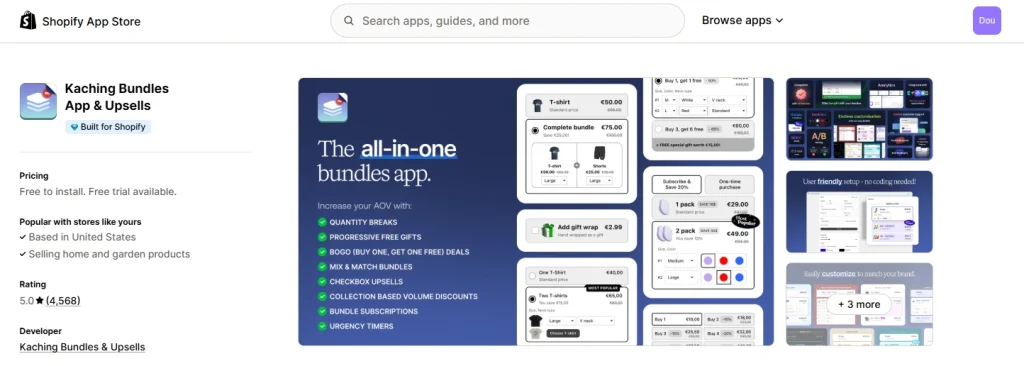
If you want to increase order value or move slow-selling inventory, Kaching Bundles is built for that job. The app uses quantity breaks, volume discounts, and product bundles to encourage customers to buy more in a single order.
It comes with a fast-loading widget that works with most Shopify themes, and merchants often praise its responsive live-chat support. There’s also a free plan available until the app generates $1,000 in sales.
Kaching works best for bundle and quantity-based offers, but it doesn’t offer the advanced funnel features or post-purchase upsells found in some other apps.
Key Features
- Volume discounts and tiered pricing
- Product bundles and upsells
- Clean, fast widget design
- Strong live-chat support
Competitive Advantages
- Clears slow stock into real cash
- Proven twenty-three per cent AOV lift
- Free until your first thousand dollars
- Faster load speed
Disadvantages
- Mainly bundles and quantities
- Free plan revenue-capped
7. Honeycomb Upsell: Best for A/B-Tested Offers

Guesswork kills profit. One offer works, while others quietly drain traffic. That’s where Honeycomb Upsell steps in.
It runs A/B tests on every offer, so two versions compete, and the stronger one wins real revenue. Both pre-purchase and post-purchase funnels support testing, keeping decisions grounded in data, not instinct.
Smart triggers adjust offers based on cart value and products. Upsells and downsells sit in one funnel, so the flow stays simple and focused.
Reports show clear revenue results. Winners are easy to spot, and weak offers get removed fast. A free plan lowers the risk to start, though setup takes more effort than plug-and-play tools. Design options stay minimal, with the focus locked on performance.
Key Features
- Built-in A/B testing on every single offer
- Shopify upsell funnel builder for upsells and downsell offers
- Smart triggers fire based on cart contents
- Detailed revenue reporting that proves real lift
Competitive Advantages
- Shows which offers drive revenue
- Free plan removes startup risk
- Scales only winning offers
- Clear reports make decisions easy
Disadvantages
- Fewer design templates offered
8. iCart Cart Drawer: Best for In-Cart Upsells

A lot of stores lose buyers right at the cart. It feels like a final step, but it is often where hesitation starts.
iCart Cart Drawer turns that moment into a selling point. The slide-out cart shows upsells right next to the items, so shoppers can add more without leaving the page. A free shipping bar also shows how close they are to unlocking a reward, which often nudges extra items into the cart.
Bundles, gifts, and progress-based offers all sit inside the drawer. Rule-based logic controls who sees each offer, based on cart behavior and product type. A free plan helps small stores start quickly, while paid tiers scale with order volume.
Setup can take time, especially with advanced rules. The focus stays on the cart, rather than full funnel upselling.
Key Features
- Slide cart with built-in upsells and offers
- Free shipping and gift bars inside the drawer
- Multi-step cart widgets that guide each shopper
- Rule-based logic decides who sees which offer
Competitive Advantages
- Shopify cart upsell becomes sales driver
- Order boost feature
- Engages buyers before checkout
- Target offers to shoppers
Disadvantages
- Cart-only placement focus
9. UpCart: Best for Branded Cart Drawer Upsells

UpCart is built for stores that treat the cart as part of the brand experience, not just a step before checkout.
The slide cart mirrors your store’s design, so colors, fonts, and layout feel consistent from product page to purchase. Inside the drawer, upsells, add-ons, and promo bars sit together in a clean, structured layout. A shopper can upgrade their order without leaving the cart, which keeps the buying flow smooth.
Sticky add-to-cart buttons and announcement bars help guide attention without clutter. Everything is managed inside one system, so the cart stays simple for shoppers but flexible for merchants.
UpCart focuses fully on the cart experience, rather than extending into checkout upsells. That keeps it sharp, but also more specialized.
Key Features
- Fully branded cart drawer matching your store
- Upsell and Shopify product add-ons modules inside the drawer
- Announcement and promo bars for timely messages
- Sticky add-to-cart that always stays in view
Competitive Advantages
- Native-feeling upsell experience
- On-brand cart experience
- All cart tools unified
- Polished premium-brand design
Disadvantages
- No free live plan
10. Candy Rack: Best for One-Tick Upsells and Cross-Sells
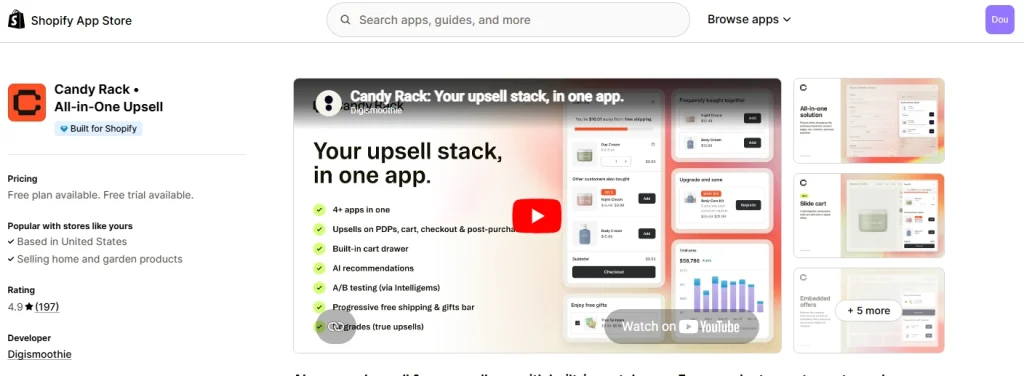
Mobile shopping moves fast, and a slow pop-up can cost a sale. Candy Rack keeps the process simple with one-tick upsell pop-ups that let shoppers accept offers instantly. No extra steps and no broken flow.
AI product recommendations suggest relevant add-ons, while merchants can still choose items manually. A customer might add a matching accessory with a single tap right after the main purchase. In-cart cross-sells add another chance to increase order value.
The design is clean and mobile-first, helping the experience stay smooth on smaller screens. Setup is easy. Used in moderation, it feels natural. Overused, it can become intrusive.
Key Features
- One-tick upsell popups designed for fast acceptance
- AI product recommendations with manual control on hand
- In-cart cross-sells that extend the offer further
- Mobile-first design that loads clean and fast
Competitive Advantages
- Mobile offers preserve flow
- One-tick acceptance reduces friction
- Native-feeling page design
- AI finds ideal matches
Disadvantages
- Popups can feel intrusive
11. LimeSpot Personalizer: Best for AI Personalization

Let’s say a store has thousands of products, but most shoppers never see the right ones. Generic recommendations miss the mark, and sales stay flat.
LimeSpot fixes this with an AI personalization engine. It tracks browsing and purchase behavior to show each shopper relevant products in real time. Recommendations update as users move through the store, keeping offers fresh and personal.
AI product recommendations also carry into email and SMS, so the experience stays consistent across channels. Dynamic bundles adjust based on behavior and live inventory, while merchandising tools let teams guide how products appear.
A free tier is available, with pricing that scales by order volume. It works best for large catalogs where relevance drives revenue.
Key Features
- Machine-learning recommendations tuned to each individual visitor
- AI product recommendations that adapt in real time
- Dynamic bundles that shift with browsing behavior
- Multi-channel personalization across web, email, and SMS
Competitive Advantages
- Relevance increases basket size
- Personalizes email and SMS
- Surfaces hidden products
- Adapts in real time
Disadvantages
- Overkill for small catalogs
12. Bold Upsell: Best Classic Upsell Engine

A store owner wants something proven, not the newest shiny object. Stability matters far more than hype in this decision. Bold Upsell has run on Shopify for years and rarely breaks.
It offers true upsells and downsells across the product page and cart. An owner sets up clean offer paths in a familiar layout. Funnel-style logic chains one offer to the next with ease. The engine is mature, so support and docs run deep.
New sellers find the core simple to grasp on day one. A free plan lets stores start before paying anything. The interface looks somewhat dated next to newer rivals.
Post-purchase options stay limited compared with specialist tools. For owners who value a dependable, no-drama upsell engine, Bold is the steady pick on this list.
Key Features
- True upsell and downsell offers across pages
- Pre-purchase and in-cart placements for every product
- Funnel-style logic chains one offer to the next
- Reliable, long-tested core with deep support docs
Competitive Advantages
- Reliable proven stability
- Easy day-one setup
- Strong support and docs
- Free plan available
Disadvantages
- Interface feels somewhat dated
13. Essential Upsell: Best for Free-Shipping Goal Upsells

Essential Upsell uses a free-shipping goal bar to make that gap clear. It updates in real time as customers add items, showing exactly how close they are to the threshold.
In-cart upsells and reward prompts help encourage small add-ons that increase order value. A sticky add-to-cart button keeps the buying option visible. This helps reduce drop-offs during browsing.
Setup is simple and quick, with a strong user rating reflecting consistent performance. A free plan covers core features, with additional options available for growing stores.
The app focuses mainly on driving higher cart value through shipping thresholds, rather than offering a full suite of funnel or post-purchase tools. Acting as a dedicated Shopify conversion optimization app, it efficiently targets key cart metrics.
Key Features
- Free shipping goal bar tracking the cart live
- In-cart upsells and reward prompts that convert
- Sticky add-to-cart keeps the next step visible
- Quick, clean setup with a strong rating
Competitive Advantages
- Shipping goal boosts cart size
- Fast setup, quick results
- Strong ratings signal reliability
- Rewards increase order size
Disadvantages
- Fewer post-purchase offer options
14. AiTrillion: Best All-in-One Upsell and Retention

Many stores end up using multiple apps for upsells, email, loyalty, and reviews. Costs rise, and data gets scattered across tools.
AiTrillion combines everything into one platform. It includes upsells, cross-sells, email, SMS, loyalty rewards, reviews, and memberships in a single system. This helps connect customer behavior across the full journey, from first purchase to repeat orders. Building trust through top-rated Shopify review apps becomes seamless when paired with its built-in loyalty features.
Automated workflows help bring customers back and increase lifetime value. Loyalty programs and memberships support retention, while upsell tools lift order value at key points.
Setup can feel complex due to its range of features, but it reduces the need for multiple separate apps and centralizes store growth in one place.
Key Features
- Upsell and cross-sell engine for the storefront
- Loyalty and rewards that deepen customer bonds
- Email and SMS automation for repeat buyers
- Reviews and memberships built into one platform
Competitive Advantages
- One platform replaces multiple apps
- Reduces costs and tool sprawl
- Unified upsell and retention system
- Automation grows repeat revenue
Disadvantages
- Upsell is one feature
15. Releasit COD Form and Upsells: Best for COD and Dropshipping

If a store runs on cash on delivery, every fake order hurts. Standard checkout often does not fit this model well.
Releasit COD Form and Upsells replaces the default checkout with a custom COD order form built for dropshipping. Upsells and quantity offers sit directly inside the form, so customers can add more before placing the order.
OTP and SMS verification help reduce fake orders at the source. Abandoned order recovery also helps bring back customers who leave mid-process.
The app is free to install, with paid plans for advanced features. It is widely used by dropshipping stores that rely on COD workflows.
Its strength is also its limit. It is designed mainly for COD setups, so traditional checkout stores may not need it.
Key Features
- Custom COD order form built for dropshipping
- Upsells and quantity offers inside the form
- OTP and SMS verification to cut fakes
- Abandoned-order recovery that wins back lost buyers
Competitive Advantages
- Purpose-built for COD
- OTP cuts fake orders
- Trusted by dropshippers widely
Disadvantages
- Built mainly for COD
How to Choose the Best Upsell App for Your Store
Fifteen options can freeze you. This section unfreezes the decision. Follow the flow, then check the match list. The trick is to match the tool to the problem, not chase the longest feature list.
The 5-Question Decision Framework
Before committing to any installation, conduct a brief audit of your store’s ecosystem using these five key criteria. By answering these questions first, you prevent “feature bloat” and ensure you select a solution that serves as a natural, profitable extension of your brand’s existing customer journey.
- Budget over AOV: If your order values are low, prioritise apps with free or low-entry tiers to protect your margins.
- Niche Constraints: Your product category dictates your strategy. Fashion stores thrive on bundles, while electronics brands excel with add-on accessories.
- Placement: Do you need cart-drawer nudges or post-purchase checkout offers? Choose based on where your customer friction actually exists.
- Pricing Model: Does a flat monthly fee or a revenue-sharing model make more sense for your current sales volume?
- Social Proof: Prioritise apps with thousands of verified merchant reviews over sleek, marketing-heavy landing pages.
Quick-Match Recommendations by Store Profile
These strategic pairings bypass the overwhelming app store directory by matching your operational stage with proven tools. What works for a scaling enterprise is often overkill for a lean startup. Use this list as a roadmap to find your ideal solution as your business grows.
Store Type | Recommended Apps |
New Store | Bundler, ReConvert |
Mid-Volume | Aftersell, Selleasy |
Shopify Plus | Aftersell, Zipify OCU |
Dropshipping | Releasit |
High-AOV Niche | LimeSpot |
Pro-Tip: Choosing an app is just step one; test AOV impact, then switch if ROI is unclear.
How to Set Up an Upsell App on Shopify

You do not need a developer for this. Most apps on this list go live in under an hour, with no code at all. The whole flow runs through plug-and-play Shopify integrations, in five simple steps:
- Install the app: Find your pick and install from the app store. One click adds it straight to your store.
- Grant theme access: Approve the prompt so the app can enable the widget. Most tools use a theme app embed, so nothing touches your code.
- Build your first offer: Choose a trigger product, then pair it with a matching upsell or bundle.
- Set targeting rules: Decide who sees the offer, by cart value, product, or customer type. Sharp rules keep it relevant.
- Preview and publish: Check the live preview on desktop and mobile, then switch it on.
That is the build done. But one thing still decides the result. Speed. A slow offer kills the sale, so pick apps that load in under a second on mobile. Test the full flow on your own phone first, since most buyers shop there.
Frequently Asked Questions (FAQs)
Still weighing your options? These quick answers cover what Shopify owners ask most about upsell apps, from free plans to post-purchase setup, so you can decide with confidence.
What is the best free upsell app for Shopify?
Bundler leads the free pack for most new stores. As a leading Shopify bundle app, it builds real bundles and quantity breaks with no monthly cost. Selleasy and ReConvert also offer strong free tiers, capped by order volume. Start free, prove the lift, then upgrade once the revenue justifies it.
Which app is best for post-purchase upsells?
Aftersell and ReConvert lead here. Both run true one-click offers on the thank-you page, so buyers add items without a second checkout. Aftersell suits Shopify Plus and larger stores, while ReConvert fits smaller shops on a tighter budget. Each lifts order value safely after payment clears.
Do upsell apps slow down a Shopify store?
A good one will not. Apps carrying the Built for Shopify badge meet strict speed and performance rules, so they load fast. Trouble comes from stacking too many widgets or picking a poorly coded app. Choose one tested tool, and your store stays quick.
How much can upsells increase AOV?
Most stores see a 10% to 30% lift in average order value. The exact gain depends on your offers, niche, and placement. Even a modest bump compounds across thousands of orders, adding real profit with no extra ad spend. Test offers to find your true number.
What is the best upsell app for beginners?
Selleasy and Bundler are the easiest to start. Both are affordable, simple, and need no developer or code. Selleasy brings the Amazon-style frequently bought together cue, while Bundler handles bundles and quantity breaks. Either one launches in minutes, so new owners see results fast.
Which upsell app works with Shopify Plus checkout?
Aftersell and Zipify OneClickUpsell both support native Shopify Plus checkout. They insert one-click offers right inside the checkout flow, where buyer intent peaks. That means higher order value with no friction and no re-entered payment. For Plus stores chasing checkout upsells, these two lead the field.
One App Away From Higher AOV
Most stores focus on getting more traffic, but real growth often comes from increasing value per order. Small improvements after checkout can raise revenue without extra ad spend.
Choosing the best upsell app for Shopify depends on where your store loses customers the most. Some tools optimize cart offers; others focus on post-purchase or recommendations.
The right choice is not about features but about fixing the biggest leak in your funnel. Start with one offer, test the results, and scale only what consistently improves AOV.
Your existing traffic is already paid for, so focus on conversion this week.
