

Data-driven marketing means using real data to make better marketing choices. It helps brands stop guessing and start using facts from ads, websites, sales, email, and customer behavior.
This matters because marketing is full of moving parts now. People find brands through Google, social media, product pages, emails, marketplaces, and paid ads.
So, if a business wants better results, it needs clear data. That data can show what works, what fails, and what needs to change.
What Is Data-Driven Marketing?
Data-driven marketing is a way to plan, run, measure, and improve marketing with real numbers. It uses customer data, campaign data, website analytics, and sales results to guide each step.
In simple words, it helps answer key questions. Who is the right customer? Which channel brings sales? What message gets clicks? Which campaign deserves more budget?
That is the heart of data-driven marketing. It turns facts into better decisions.
A brand can collect data from many places. This may include Google Analytics 4, Google Search Console, Shopify analytics, CRM tools, Meta Ads, Google Ads, Amazon Ads, email tools, and sales reports.
Then, the team can use that data to make smart changes. It can cut weak campaigns, improve strong pages, and scale what brings results.
Why Data-Driven Marketing Matters Today

Marketing is harder than it was before. Customers move across many channels before they buy. They may first find a brand on Google. Then they may check social media, read reviews, open an email, visit the site again, and buy later.
Because of that, brands need to understand the full customer journey. They need to know where people come from, what builds trust, and what leads to a sale. This is why data matters so much today. It helps teams fix real problems instead of making random guesses.
For example, a store may get lots of traffic from PPC. But if the conversion rate is low, the problem may be the landing page, the offer, the product image, the copy, or the checkout. Data helps the team find the weak spot. Then it can take action faster.
Data-Driven Marketing vs Traditional Marketing
Traditional marketing and data-driven marketing both help brands reach people. The main difference is how each one makes choices.
Traditional marketing often starts with ideas and past experience. Data-driven marketing starts with customer data, campaign data, and clear proof.
Traditional Marketing | Data-Driven Marketing |
Uses broad ideas and past experience | Uses real-time marketing data and customer insights |
Picks messages that sound strong | Picks messages based on campaign measurement |
Targets large audience groups | Targets clear customer segments |
Asks, “What do we think people want?” | Asks, “What does the data show people want?” |
Tracks results after the campaign ends | Tracks results during and after the campaign |
Can waste more budget | Helps reduce wasted ad spend |
Depends more on guesswork | Uses evidence-based marketing |
Measures success in a broad way | Measures success with clear KPIs |
This does not mean human ideas do not matter. They still matter a lot.
Data helps a team test those ideas. It shows which ideas deserve more time, money, and effort.
That is the link between creativity and growth. Great marketing uses smart ideas and clear proof.
How Does Data-Driven Marketing Work?

Data-driven marketing follows a simple flow. First, a brand collects data. Then it studies the data, finds patterns, builds campaigns, and checks results.
The process starts with data collection. This can include page views, clicks, sales, product views, email clicks, ad spend, search terms, and repeat purchases.
Next comes data quality. Bad data can lead to bad choices. So, tracking must be clean, clear, and linked to real business goals.
After that, the team looks for customer insights. They may find that one product sells best from Google Ads, while another product gets better results from SEO.
Then the team builds better campaigns. Finally, they measure ROI, ROAS, CAC, CLV, AOV, CTR, CPC, CPA, retention rate, and conversion rate. This cycle keeps going. Each round gives the brand better data and better results.
What Types of Data Are Used in Data-Driven Marketing?

A strong strategy does not rely on one kind of data. It uses different data types to show the full picture. Each type tells part of the story. Together, they help explain who the customer is, what the customer does, and what leads to revenue.
First-Party Data
First-party data comes from the brand’s own channels. This includes website visits, form fills, email signups, orders, reviews, and CRM records.
This is one of the most useful data types. It is based on real customer behavior and real contact with the brand. It also supports data privacy better than broad third-party data. That is important for trust.
Behavioral Data
Behavioral data shows what people do. It includes clicks, product views, add-to-cart actions, site search, bounce points, and checkout steps. This helps brands find friction. For example, it can show where users leave before they buy.
Transactional Data
Transactional data shows what people buy. It includes orders, refunds, repeat sales, average order value, and product revenue. This data connects marketing to real business results. It helps teams see what drives sales, not just traffic.
Demographic Data
Demographic data shows who the customer is. It can include location, device, language, age group, and customer type. This helps with audience segmentation. Still, it works best when paired with behavior and sales data.
Campaign Data
Campaign data shows how ads and content perform. It includes CTR, CPC, CPA, impressions, conversions, and return on ad spend. This helps with budget choices. It shows where to spend more and where to cut back.
Customer Insight Data
Customer insight data explains why people act a certain way. It can come from reviews, surveys, support chats, and customer feedback. This adds context to the numbers. It helps improve copy, offers, product pages, and customer experience.
Search Data
Search data shows what people want to find. It includes keywords, search intent, impressions, rankings, clicks, and content gaps. This is very useful for SEO and content strategy. It helps brands answer real questions from real users.
CRM Data
CRM data includes customer emails, order history, lead status, support history, and customer value. This helps with follow-up, personalization, retention, and lifecycle marketing.
Product Data
Product data shows how each product performs. It includes product views, add-to-cart rate, sales, returns, reviews, and stock status. This helps teams improve weak products and push strong ones.
So, when these data types work together, the brand gets a much clearer view. That makes every marketing choice smarter.
How to Build a Data-Driven Marketing Strategy
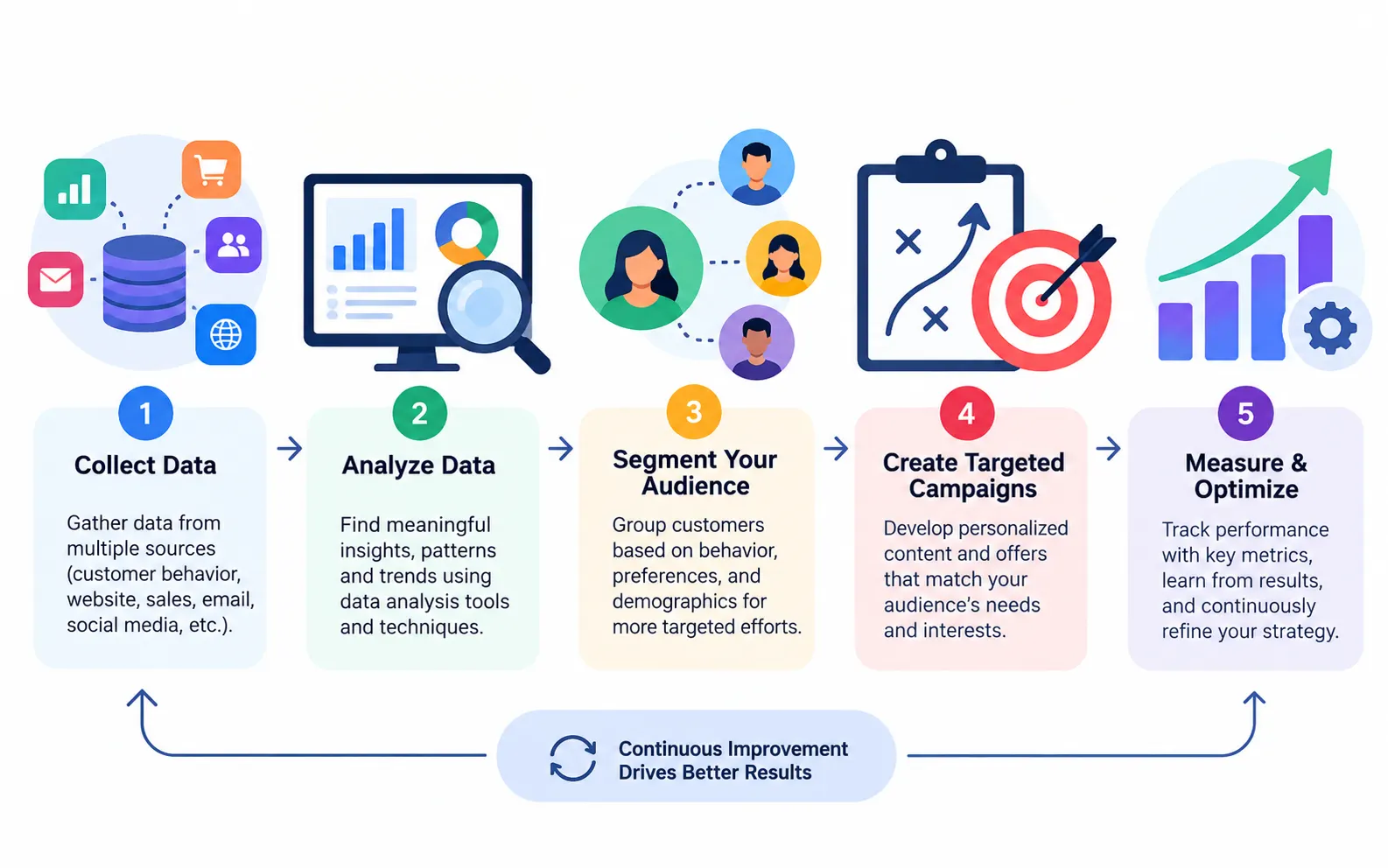
Building a data-driven marketing strategy gets easier when you break it into clear steps. The goal is to use real customer data, marketing analytics, and campaign data to make better decisions.
This helps a business stop wasting time on guesswork. It also helps the team focus on what drives traffic, leads, sales, and long-term growth.
Start with one clear goal
First, decide what you want to improve. Your goal could be more sales, lower customer acquisition cost, better retention, higher customer lifetime value, or more organic traffic. A clear goal keeps the strategy focused. It also makes it easier to choose the right data, the right KPIs, and the right marketing channels.
Choose the right KPIs
Next, pick a small group of KPIs that match the goal. These numbers help you measure progress in a simple way. For paid ads, ROAS, CPA, CAC, CTR, and conversion rate may matter most. For SEO, you may focus on rankings, clicks, impressions, organic traffic, and conversions.
The key is to track what leads to action. Vanity metrics may look nice, but they do not always show real business results.
Map the customer journey
After that, study the customer journey. Look at how people move from the first touchpoint to the final sale. A customer may first find your brand through Google search, a paid ad, social media, or email. Then they may visit a landing page, view a product, leave the site, come back later, and finally convert.
This step helps you find weak spots. It shows where people lose interest, where trust drops, and where you need a better offer or a better page.
Review your channel data
Now look at your channel data. This shows which channels bring traffic, leads, and revenue. You may review data from SEO, PPC, email marketing, social media, referral traffic, or marketplaces like Amazon. Some channels may bring lots of visitors, while others may bring fewer visitors but more conversions.
This helps you put more effort into the channels that create value. It also helps you cut back on channels that spend money without clear results.
Study your content and page performance
Then, review your content data. Look at which blog posts, category pages, product pages, landing pages, and email campaigns lead to action. This can help you spot pages that get traffic but do not convert. It can also show which pages answer user intent well and which ones need better copy, stronger structure, or clearer calls to action.
Content data is very useful because it connects search intent with customer behavior. It helps you build pages that are useful, clear, and more likely to drive results.
Use testing data to improve performance
A strong strategy should always include testing. This helps you learn what works instead of making random changes. You can test headlines, ad copy, product images, page layouts, CTA buttons, offers, subject lines, and audience segments. Even a small test can reveal useful customer insights.
Over time, these tests help improve conversion rate, reduce wasted ad spend, and build a stronger customer experience.
Make sure your tracking is clean
Good strategy depends on good data. If the tracking is wrong, your team may make bad decisions. So, make sure your website analytics, ad platforms, CRM data, email tools, and store data all track the right actions. These actions may include clicks, add-to-cart events, form fills, purchases, and repeat orders.
Clean data improves reporting. It also helps your team trust the numbers before making a change.
Turn insights into a clear action plan
The last step is to turn all those insights into action. This is where the strategy becomes useful. If data shows that one channel has a high conversion rate, you may give it more budget. If a landing page gets traffic but few sales, you may improve the copy, design, trust signs, or offer.
This is what makes a data-driven marketing strategy work. It is not just about reports. It is about using customer insights, campaign measurement, and performance data to make smarter moves over time. So, the best strategy is not the one with the most data. It is the one that uses the right data to improve the next decision.
How Data-Driven Marketing Works Across Digital Channels

A good strategy should not stay in one place. It should help every digital channel do its job better. That includes SEO, PPC, email marketing, social media, CRO, and marketplace ads.
SEO (Search Engine Optimization)
In SEO, data helps brands find keyword gaps, search intent, low-click pages, thin content, and internal link gaps.
Google Search Console can show what queries bring impressions and clicks. Google Analytics 4 can show which pages lead to conversions. This helps teams improve category pages, product pages, blog posts, and site structure.
PPC (Pay Per Click)
In PPC, data helps brands improve targeting, bids, audiences, and ad copy. Google Ads, Meta Ads, and Amazon Ads all produce useful campaign data. Teams can review CTR, CPC, CPA, ROAS, and conversion rate to see what is worth scaling. This helps reduce wasted ad spend. It also helps improve profit, not just traffic.
Content Marketing
In content marketing, data helps teams choose the right topics. It can show what people search for, what questions they ask, and which pages build trust. That makes it easier to create useful blog posts, buying guides, comparison pages, and FAQs.
Content should not just repeat keywords. It should answer the topic fully and cover related entities, attributes, and user questions.
CRO (Conversation Rate Optimization)
In conversion rate optimization, data helps teams find what blocks a sale. Heatmaps, session recordings, checkout data, and form data can show where people get stuck. Then the team can test better layouts, trust signals, images, copy, and calls to action. So, data gives each channel a clear job. It also helps each channel support the others.
What Is a Data-Driven Marketing Campaign?
After strategy comes execution. A data-driven marketing campaign is built with real audience and performance data. It does not start with a random message. It starts with a clear audience and a clear goal.
For example, a team may target cart abandoners, past buyers, high-value customers, or users who viewed a product but did not buy. Then the team builds a message that fits that group. They may test ad copy, images, landing pages, offers, and calls to action.
For Amazon brands, this can include search term reports, keyword bids, ACoS, product-level sales, and conversion tracking. A PPC management agency can help improve ad performance, reduce wasted spend, and scale the search terms that bring better results.
After the campaign runs, the team studies the result. Then it shifts budget to what works best. That is the main value of campaign optimization. It helps money move toward stronger results.
Predictive Analytics and Customer Insight in Data-Driven Marketing
At this point, it helps to move from past data to future action. That is where predictive analytics comes in. Predictive analytics uses past behavior to estimate what may happen next. It can help forecast repeat purchases, churn risk, customer lifetime value, and product demand.
For example, if many customers reorder every 30 days, a brand can send an email before that point. If two items are often bought together, the brand can create a product bundle. Customer insight is the human side of the data. It explains why people act the way they do.
For example, survey data may show that buyers trust a product more when they see reviews, shipping details, and clear return terms. That insight can improve both ads and product pages. So, predictive analytics helps with timing. Customer insight helps with meaning.
Benefits of Data-Driven Marketing
The biggest benefit of data-driven marketing is simple. It helps brands make smarter decisions with real numbers, not guesswork.
When a team understands what users do, what channels work, and what pages lead to sales, it can make better choices faster. That often leads to better efficiency, better customer experience, and stronger growth. Here are some of the main benefits.
Better decisions
Data shows what is working and what is not. This helps teams stop wasting time on ideas that do not lead to results.
Instead of relying on opinions alone, they can use customer behavior, website analytics, sales data, and campaign performance to guide the next move. That makes each decision more clear and more confident.
Clear audience segments
Not every customer is the same. Some people are new visitors, while others are repeat buyers or high-value customers.
Data helps brands group users by action, value, interest, location, device, or buyer stage. This makes it easier to send the right message to the right audience at the right time.
Better personalization
Personalization gets stronger when it is based on real customer data. A new visitor may need trust content, simple product details, or social proof.
A repeat buyer may respond better to a reorder reminder, a bundle offer, or a loyalty message. This makes the experience feel more useful and more relevant.
Higher conversion rates
Data can show where users leave before they buy. It may reveal weak product pages, slow page speed, unclear offers, poor images, or friction in the checkout process.
Once the team sees the problem, it can fix it. That often leads to better conversion rates and a smoother customer journey.
Less wasted ad spend
Weak campaigns can drain budget fast. Data helps teams find ads, audiences, and keywords that spend money without bringing enough value.
Then they can pause low-performing campaigns and move budget to what works better. This is one reason many brands work with a Facebook Ads agency when they want stronger paid social results backed by audience data, conversion tracking, and clear campaign insights.
Better ROAS
Return on ad spend improves when teams track ad cost, clicks, conversions, and revenue with care. This gives a clearer view of which campaigns bring profit, not just traffic.
It also helps brands scale the right campaigns with less risk. That is very important in eCommerce, where margins, product demand, and customer intent can change fast.
Stronger retention
Data-driven marketing is not only about getting new customers. It also helps brands keep the customers they already have.
Customer data can help teams send follow-up emails, reorder reminders, upsell offers, and win-back campaigns. This can improve retention rate, repeat purchase rate, and customer lifetime value over time.
Better full-funnel performance
The value of data-driven marketing goes beyond one channel or one campaign. It helps brands improve the full funnel, from first click to final sale and even post-purchase follow-up.
So, the real benefit is not just more traffic. It is better performance across SEO, PPC, email, social media, product pages, landing pages, and customer retention.
Real Results From a Data-Driven Approach
One eCommerce brand in a competitive retail niche came to us after spending on ads and content without clear growth. Traffic was coming in, but sales were still lower than expected.
We reviewed ad spend, landing page behavior, search intent, product page signals, and conversion data. The data showed wasted budget, weak page alignment, and missing trust signals that were hurting sales.
After the fixes, the brand had a clearer path to growth. Traffic quality improved, the user journey became smoother, and the site was better set up to turn visits into sales.
Results included:
- 22% higher conversion rate
- 18% lower cost per acquisition
- 31% more qualified traffic
- 14% higher add-to-cart rate
That is what data-driven marketing should do. It should help brands find the real problem, fix it with confidence, and improve performance with clear numbers.
Important Metrics in Data-Driven Marketing
Metrics show if a plan works. They also show what wastes money. The best metrics link traffic, cost, sales, and profit. That makes reports easier to act on.
Key metrics include:
- ROAS: Shows ad revenue.
- CPC: Shows cost per click.
- CPA: Shows cost per sale or lead.
- CTR: Shows click rate.
- Conversion rate: Shows how many users act.
- CAC: Shows cost per new customer.
- Customer lifetime value: Shows long-term customer value.
- Average order value: Shows average spend per order.
- Add-to-cart rate:Shows cart interest.
- Checkout rate: Shows checkout success.
- Repeat purchase rate: Shows repeat sales.
- Retention rate: Shows customer loyalty.
- SEO growth: Shows search progress.
A brand should avoid vanity metrics. Clicks and views do not help if they bring no sales. The best reports show what to fix next. That makes the data useful.
Tools Used in Data-Driven Marketing
Many tools can help with data-driven marketing. The best tool depends on the business goal.
- Google Analytics 4 helps track website analytics, user actions, traffic, and events.
- Google Search Console helps track search data, impressions, clicks, and SEO performance.
- Google Ads, Meta Ads Manager, and Amazon Ads Console show ad performance data like clicks, conversions, and spend.
- Shopify analytics helps track product sales, store behavior, and customer activity.
- CRM platforms help store customer records, order history, and sales data.
- CDP marketing software can connect data from many sources into one system.
- Email tools show open rates, click rates, flows, and customer segments.
- Heatmap tools show how users behave on a page and where they drop off.
- Marketing dashboards bring key numbers into one place, so teams can spot trends and act faster.
Still, tools alone do not solve problems. A good team must ask the right questions and know what to do with the data.
Common Challenges in Data-Driven Marketing

Data-driven marketing has many benefits. But it also has real challenges. Most problems come from poor tracking, weak goals, or messy reports. When the data is not clear, the team may make choices that hurt growth. Most issues can be fixed with clean data and better focus.
Common challenges include:
- Poor data quality: Wrong tracking can lead to wrong reports.
- Bad decisions from bad data: A team may make the wrong move if the data is not clean.
- Disconnected tools: A brand may have data in ads, email, CRM, Shopify, and reports. These tools may not link well.
- Unclear attribution: It can be hard to know which channel deserves credit for a sale.
- Small data samples: One test may look strong, but the result may not have enough proof.
- Privacy rules: Brands must respect data privacy, consent, and customer trust.
- Too many metrics: A team can lose focus when it tracks too many numbers at once.
- Reports with no action: Data has little value if the team does not act on it.
The best solution is simple. Clean data, clear goals, and honest reports help a team grow.
Data Privacy, First-Party Data, and Trust
Good marketing should help people, not confuse them. That is why data privacy matters so much.
Customers want better offers and better content. But they also want respect, control, and trust.
This is why first-party data is so valuable. It comes from direct brand contact, like visits, purchases, forms, account activity, and email signups.
That makes it more useful and more reliable. It also makes it easier to build trust when brands are clear about consent and data use.
Trust also supports E-E-A-T. Clear policies, honest tracking, expert content, and useful recommendations all help show credibility.
So, data-driven marketing should improve the customer experience. It should never feel pushy or shady.
What Does a Good Data-Driven Marketing Team Do?
Now that the system is clear, it helps to look at the people behind it. A good data-driven marketing team does more than collect reports. It uses data to make clear choices.
That team usually connects marketing analytics with business goals. It reviews traffic, channel performance, sales data, and customer behavior to find the next best move. For eCommerce brands, that may include SEO, PPC, Amazon ads, CRO, email marketing, content strategy, and retention work.
But the real value is not in the dashboard alone. The value comes from turning insight into action. That is what separates useful data from noise.
How e-Commerce Brands Can Start With Data-Driven Marketing
Getting started with data-driven marketing does not have to be hard. An eCommerce brand does not need a big team, a huge budget, or a complex setup on day one.
In fact, a small and simple plan is often the best place to start. Once the basics are in place, the team can learn from the data and improve step by step.
Pick one main goal
First, choose one clear goal. This gives the team direction and makes the data easier to understand.
That goal could be more sales, higher ROAS, lower customer acquisition cost, better retention, or more organic traffic. When the goal is clear, it becomes easier to decide what to track and what to improve.
Set up tracking
Next, make sure tracking is in place. This is one of the most important first steps because weak tracking leads to weak decisions.
The website, ad platforms, email tools, CRM, and store platform should all show the right numbers. That may include traffic, clicks, add-to-cart actions, purchases, repeat orders, and conversion rate.
Choose key KPIs
After that, focus on a small group of KPIs. This keeps the team from getting lost in too many reports.
The best KPIs are the ones that match the main goal. For example, if the goal is stronger paid ads, the team may track ROAS, CPA, CAC, and conversion rate. If the goal is SEO growth, then clicks, rankings, organic traffic, and organic conversions may matter more.
Study the customer journey
Then, look at the customer journey. This helps the team understand how people move from first visit to final sale.
A customer may find the brand through Google search, a social ad, an email, or a product page. Then they may browse, compare, leave, come back later, and finally buy.
This step is useful because it shows where people drop off. It also shows what helps build trust and what pushes people to take action.
Start with one test
Once the data is clear, start with one simple test. There is no need to change everything at once.
The team may test a new ad, a better email flow, a stronger product page, a cleaner landing page, or a new blog post. One focused test is easier to measure and easier to learn from.
Read the result
After the test runs, review the result with care. Look at what changed and what stayed the same.
Did the page get more clicks? Did the ad lower CPA? Did the email improve open rate or sales? This is where data turns into insight.
Improve the next version
The next step is to improve the new version based on what the data shows. If something worked, build on it. If something fails, adjust it and test again.
This is how steady growth happens. Each test teaches the team something useful, and each lesson helps make the next move better.
So, the best way to start is to keep things simple. Focus on one goal, track the right data, test one change, and improve over time.
Frequently Asked Questions
People often ask about customer journeys, AI, survey data, attribution, and how data turns into action. These questions add new depth to the blog. They also help cover search intent without repeating the same answers.
How does data-driven marketing improve the customer journey?
Data shows each step a customer takes before a sale. A brand can see where people enter, what they view, and where they leave. This helps the team fix weak steps and build a better path.
What role does AI play in data-driven marketing?
AI can scan large sets of marketing data and find patterns. It can help predict demand, group users, and suggest better offers. Human teams still need to guide the plan and review the output.
How often should marketing data be reviewed?
Marketing data should be reviewed on a set schedule. Paid ads may need checks each week. SEO and content data may need a monthly review because search results and content results take more time.
How can survey data support data-driven marketing?
Survey data explains why people act a certain way. Clicks show what happened, but feedback shows the reason. This helps brands fix offers, improve copy, and match messages with real customer needs.
What is data-driven attribution?
Data-driven attribution shows which channels helped create a sale. It looks at the customer path across ads, search, email, and site visits. This helps a brand give fair credit to each touchpoint.
How can brands turn marketing data into action?
A brand turns data into action by linking each insight to one next step. Low sales may lead to a page test. High ad cost may lead to budget changes or a new audience test.
Ready to Grow With Data-Driven Marketing?
Data-driven marketing helps a brand stop guessing and start making better choices. It shows what customers want, which campaigns work, and where money should go.
For eCommerce brands, this can mean better SEO, stronger PPC, higher ROAS, and more repeat sales. It can also help teams fix weak pages, improve offers, and build smarter campaigns.
BrandsBro helps eCommerce brands turn data into clear growth steps. From ads and SEO to Amazon, CRO, and campaign tracking, the right data can guide every move.
If your brand wants clearer reports, better campaigns, and stronger growth, data-driven marketing is the right place to start.
