
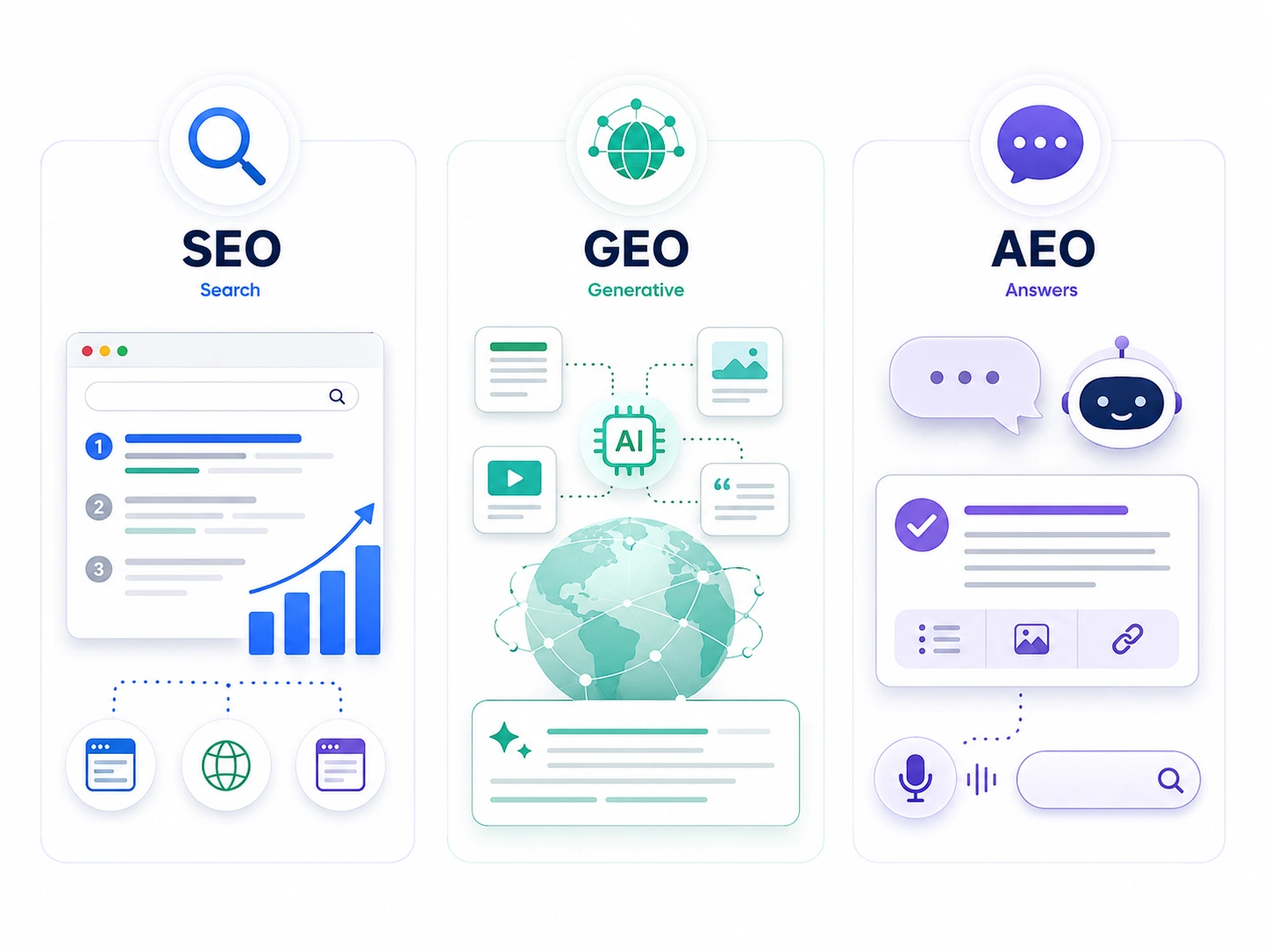
Search does not work like it did five years ago. People still use Google to find useful websites. They also use AI tools to get fast answers. These tools include ChatGPT, AI Mode, and Perplexity. This change gives brands more ways to appear online. It also makes search marketing harder to understand.
That is why SEO vs GEO vs AEO matters. Each method supports a different type of search result. SEO helps your page appear in search results. AEO helps your content answer a clear question. GEO helps AI tools find and use your content. However, all three methods share the same base.
SEO, AEO, and GEO Explained
Before comparing SEO, AEO, and GEO, it helps to understand what each one actually does. They work together, but each targets a different part of modern search visibility, from rankings to direct answers and AI citations.
What Is SEO?
SEO stands for search engine optimization. It helps search engines find and understand your pages. Good SEO connects each page to a clear search need. It also keeps the website easy to use.
SEO covers many parts of a website. These parts include content, links, speed, and page access. The main goal is more useful search traffic. You can track rankings, clicks, sales, and leads.
What Is AEO?
AEO stands for answer engine optimization. It helps your content answer a direct question. The answer should appear near the top of a section. Readers should not need to search for it. AEO can support featured snippets and voice search. It can also support People Also Ask results.
Clear headings make each answer easier to find. Lists and tables can explain some answers faster. There is no perfect length for every answer. Google changes snippet length based on the search.
Google also picks each featured snippet on its own. Website owners cannot mark one answer as the winner. You can read Google’s featured snippet guide for more details.
What Is GEO?
GEO stands for generative engine optimization. It helps AI tools understand and use your content. These tools may use content to build a full answer. Some answers also show links to their sources.
GEO depends on clear facts and trusted sources. It also needs useful content that adds something new. A copied product description offers little new value. Original tests or examples provide more useful facts. No method can promise an AI citation. Results can change across tools and search questions.
SEO vs GEO vs AEO: What Is the Difference?
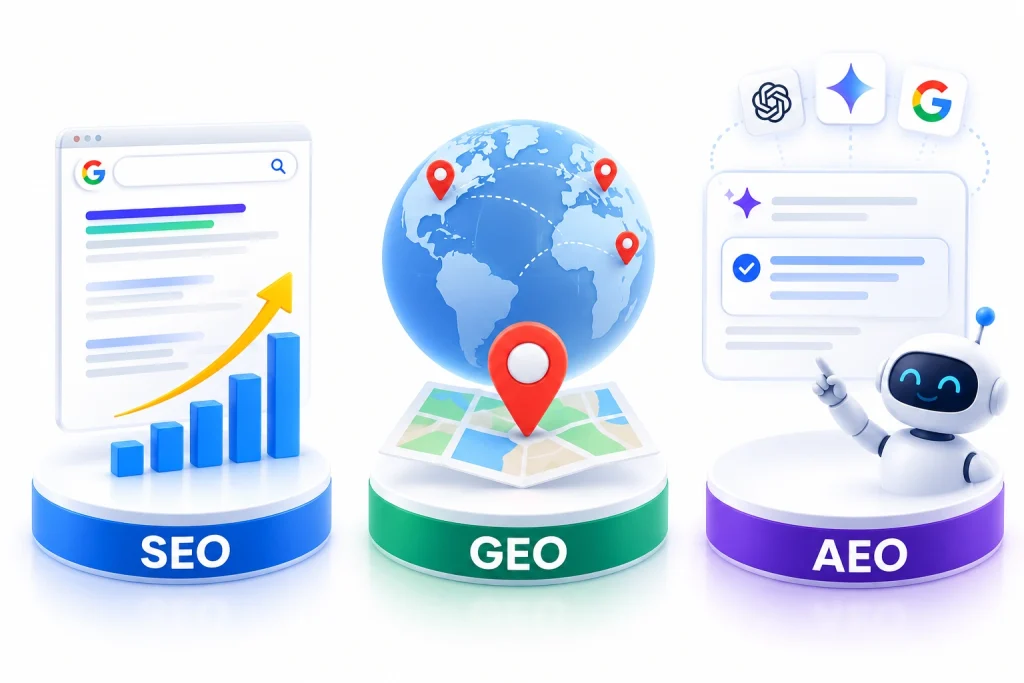
SEO focuses on normal search results. AEO focuses on short and direct answers. GEO focuses on answers made by AI tools. The table below shows the main differences.
Detail | SEO | AEO | GEO |
Full name | Search engine optimization | Answer engine optimization | Generative engine optimization |
Main goal | Improve search visibility | Give a direct answer | Appear in AI answers |
Main target | A page or website | A clear answer | A page or brand |
Common results | Organic search listings | Snippets and PAA | AI answers and citations |
Main work | Improve access and value | Answer questions clearly | Add facts and sources |
Main metrics | Rankings and clicks | Answer placements | Citations and mentions |
The methods have many shared parts. One page can support all three at once. For example, a guide may rank on Google. One section may also win a featured snippet. An AI tool may then cite that same guide. Each result starts with useful and clear content.
Are AEO and GEO Part of SEO?
AEO and GEO are common marketing terms. They are not separate Google ranking systems. Both methods use many basic SEO practices. They need clear pages that search tools can access.
Google warns against unsupported AEO and GEO tricks. These tricks include special AI files and tiny text blocks. Google does not require a special AI writing style. It also does not require a set page length.
The goal should always be useful content for people. Google explains this in its AI search guide. This means you do not need three separate plans. You need one useful and easy-to-use website.
Why Has Search Changed?
People now use more than one search tool. A buyer may start with a Google search. The buyer may then ask ChatGPT for more details. That same buyer may visit several product pages later.
This journey can include many types of results. These include links, product cards, and AI answers. ChatGPT Search can find current facts on the web. Its answers may also include links and citations.
OpenAI explains these features in its ChatGPT Search guide. However, each search tool uses its own system. The same page may not appear on every tool.
Why SEO Is Still the Foundation
Search tools must first find and access your page. Google calls this process crawling. Google must then store and understand the page. This process is called indexing.
A page normally needs indexing before it can rank. Google’s AI search features also use indexed web pages. Technical SEO helps search tools reach your content. It also helps them understand each page correctly.
Start by checking these basic SEO tasks:
- Allow search tools to crawl important pages.
- Remove unwanted noindex tags.
- Submit a clean XML sitemap.
- Use clear page titles.
- Add useful internal links.
- Fix broken links.
- Remove thin or copied pages.
- Improve mobile page speed.
- Match each page to one intent.
These tasks create a strong base for search visibility. They also support AEO and GEO work. However, technical fixes cannot replace useful content. Each page must still solve a real problem.
How to Improve Content for AEO
Start by finding the reader’s main question. Place the answer near the relevant heading. Give the main answer in one or two sentences. Add more details after the direct answer. Use the format that fits the question. Different questions need different types of answers.
- Use a short paragraph for a definition.
- Use numbered steps for a process.
- Use bullets for checks or features.
- Use a table for a comparison.
- Use FAQs for extra questions.
Do not force every answer into 40 words. Some questions need more details or warnings. A short definition may need only two sentences. A technical answer may need several paragraphs.
Clear words also help with voice search. A spoken answer should sound natural when read aloud. Avoid long words when simple words work better. Explain each technical term on its first use.
How to Improve Content for GEO
AI tools need useful facts to build answers. Common facts alone may not make your page stand out. Add details that other pages do not have. Real tests and expert advice can add value.
Useful GEO content may include:
- Original research
- Real product tests
- Expert comments
- Clear case studies
- Product comparison data
- First-hand lessons
- Updated facts
- Links to primary sources
Primary sources come from the original publisher. They include official reports, studies, and product guides. Link each strong claim to its main source. This step helps readers check the information.
Show who created or checked the content. Add a real author name and a useful bio. Add a review date for topics that may change. Update the facts when new information appears. Keep names and facts the same across your website. Mixed details can confuse readers and search tools.
How Search Tools Use Sources
Google, ChatGPT, and Perplexity use different systems. They may choose different sources for one question. Google’s AI features still use its main search systems. Normal SEO practices remain important for these results.
ChatGPT may answer from its existing knowledge. It may also search the web for current facts. A searched answer can include source links. However, not every ChatGPT answer needs web search.
This means GEO has no single ranking formula. A tactic that helps Google may work differently elsewhere. Focus on content that several tools can understand. Keep the facts clear, current, and easy to check.
Which Method Should You Use First?
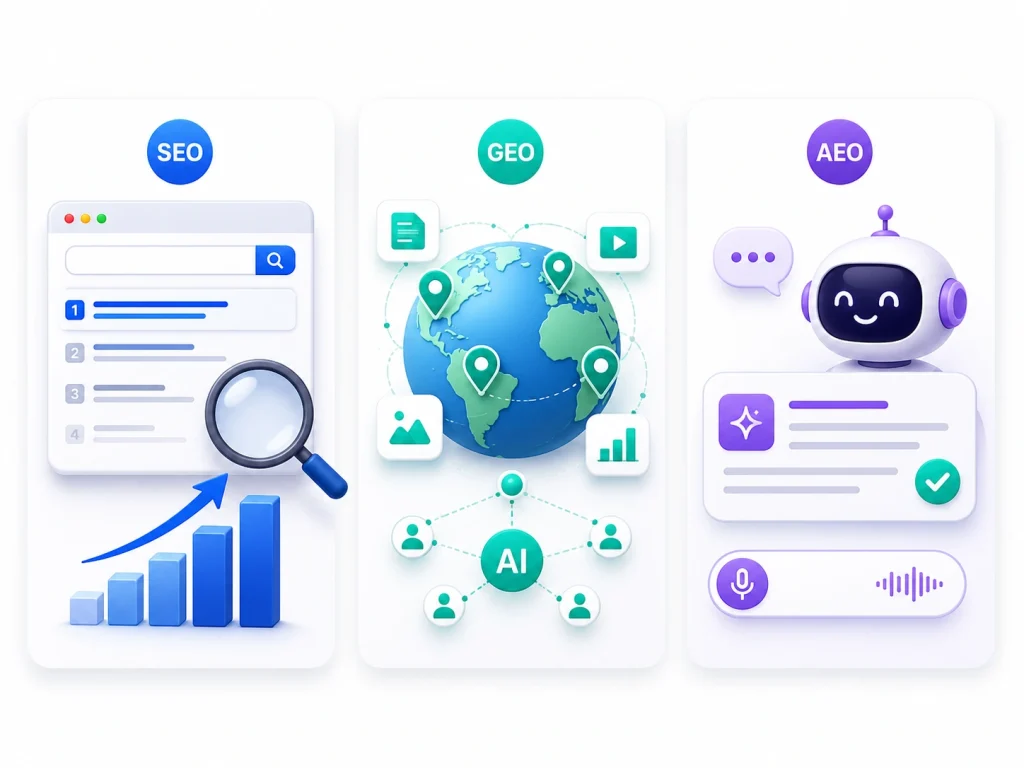
Most websites should start with SEO. AEO and GEO need the same strong base. However, your best starting point depends on your website. Check your current problems before choosing a method.
Start With SEO When:
Your pages do not rank for useful searches. Some pages may also be missing from Google. Fix page access and search intent first. Then improve your content and internal links.
Add AEO When:
Your readers ask many direct questions. This often happens with guides and service pages. It also happens on product and support pages. Answer each common question near a clear heading.
Focus More on GEO When:
Your buyers use AI tools during research. They may compare products or services through AI answers. Add expert advice and original facts. Link strong claims to trusted primary sources.
Use All Three When:
Your site already has a sound SEO base. Each new page can then support all three methods. Plan the page around one main search need. Then add clear answers and original details.
How Ecommerce Brands Can Use All Three
An online store has many types of pages. These include products, collections, guides, and company pages. SEO helps Google find these pages. It also connects products with useful buying searches. Clear product names can improve page meaning. Accurate price and stock details also help buyers.
AEO can improve product and collection FAQs. These answers can cover sizing, care, or shipping. For example, a battery page may answer fit questions. It may also explain charging time or battery life.
GEO needs more than a supplier description. Add real product facts and useful buying advice. Stores can also add original product photos. Clear comparison data may help buyers choose faster.
Google Merchant Center can share product details with Google. Product schema can support product-rich search results. However, schema cannot promise rankings or AI citations. It must also match the visible page content.
Do You Need Structured Data?
Structured data gives search tools clear page details. Many people also call it schema markup. Google supports schema for products and other content types. Correct schema can support some rich results.
However, schema is not required for AI search. Google also has no special GEO schema. Use schema only when it matches the page. Never add fake ratings or hidden product details. Test the code before publishing the page. Google offers a free Rich Results Test.
How to Measure SEO Results
Google Search Console tracks search performance. It shows clicks, views, queries, and page positions. Use this data to find weak pages. You can also spot queries with growing search demand.
Analytics tools track actions after the click. These actions may include sales, leads, or sign-ups. Do not measure SEO through rankings alone. A high ranking has little value without useful traffic.
How to Measure AEO Results
AEO results can be harder to track. Google does not provide one full AEO report. Track featured snippets and People Also Ask results. You can also review traffic from question-based searches.
Check whether the direct answer matches the page. Update weak answers when they miss the real question. Track clicks and sales from those pages too. An answer placement should support a business goal.
How to Measure GEO Results
GEO tracking depends on the AI platform. No single tool can track every AI answer. Check citations and brand mentions across key tools. Review the links shown beside each answer.
Website analytics may show visits from AI platforms. Track what those visitors do on your website. Use the same test questions during each review. Record the tool, date, question, and source links.
Results may change from one test to another. That is why a written record matters. Google also offers AI search data in Search Console. Eligible sites can use its AI performance report. Google explains this report in its AI search guide.
How to Build One Page for All Three
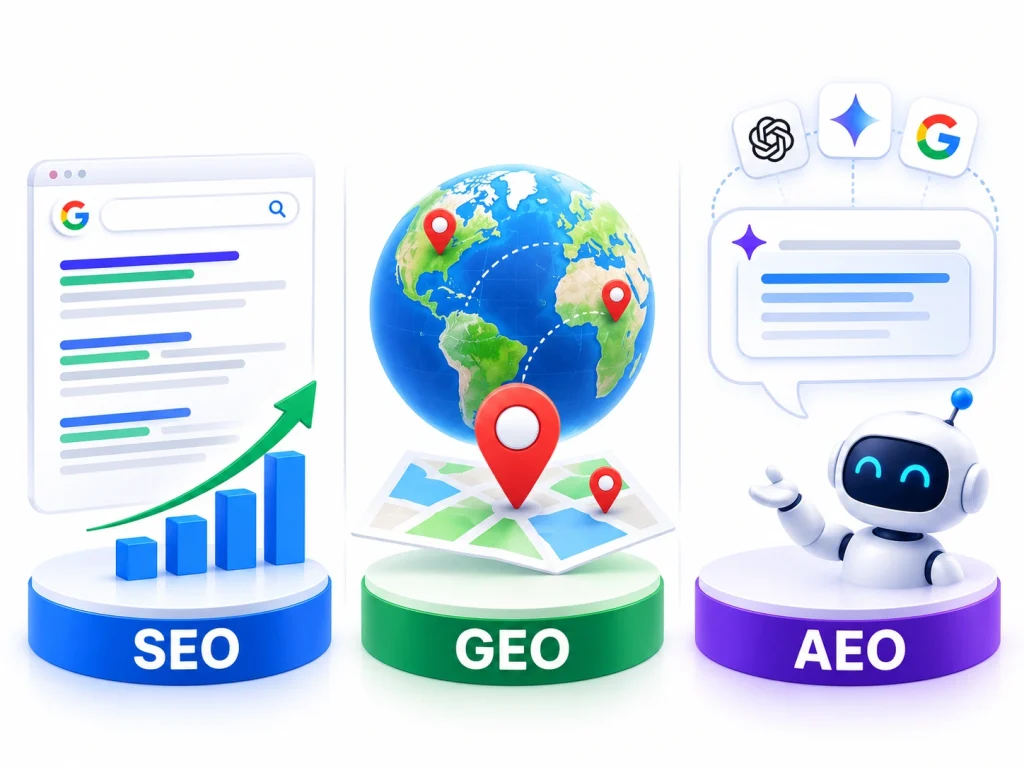
Start with one clear search intent. Decide what the reader needs from the page. Check the top search results for that topic. Note the key questions and details those pages cover.
Then build the page in this order:
- Answer the main question early.
- Define the main terms.
- Explain the key differences.
- Add useful steps or examples.
- Support claims with primary sources.
- Link to related pages.
- Add new questions in the FAQ.
- Review facts when they change.
Do not create a page for every keyword change. Similar pages can compete with each other. One complete page often gives readers more value. Split the topic only when the intent changes.
How to Show Real E-E-A-T
E-E-A-T stands for experience, expertise, authority, and trust. Google does not call it one ranking factor. Google says trust is the most important part. Its people-first content guide explains this point. A trusted page should show who made it. It should also show where the facts came from.
Use these trust checks before publishing:
- Add a real author name.
- Add a useful author bio.
- Link to primary sources.
- Show the last review date.
- List real business details.
- Provide clear contact details.
- Correct old facts.
- Use real examples.
- Explain how tests were done.
Never invent tests or customer results. Fake proof can harm the whole website’s trust.
Common SEO, AEO, and GEO Mistakes
Some websites treat SEO as outdated. This view ignores how AI search finds web pages. Others follow a fixed answer length. Google does not set one length for every question. Small content mistakes can also weaken trust. They may stop readers from taking the next step.
Avoid these common mistakes:
- Repeating keywords too often
- Adding terms without useful context
- Copying facts from other blogs
- Creating many similar pages
- Using fake author profiles
- Adding false schema details
- Making claims without proof
- Writing only for AI tools
- Ignoring sales and leads
A page can get traffic without helping the business. Always connect visibility to a clear business goal. Check each page often and fix problems before they grow.
SEO, AEO, and GEO Checklist
Use this checklist before publishing a page. It can also guide future content updates. Each check covers a different part of search visibility. Review all three groups before the page goes live.
SEO Checks
- Does the page match one clear intent?
- Can Google crawl the page?
- Can Google index the page?
- Does the title explain the topic?
- Do internal links support the page?
- Does the page add useful value?
AEO Checks
- Does the page answer the question early?
- Is the answer clear and complete?
- Does the format match the question?
- Are key limits explained?
- Are technical words defined?
GEO Checks
- Does the page add original facts?
- Are strong claims linked to sources?
- Is the author easy to find?
- Are key facts still current?
- Can AI tools access the page?
- Does the page offer useful proof?
Use this checklist whenever you publish or update content. Fix basic SEO issues before testing newer methods. Then track real results and improve weak areas over time.
Frequently Asked Questions (FAQs)
Many readers still have questions after learning the main differences. These FAQs cover six useful topics the blog has not answered. They focus on content quality, local search, links, media, and traffic.
Do Backlinks Still Matter for AEO and GEO?
Backlinks still support SEO and can help people find your content. However, links alone cannot earn an AI citation. The page also needs clear facts, useful details, and trusted sources.
Can AI-Written Content Rank in Search Results?
Yes, AI-made content can appear in search when it helps readers. Google cares more about quality than the tool used. Review every claim, remove copied filler, and add real knowledge before publishing. Google’s guidance confirms this.
Can Small Businesses Compete in GEO?
Yes, small businesses can benefit from AEO and GEO. A narrow topic may help them provide deeper answers than large sites. Local facts, expert knowledge, and real customer questions can add useful value.
Do Images and Videos Help With GEO?
Yes, useful images and videos can support search visibility. They can explain a process or show real product details. Google says its AI search features may also show relevant visual content. Google explains this here.
Can Local Businesses Use AEO and GEO?
Local businesses can use AEO to answer service and location questions. They can support GEO with accurate business details and local proof. A complete Google Business Profile may also improve Google visibility.
Will AI Search Reduce Website Traffic?
AI answers may reduce clicks for some simple searches. However, they can also send informed visitors to a useful source. Track referral traffic, leads, and sales before judging the true business impact.
Build a Search Strategy That Gets Your Brand Found
Your customers now search through Google, AI answers, and voice tools. Your brand needs clear pages that work across each search path. SEO builds the base, while AEO and GEO expand your reach.
Brand’s Bro can review your site and find the biggest gaps. We check page access, search intent, content quality, internal links, and answer structure. Then we build a clear plan around your products and goals.
Your rankings may be weak right now. AI citations may also feel out of reach. We can show you what to fix first.
You do not need random keywords or short-lived AI tricks. You need useful content that people trust and search tools understand. Explore our ecommerce SEO services and start building stronger search visibility today.
