
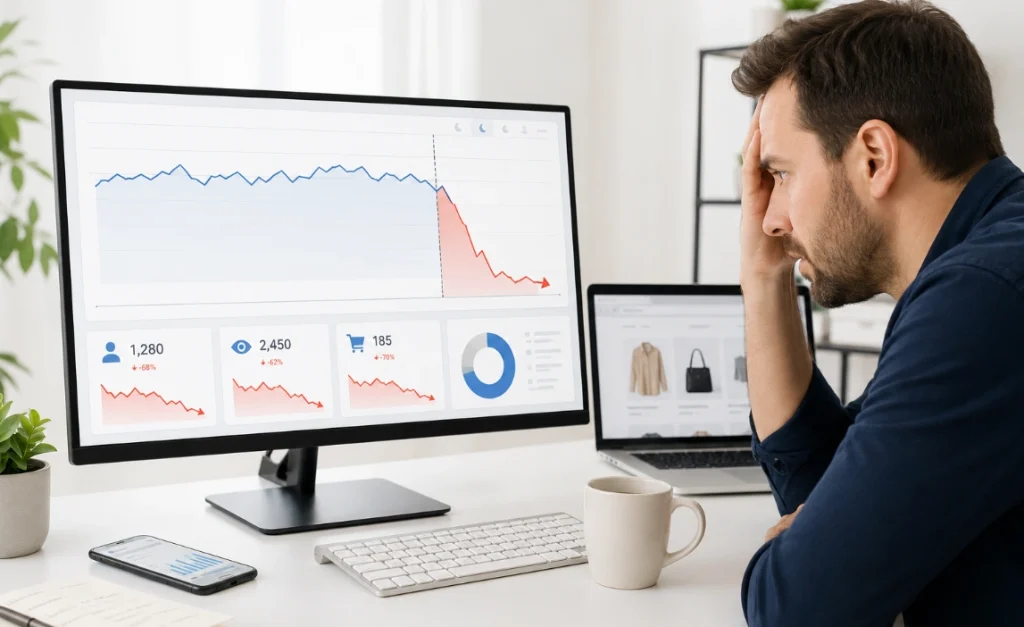
You opened Search Console today and the line fell off a cliff. Yesterday it looked fine. Shopify organic traffic dropped suddenly for one of eight reasons. The most common are a tracking fault, an accidental noindex tag, a server error, the Shopify duplicate-URL trap, a Google update, a bad migration, an AI Overview stealing your clicks, or falling demand.
You find the cause by reading the shape of the drop in Search Console, then you fix that one thing. Those eight causes fall into three buckets: technical SEO, on-page SEO, and off-page SEO. So do not rewrite your whole store on day one. That fixes nothing, and it hides the real problem.
Here is the part that trips people up in 2026. Your traffic can fall even when your rankings never move. So the first question is not what caused the drop. It is whether the drop is even real.
Confirm the Drop Is Real Before You Panic
So you check before you react, the same way Google’s own traffic-drop guide walks through. Open the same date window in four places. Look at your Search Console clicks, your GA4 organic sessions, your Shopify Analytics sessions, and your organic orders. If all four fell together, the drop is real. If only one fell, you likely have a tracking fault, not a search problem.
These four tools rarely match to the number, and that is normal. They count sessions, cookies, reloads, bots and time zones in different ways. So you look for the same shape across them, not the same figure. A real drop leaves a fingerprint. That shape tells you where to look next.
Check for a Penalty First
Some drops are not about rankings at all. They are a punishment. Google can penalise a site by hand, and when it does, your traffic can vanish overnight.
This check takes thirty seconds, so you do it before anything else. Open Search Console and look at two reports. The Manual Actions report and the Security Issues report sit in the left menu.
Manual actions
A manual action means a human reviewer at Google flagged your site. It happens when a site breaks Google’s spam rules, through things like bought links or thin, spammy pages.
If this report says “No issues detected,” you are clear and you move on. If it lists a problem, that is your answer, and no other fix matters until you deal with it. You clean up what it names, then submit a reconsideration request through the same report.
Security issues
This report flags a hacked or infected site. Google shows warning pages to searchers before they reach a hacked store, which scares your traffic away fast.
A clean report here rules out a hack. A flagged one means you clean the malware, then ask Google to review the site again. Both reports being clean tells you the drop is something quieter, so you move on to read its shape.
Start Inside Shopify's Own Analytics
Most guides send you straight to Google tools. You have a faster first stop though, and it is already in your admin. Shopify has its own analytics built in, and it reads your store better than any outside tool.
You find it under Analytics, then Reports. The dashboard above gives a quick overview, while the reports hold the detail you need. So you open Reports when you want to actually diagnose something.
The four reports that matter here
Four built-in reports answer most of your first questions. Each one splits your traffic a different way.
- Sessions by traffic source. This shows organic search on its own, apart from social, direct, and email. So you see at a glance if the drop hit search or another channel
- Sessions by device. A drop that only shows on mobile points at a speed or layout fault
- Sessions by location. One country falling off often means a Shopify Markets problem
- Sales by traffic source. This ties each channel to real orders, so you learn if lost traffic actually cost you money
Why it beats jumping to Google first
Shopify counts sessions from its own servers, so its numbers are steady and quick to read. It also knows your orders, which Search Console never sees. So you get traffic and revenue side by side in one place.
One limit is worth knowing. Shopify Analytics will not tell you why Google changed, since it cannot see rankings, impressions, or clicks. For that half of the story you still need Search Console, which is the next tool up.
Read the Shape of the Drop
The shape of your drop narrows eight suspects down to one or two. So you read it before you spend an hour anywhere. One tool does most of this work, and you will use it all day.
Google Search Console’s URL Inspection tool checks any single page. It tells you if Google can see and index that page. You return to it after every fix to confirm the repair worked.
Cliff or slow slope
A straight vertical drop on one date means a technical break or a Google update. Both happen fast. A slow bleed over weeks means something gentler. Think content decay, falling demand, or a competitor pulling ahead.
Clicks versus impressions
This is the most useful reading in all of 2026. It splits your whole diagnosis in two. Both clicks and impressions falling means lost visibility or lost demand. Impressions holding steady while clicks fall means your click-through rate dropped. In 2026 that usually points at an AI Overview or another SERP feature eating the click.
Did your indexed page count fall
Check the Pages report in Search Console. A drop in indexed pages is always technical, and it sends your next step straight to crawling and indexing. The shape only helps once you match it to a cause. So here is the map.
The Pattern That Points to Your Cause
This table is the heart of the whole guide. You find your row, and it names your likely cause.
What your data shows | Likely cause | How often |
GA4 falls, Search Console steady | Tracking or consent fault | common false alarm |
Clicks and impressions both fall | Lost visibility or demand | frequent |
Impressions steady, clicks fall | CTR loss, AI Overviews, SERP features | the 2026 classic |
Position falls across the site | Update, technical break, authority loss | frequent |
Only one page type falls | Template or content issue | 10 to 15% of real drops |
Mobile falls, desktop steady | Mobile speed or UX | occasional |
One country falls | Shopify Markets or local demand | occasional |
Traffic steady, revenue falls | Conversion, not SEO | easy to miss |
Look at that last row for a second. Shopify organic traffic dropped suddenly is not always your problem, because steady traffic with falling sales is a conversion issue. The first row hides a trap though. So you rule it out before you touch a single page.
Rule Out a Tracking Failure First
This is the costliest false alarm in SEO. People spend weeks fixing search when the real fault was a broken tag. The usual culprits are simple. A GA4 tag removed during a theme edit. A new consent banner that blocks analytics.
A Tag Manager change, or a reporting time-zone shift. Any of these makes real visits vanish from your reports while the visitors keep arriving. The tell is clean and quick to spot. Your Search Console clicks hold steady while your GA4 sessions crater.
That means the traffic still lands and only the counter broke. A quick Shopify SEO agency check will confirm a tag fault in minutes rather than days. With tracking cleared, a real drop usually hides in one page type. It rarely hits everything at once.
Segment by Page Type and Market
A sitewide average hides which template actually broke. So you split your traffic apart and look at each page group on its own. One collapsed page type points straight at its own cause.
- Product pages. Look for changed handles, removed products, or an out-of-stock item set to noindex
- Collection pages. Watch for the duplicate-URL trap and thin grids with no text. Adding 200 to 300 words of category copy often lifts rankings within 30 to 45 days
- Blog posts. Content decay and keyword cannibalization live here
- Homepage. A homepage drop is rare and usually means a technical fault or a penalty
- Market and language URLs. A deleted Shopify Markets subfolder can wipe one whole country
- Image search. People forget this one, and renamed image files often cause it
Once you know which pages fell, you check the next thing. Can Google still reach them and read them at all?
Crawling, Indexing, and the Shopify Faults Behind Them
A page Google cannot crawl or index earns zero traffic, however good it is. On Shopify, your own recent changes usually cause these technical SEO faults. So you build a quick change log of everything touched before the drop date.
That log saves hours. It lines your drop date up against your own actions, and the match is often obvious.
The accidental noindex
This is the classic overnight killer. A theme change or an app adds a noindex tag across the site, and Google drops those pages fast.
A noindex tag tells Google to keep a page out of search. You catch it in the URL Inspection tool, which states plainly if a page cannot be indexed. It also tells you when Google picked a different canonical than you expected.
robots.txt, sitemap, and crawl budget
A blocked path in robots.txt can hide pages from Google. A sitemap that stopped processing does the same. So does a chain of three or more redirects, which leaks ranking power at every hop.
Crawl budget matters on big catalogs too. Google raises its crawl rate when your store responds fast, and lowers it when your server slows or errors out. Wasted crawl on duplicate and filtered URLs then starves your money pages. Shopify builds your sitemap for you, so a resubmission in Search Console usually beats editing anything by hand.
The Shopify duplicate-URL trap
This is the Shopify-native fault most guides miss. Your products load at two addresses at once, at /products/ and at /collections/collection-name/products/.
Google sees two pages with the same content and splits the signal between them. The 2025 and 2026 core updates punished this pattern harder than before. Canonical tags plus a noindex on thin tag and variant pages clear it up.
Changed handles and rendering
A renamed product or collection handle changes its URL. The old link then returns a 404. You fix it with a 301 redirect through Online Store, then Navigation, then URL Redirects, and you search “URL redirects” in your admin if the menu has moved.
One last check belongs here. If the URL Inspection live test looks different from your live page, you have a JavaScript rendering problem worth a closer look.
If none of your own changes line up with the date, the change may have come from Google instead.
Match the Date Against a Google Update
The fastest test is a date match. You line your drop up against Google’s confirmed update calendar. Google ran several updates in 2026, and the dates are public. The March spam update hit on March 24 to 25. The March core update ran from March 27 to April 8. The May core update followed from May 21 to June 2, and the June spam update began on June 24.
You confirm all of this on the Google Search Status Dashboard, which is the official record. One more thing to watch: the next core update is expected around August or September 2026. So a store reading this in late summer may be near another one.
Now a core update is not a penalty. Google simply re-scored everyone, and your pages got measured against fresh standards. Shopify organic traffic dropped suddenly after an update usually recovers through better content over months, not a quick technical patch. Updates hit hardest when a site recently moved address. That case deserves its own look.
If the Drop Followed a Migration
A migration multiplies every technical risk at once. You changed your platform, your URLs, or your theme, and any one of those can break search.
So you work through a tight checklist. Map 301 redirects from every old URL to the new one. Point canonicals at the correct version, and check that no noindex tag came across from your staging site. Then resubmit the sitemap, update your internal links, and rebuild any content you dropped along the way. A careful Shopify migration plan prevents most of these faults before they start. Sometimes though, your site is fine and the SERP itself changed. That is the real story of 2026.
When Your Rankings Hold but Clicks Vanish
Here is the case that confuses everyone. Your traffic falls while your rankings sit exactly where they were. The click went somewhere else on the page.
This pattern barely existed a few years ago. It is now one of the most common drops of 2026. So you learn to spot it before you waste time chasing a rank that never moved.
AI Overviews
Google now answers many questions right on the results page. That block is an AI Overview, and the user reads it without clicking your link. It sits above the normal results, so it takes the first look every time.
You confirm it in Search Console with one pattern. Impressions hold steady while clicks and click-through rate fall. Informational queries get hit hardest, while transactional ones hold up better.
So piling on more blog posts can backfire here. Each thin post just gives the AI Overview more to pull from. The fix is content a summary cannot copy, so you add comparison tables, real examples, screenshots, and clear decision steps. That makes it an on-page SEO fix, since the work lives on the page itself.
Featured snippets and SERP features
A lost featured snippet can drop your clicks overnight. So can a new shopping module or a competitor with a stronger title. Each one pushes your link further from the eye.
You spot these by looking at the live results page yourself. Search your main term and see what sits above your link now. A single new box between you and the click can explain the whole drop.
Falling demand
Sometimes fewer people are searching at all. You check this in Google Trends for your main terms. If demand fell, no fix on your side brings those searches back.
Seasonal products show this pattern every year. A garden store fades in winter, and a gift store dips in January. So you compare against the same month last year, not just last week, before you call it a problem. Clicks also fall when your competitors simply get better. That is worth a direct look.
Competitors, Backlinks, and Content Decay
These are the slow-bleed causes. A sharp cliff rules them out, but a gentle slope points right at them. These are off-page SEO causes, the ones that happen away from your own store.
- A new competitor started ranking for your terms
- A rival refreshed a page you left untouched for a year
- You lost backlinks that once held a key page up
- Content decay set in, where an old post slowly stopped matching what searchers want
- Two of your own pages now split one keyword, which is keyword cannibalization
All this diagnosis serves one goal. That goal is not traffic for its own sake.
Lost Traffic Does Not Always Mean Lost Sales
This reframe saves a lot of wasted work. Not every lost visit costs you money. So you check the revenue behind the traffic before you panic. Three points make this clear.
A drop in low-intent blog traffic may cost you almost nothing in sales. Steady traffic with falling orders is a conversion problem, not a search one, and a Shopify CRO review handles that case instead.
Your recovery should start with pages that used to earn money, not the pages with the biggest impression counts. With the cause named and your priorities set, recovery becomes a short list. You just work it in order.
Your Recovery Plan, Ranked by Speed
Each type of cause heals on its own clock. So you fix by type and set honest expectations for each. A full audit works all three in order: technical SEO first, then on-page SEO, then off-page SEO last, since links take the most time.
Cause type | What you do | Recovery window |
Technical fault | Fix it, then verify in URL Inspection | days to two weeks |
Thin or decayed content | Rebuild revenue pages first | weeks |
Algorithm re-score | Run a content and trust programme | months, often the next update |
SERP feature or AI Overview | Shift strategy, do not chase the rank | ongoing |
Your first pass follows a clear order. Restore any noindex or robots block, then fix redirects and 404s. Resolve duplicate URLs with canonicals, resubmit your sitemap, and rebuild thin content on your revenue pages. Then you earn back the links you lost, and you tie each fix to the one number it should move.
A full Shopify SEO audit maps all of this in one pass if you would rather not guess. Recovery is only real once the graph confirms it though. So the last job is watching the right numbers.
Monitor the Recovery, and Know When to Call It In
Recovery shows up in a set order. Impressions climb back first, then clicks, then revenue. So you track them in that order and you stay patient.
Core-update recovery can take weeks, and it often waits for the next update to land. So you avoid panic edits while a rollout is still live. You also verify every technical fix in the URL Inspection tool instead of guessing that it worked.
Some drops are worth handing off. A confirmed core-update hit or a tangled migration is where a professional audit saves you months of trial and error.
Frequently Asked Questions (FAQs)
These come up in almost every traffic-drop investigation we run. Short answers below.
How long does it take to recover from a Google core update?
Recovery often takes weeks to months, and it usually needs the next update to land. Google re-scores your pages then, so your content work shows its full effect at that point.
Can Shopify traffic drop without my rankings changing?
Yes, and it is common in 2026. AI Overviews and featured snippets answer the query on the results page, so people read the answer without ever clicking your link.
Does Shopify's duplicate URL structure really hurt SEO?
It can, since products load at two URL paths at once. That splits your ranking signal, so you fix it with canonical tags and a noindex on thin variant and tag pages.
How do I tell a penalty from a normal update?
Check the Manual Actions report in Search Console. A penalty shows there as a manual action, while a normal update leaves that report empty and simply re-scores your pages.
Should I pause SEO work while traffic is down?
No, but you diagnose before you act. Fix confirmed technical faults right away, and hold off on big content changes until you know the true cause.
Will publishing more blog posts bring the traffic back?
Not always, and it can backfire. If AI Overviews are absorbing your clicks, more thin posts just give them more to absorb, so quality beats volume every time.
Getting Your Traffic Back on Track
You now have the full path in front of you. You confirm the drop is real, read its shape, then match the pattern to a cause.
After that you check your own changes, your indexing, and the Google update calendar. Each cause has its own fix and its own recovery clock.
Shopify organic traffic dropped suddenly feels like an emergency, and the graph makes it look worse than it often is. Most drops trace to one cause, not ten. So you find that one, fix it, and watch the right number climb back.
