

Choosing the wrong Amazon review checker is not a small mistake. Fake reviews, weak product ratings, and low-trust listings can quietly destroy conversions before shoppers even click Add to Cart. On Amazon, reviews are not just feedback, they directly affect trust, ranking, ad performance, and sales.
At Brand’s Bro, we have spent over 11 years helping ecommerce and Amazon brands grow through listing optimization, PPC strategy, SEO, review analysis, and conversion-focused marketplace management. Our team has worked with 78+ brands across niches like home appliances, beauty products, fashion accessories, and consumer electronics.
We have seen brands lose sales because they ignored review quality. We have also seen brands recover fast when they used the right tools to identify fake reviews, analyze customer sentiment, and improve product credibility.
In one Amazon project, a Home & Kitchen brand was struggling with low buyer trust and poor listing performance. After reviewing their customer feedback, improving listing structure, and refining their PPC strategy, their sales increased by 187% within 90 days.
Another Beauty & Personal Care brand had strong products but weak review visibility. After our team analyzed review patterns, optimized their product pages, and improved their Amazon advertising strategy, monthly revenue increased from $42,000 to over $96,000.
These results did not happen by guessing. They came from understanding how Amazon customers think, how reviews influence buying decisions, and which tools actually help sellers make smarter decisions.
In this guide, we share the top 4 Amazon review checker tools and extensions that can help sellers identify suspicious reviews, understand customer trust signals, and make better decisions before scaling their products.
And if you are struggling with Amazon sales, poor product ranking, weak reviews, or low conversion, Brand’s Bro can help you find the problem and fix it with a data-driven Amazon growth strategy.
What Is An Amazon Review Checker And Why Is It Important?
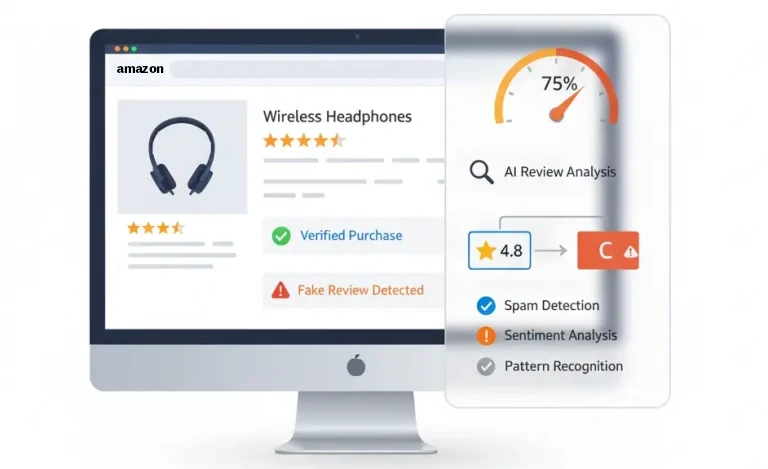
An Amazon review checker helps analyze product reviews for authenticity, quality, and customer sentiment, helping shoppers avoid fake reviews and sellers improve trust, rankings, and conversions.
An Amazon review checker tool is a smart assistant for online shopping. It is a program that carefully analyzes product reviews for you. Its goal is to determine if the customer feedback is authentic and trustworthy. This gives you a clearer picture of a product’s true quality.
These tools are incredibly useful for buyers and sellers. Shoppers use them to avoid scams and find high-quality products. Honest sellers use a review checker for Amazon to protect their brand. It helps them spot fake negative reviews on their own listings.
So, how does this Amazon reviews checker work its magic? It uses powerful AI review filtering to look at different trust signals. The tool scans for unnatural text patterns or overly positive language. It also checks for the official “Verified Purchase” tag from Amazon.
A good fake review checker for Amazon digs even deeper. It analyzes the reviewer’s account for suspicious activity. For instance, it might flag a user who posts many five-star reviews in one day. This review authenticity check provides a more accurate rating.
Let’s consider a quick example. You might find headphones with a 4.8-star rating. The tool, however, might give it a “C” grade. It found that many positive reviews came from unverified accounts on the same day. This insight helps you avoid a potentially bad purchase.
Ultimately, these tools give you credibility and purchase safety. Well-known checkers like ReviewMeta help you shop with more confidence. They work alongside Amazon’s own programs, like Amazon Vine, to promote trustworthy product feedback and protect buyers.
Why Fake Reviews Are A Growing Problem On Amazon

Fake reviews are a growing problem on Amazon because they mislead buyers, damage trust, manipulate rankings, and make it harder for honest brands to compete fairly.
Fake reviews represent a serious and organized issue. It goes far beyond a few unhappy customers or overly excited fans. The problem has become a widespread challenge for the entire Amazon marketplace. To understand this threat, we must look at who is behind it.
The Scale Of Review Manipulation On Amazon
Dishonest sellers and fake review brokers are the primary culprits. These individuals operate in the shadows to post deceptive product feedback. Organized groups run large, paid review rings to create false hype. Their main goal is to trick the system for financial gain.
Such a coordinated effort makes it difficult for shoppers to trust ratings. A product’s reputation gets inflated with inauthentic praise. This review manipulation on Amazon has become a significant hurdle for online shoppers who want honest opinions.
Fake Reviews Distort Ratings And Harm Buyers
Inauthentic reviews create a completely false reality for you. A cheaply made, low-quality product can be made to seem like a best-seller. This process often involves algorithm manipulation to reach the first page. Many brokers also use keyword-stuffed reviews for more visibility.
Imagine a product that genuinely deserves only a 2-star rating. Fraudsters can flood its page with hundreds of fake 5-star reviews. When you check for fake Amazon reviews, you can spot the deception. Otherwise, you might waste your money on a worthless item.
Evidence And Consequences For Brand Trust
The severity of fake reviews has forced governments to get involved. For instance, the Federal Trade Commission (FTC) is taking legal action against brokers. Amazon’s own fraud team also works constantly to stop this activity. A regular fake Amazon review check helps everyone.
This issue also hurts honest sellers and their brand trust. It becomes very hard for them to compete fairly in the marketplace. When buyers lose confidence in the review system, everyone loses. The situation damages the credibility of the entire e-commerce platform.
BrandsBro helped an outdoor client improve its Amazon fake review check strategy, storefront structure, and product presentation.
With a cleaner layout and better shopping flow, the brand looked more trustworthy and performed stronger. Need help? Book a free consultation.
How To Check If Amazon Reviews Are Real?

To check if Amazon reviews are real, look for verified purchases, balanced feedback, real photos, detailed product experience, natural wording, reviewer history, and unusual review spikes.
Now that you understand the problem, let’s focus on the solution. You have powerful ways to identify fake Amazon reviews. Some methods involve a bit of detective work on your own. Others use automated tools that do the hard work for you.
So, where should you begin? Let’s start with what you can do yourself.
Check Amazon Reviews Directly On The Product Page
You can learn a lot just by carefully looking at the product page. Before you trust a rating, perform a quick Amazon reviews check. These five steps will help you spot the manual signs of authentic versus fake feedback.
- Always look for the “Verified Purchase” badge. This label confirms the reviewer actually bought the item on Amazon. It is a strong first signal of a legitimate review. Unverified reviews are much easier to fake.
- Next, analyze the overall star distribution of the product. A trustworthy product usually has a mix of different ratings. Be cautious if you only see five-star and one-star reviews. This pattern can suggest review manipulation.
- You should also check the review timelines. Did hundreds of positive reviews appear in just a few days? A sudden, unnatural spike is a major red flag. Real feedback tends to accumulate at a much steadier pace over time.
- Then, read the actual content of the reviews. Fake reviews often use vague, generic, or overly enthusiastic language. Authentic reviews are typically more specific and balanced. Look for customer photos and videos as extra proof.
- Finally, you can check an individual’s reviewer history. Click on the reviewer’s name to see their profile. If they have reviewed dozens of products in a short time, be wary. A suspicious profile can indicate a paid or fake reviewer.
Use Browser Extensions To Check Amazon Reviews
If manual checks feel like too much work, there is a faster way. A dedicated fake Amazon review checker can automate the entire process for you. These tools are often available as a simple browser extension. You can add one to Chrome, Firefox, or Edge.
This Amazon review checker extension simplifies your Amazon review check. Once installed, it works directly on the product page you are viewing. The tool uses advanced AI language analysis to assess all the reviews instantly. It performs all the manual checks we just discussed in seconds.
For example, you might be looking at a product with a 4.5-star rating. You click the extension’s button in your browser. The tool might show you an “adjusted” rating of only 3.0 stars. It will also provide a simple grade, like a “D,” for review quality.
Top 4 Amazon Review Checker Tools And Extensions To Try

Manually checking every review for every purchase is very time-consuming. You need a much faster way to verify product feedback. This is exactly what an Amazon review checker provides. It automates the entire process, which helps to save you valuable time and effort.
To simplify your decision, we’ve compared the leading tools. This chart highlights what makes each one stand out. It is designed to help you find the perfect fit for your needs.
| Tool | Best For | Accuracy | Pricing | Unique Feature |
|---|---|---|---|---|
|
ReviewMeta |
Detailed Shoppers |
High |
Free |
Provides an “Adjusted Rating” and a report card. |
|
Null Fake |
Quick and Easy Checks |
Very Good |
Free |
Gives a simple Pass/Fail with an AI score. |
|
TheReviewIndex |
Data-Driven Insights |
Good |
Freemium |
Offers a spam score based on review data. |
|
Helium10 Insights |
Amazon Sellers |
Professional |
Paid Plans |
Part of a complete suite for brand analytics. |
The table gives you a great overview of the top choices. To help you decide, let’s take a closer look now. Here are more details on what makes each of these tools so effective.
1. ReviewMeta
Price: Free
Ideal for: Amazon shoppers, deal hunters, marketplace researchers, ecommerce teams, and anyone checking review trust before buying
ReviewMeta is built for one clear job: helping shoppers understand whether Amazon product reviews look natural or suspicious. Instead of trusting a star rating at face value, it analyzes review patterns and gives a cleaner picture of what customers may actually think.
Quick Snapshot
ReviewMeta is a simple but powerful review checker for Amazon products. You paste a product link, and it reviews the feedback quality behind the listing. It helps filter out questionable review behavior, inflated ratings, repeated language, unusual reviewer activity, and other signals that may make a product look better than it really is.
For shoppers, it adds a smart second opinion before purchase. For ecommerce teams, it helps study competitors, review quality, and customer trust signals without wasting time manually checking hundreds of reviews.
Key Features
Amazon review analysis: ReviewMeta checks product reviews and highlights patterns that may affect trust. This helps users avoid judging a product only by its star rating.
Adjusted rating estimate: The tool gives a more realistic rating view after analyzing review quality. This makes it easier to compare products fairly.
Suspicious review pattern detection: It looks for signs like repeated phrases, unusual reviewer behavior, and review timing issues. These signals help users spot products that may have inflated social proof.
Easy product link checking: Users can paste an Amazon product URL and get results quickly. No complicated setup is needed.
Helpful for competitor research: Brands and sellers can use ReviewMeta to understand how strong or weak competitor reviews really are. This is useful before entering a market or improving product positioning.
Pros
Free and easy to use: ReviewMeta does not require a complex dashboard or learning curve. Anyone can check a product quickly.
Helps avoid bad buying decisions: A product may look strong on Amazon, but ReviewMeta can reveal weak or questionable review quality behind the rating.
Useful for Amazon research: Ecommerce teams can use it to study review strength, customer trust, and competitor credibility.
Clear trust-focused insights: The tool does not overload users with unnecessary data. It focuses on review quality, which is exactly what shoppers need.
Cons
Not a final verdict on product quality: ReviewMeta analyzes review behavior, not the physical product itself. A product can still be good even if some reviews look questionable.
Works best as a second opinion: Users should still check product images, descriptions, Q&A, shipping details, and recent customer feedback.
Amazon-focused use case: It is mainly useful for Amazon product review analysis, so it is not a complete ecommerce research platform.
Our Take
ReviewMeta is a smart tool for anyone who does not want to be fooled by inflated Amazon ratings. It is especially useful before buying higher-priced items or researching competitors.
Use it as a trust-checking layer, not the only decision-maker. For shoppers and Amazon-focused teams, ReviewMeta is simple, practical, and worth using before making a purchase decision.
2. Null Fake
Cost: Free
Best for: Amazon shoppers, bargain hunters, ecommerce researchers, and buyers who want to avoid misleading reviews
Null Fake helps users check whether Amazon product reviews look trustworthy before making a purchase. It is a free, open-source Amazon review analysis tool developed by Shift8 Web.
Why It Stands Out
Null Fake is made for shoppers who do not want to depend only on Amazon star ratings. A product may show thousands of positive reviews, but that does not always mean the feedback is reliable.
The tool reviews Amazon product links and gives users a clearer look at review quality, suspicious patterns, and possible rating manipulation. For everyday buyers, it works like a quick trust check before checkout. For ecommerce teams, it can help with competitor research and product validation.
What Null Fake Checks
Review trust signals: Null Fake analyzes customer reviews to identify whether the feedback looks natural or questionable.
Adjusted review insight: It helps users look beyond the public star rating and understand whether the product reputation may be inflated.
Suspicious language patterns: The tool can help detect reviews that feel overly repetitive, unnatural, or too polished.
Amazon product link analysis: Users can paste an Amazon product URL and get review insights without complicated setup.
Open-source transparency: Because Null Fake is open-source, it gives users more visibility than many closed review-checking tools.
Where It Performs Well
Simple and beginner-friendly: Null Fake does not require technical knowledge. Anyone can use it before buying from Amazon.
Great for avoiding risky purchases: It helps shoppers slow down before trusting a product with perfect-looking ratings.
Useful for ecommerce research: Amazon sellers and agencies can use it to study competitor review quality and market trust.
Free access: There is no upfront cost, which makes it easy for casual shoppers and small teams to test.
Where It Falls Short
It does not prove a review is fake: No review checker can guarantee perfect accuracy. Null Fake shows risk signals, not legal proof.
It does not judge product quality directly: A product can still be good even if some reviews look suspicious.
Mostly useful for Amazon: It is not a full ecommerce intelligence platform for every marketplace.
3. The Review Index
Cost: Previously free
Best for: Amazon shoppers, product researchers, electronics buyers, and ecommerce teams studying customer feedback
Status: Legacy tool / limited availability
The Review Index was built to make Amazon reviews easier to understand. Instead of forcing users to scroll through hundreds or thousands of reviews, it grouped customer feedback into clear product-level insights.
Main Value
The Review Index focused less on “fake review detection” and more on review summarization. That made it useful for shoppers who wanted to know what buyers repeatedly liked or disliked about a product.
For example, instead of reading every review manually, users could quickly see common patterns around performance, build quality, pricing, reliability, comfort, or defects. That saved time and made purchase decisions less confusing.
Core Functions
Review summary by feature: The tool organized customer opinions into product-specific categories, making it easier to understand what people actually talked about most.
Positive and negative feedback separation: Users could quickly compare what buyers praised versus what they complained about.
Fast Amazon product research: The Review Index helped users scan large review sections without reading every single comment.
Helpful for product comparison: It worked well when comparing similar Amazon products with large review counts.
Useful for ecommerce teams: Sellers and agencies could use the insights to find customer pain points, competitor weaknesses, and product improvement ideas.
Strong Points
Great for saving time: Reading hundreds of reviews manually is slow. The Review Index made that process much faster.
Better than judging only by star rating: A 4.5-star product can still have repeated complaints. This tool helped surface those patterns.
Useful for feature-level decisions: It helped shoppers understand why people liked or disliked a product, not just whether they rated it highly.
Good for competitor research: Amazon sellers could use it to study what customers wanted, what they disliked, and where competitors were weak.
Weak Points
Availability is the biggest issue: The tool cannot be treated as a reliable active option today because its official site shows limited or discontinued access.
Not a full fake-review checker: It was stronger as a review summarizer than as a direct fake-review detector.
Not enough for final purchase decisions: Users still need to check recent reviews, seller reputation, return policy, product images, and Q&A.
Marketplace limits may apply: Even when available through extensions, support can vary by Amazon region.
4. Helium10 Review Insights
Cost: Paid Helium 10 subscription required
Best for: Amazon sellers, FBA brands, product researchers, listing teams, and agencies doing competitor review analysis
Helium 10 Review Insights is not just a basic review checker. It is built for sellers who want to understand what customers are repeatedly saying about a product, what issues hurt ratings, and which product strengths deserve more attention in the listing. Helium 10 says Review Insights works inside its Chrome Extension and uses Amazon customer feedback data to turn review information into product-level insights.
What Makes It Valuable
Review Insights helps sellers move beyond surface-level star ratings. A product may have strong ratings, but the real money is hidden inside repeated customer complaints, common praise, and rating-impact patterns.
For Amazon brands, this is useful before launching a product, improving a listing, updating images, writing bullet points, or studying competitor weaknesses. It shows what buyers actually care about instead of forcing teams to manually read hundreds of reviews.
Main Capabilities
Customer topic analysis: Review Insights organizes positive and negative review topics so sellers can quickly see what customers love and what they dislike most.
Rating impact breakdown: The tool helps identify which review topics push ratings up and which issues drag ratings down. This is useful for deciding what to highlight in product copy and what problems to fix first.
Six-month trend view: Sellers can track whether customer sentiment around a topic is improving, declining, or staying stable over time. That makes it helpful after product updates or listing changes.
Variation-level review analysis: For products with multiple child ASINs, Review Insights can analyze specific variations separately. This matters because one color, size, or model may perform very differently from another.
CSV export support: Teams can export review insights for deeper research, reporting, or internal strategy work. That makes it more useful for agencies and serious Amazon operators, not just casual shoppers.
Where It Performs Best
Strong for Amazon product research: Review Insights helps sellers understand what buyers repeatedly mention before entering a market.
Useful for listing optimization: Positive topics can be turned into stronger titles, bullets, images, A+ Content, and ad angles.
Good for competitor analysis: It can reveal where competing products are weak, giving sellers a clear angle for product improvement.
Better than manual review reading: Helium 10’s Chrome Extension is designed to help users scan large volumes of reviews and identify common complaints faster.
Where It Falls Short
Not a pure fake-review detector: Do not position this like ReviewMeta or Fakespot. Helium 10 Review Insights is stronger for customer feedback analysis, not proving whether reviews are fake.
Paid access limits casual users: Helium 10 states Review Insights is available to paid subscribers, so free users must upgrade to use it.
Marketplace support is limited: Helium 10 lists support for selected Amazon marketplaces, including the United States, United Kingdom, France, Italy, Germany, Spain, and Japan.
Too much tool for basic shoppers: A regular buyer may not need this level of data. It is more valuable for sellers, brands, and ecommerce teams.
Lorem ipsum dolor sit amet, consectetur adipiscing elit. Ut elit tellus, luctus nec ullamcorper mattis, pulvinar dapibus leo.
If your Amazon sales are not growing, your product ranking is weak, reviews are holding you back, or conversions are low, Brand’s Bro can identify the real issues and fix them with a data-driven Amazon growth strategy.
To discuss your brand’s growth plan, you can book a meeting with us today.
How To Check Your Own Reviews On Amazon (For Sellers)

Amazon sellers can check their own reviews by opening product detail pages, Seller Central feedback tools, Brand Dashboard, or Voice of the Customer to monitor ratings, complaints, and customer experience.
To protect your brand’s health, you must watch your Amazon feedback closely. This means paying attention to two distinct areas of customer opinion. These are your Seller Feedback and your individual Product Reviews.
Seller Feedback directly impacts your account’s performance metrics. Product Reviews directly impact your product’s sales and ranking. Follow these steps to effectively manage both types of feedback.
- Know the Two Feedback Types: Your first step is to understand the two different kinds of feedback. Ask yourself what you need to know. Do you need info on your shipping? That is Seller Feedback. Do you need opinions on your product? That is a Product Review. This distinction is the key to managing your reputation effectively.
- Find Your Seller Feedback: To see feedback on your performance, use the Feedback Manager. In Seller Central, simply navigate to the Performance tab. Then select Customer Feedback to view your main rating dashboard.
- Locate Your Product Reviews: Avoid checking each product page individually, as it is too inefficient. Brand-registered sellers should instead use the Brand Dashboard. This tool provides a much better overview with helpful analytics.
- Use Tools for a Deeper Analysis: For serious monitoring, use a professional tool like Helium 10. It automatically gathers all your product reviews in one place. This lets you analyze trends and get alerts for new customer feedback.
How Amazon’s AI Detects And Removes Fake Reviews
Amazon’s AI detects fake reviews by analyzing review patterns, account behavior, unusual ratings, and suspicious activity, then removes misleading reviews to protect shoppers and improve trust.
Amazon has a sophisticated AI system that acts as a digital gatekeeper. This system analyzes every single review before it gets published to decide if it is authentic. It is a multi-layered process designed to catch fraud automatically.
Here is a clearer breakdown of how this smart technology detects and removes fake reviews.
- The moment a review is submitted, machine learning models scan its text. The AI looks for red flags like generic phrases, repeated words, or other language patterns that are common in fake reviews.
- Next, the system looks beyond the text. It analyzes the reviewer’s account for suspicious behavior. This includes checking the number of reviews they have posted in a short time and their past review history.
- The AI then uses powerful graph neural networks to find hidden relationships. It checks if the reviewer’s account is secretly linked to sellers, third-party brokers, or other accounts known for fraudulent activity.
- Based on the combined signals from the content and account analysis, the AI then acts. High-risk reviews are blocked instantly. Borderline cases are flagged for a final check by a human moderator.
How To Report Fake Reviews On Amazon?
Report fake Amazon reviews by clicking “Report abuse” under the suspicious review, selecting the issue, and submitting it for Amazon’s review moderation team.
When you check fake Amazon reviews and find one, you can take action. Amazon allows both shoppers and sellers to report suspicious feedback. This helps keep the marketplace honest for everyone. The method you need to use depends entirely on who you are.
The table below provides a direct comparison of the correct reporting process.
| Instructions for Buyers | Instructions for Sellers |
|---|---|
|
Go to the specific review you think is fraudulent. |
You cannot use the report button on your own listings. |
|
Find the Amazon Report Abuse Button just below the text. |
You must log in to your Seller Central account first. |
|
Click the button, and a new window will pop up. |
Open a new Seller Support Case for the issue. |
|
Submit the report to send it to the moderation team. |
Clearly explain which Amazon policy the review violates. |
After being reported, a review enters a moderation queue. Amazon’s Policy Team investigates, which can take anywhere from a few days to two weeks.
Amazon will only remove a review if it clearly violates its guidelines. Please note that you may not receive a direct update. The outcome of a review appeal is not always shared with the person who reported it.
Real Vs Fake Review Comparisons
Sometimes the best way to learn is by seeing direct comparisons. A fake Amazon review check becomes much easier when you recognize the patterns. Let’s look at some common examples of both fake and authentic reviews.
Hallmarks Of A Fake Review
Fake reviews are designed to manipulate ratings and often share common traits, such as vague language or unnatural phrasing. Here are clear examples of what to watch out for.
Example 1: The Overly-Enthusiastic Review
⭐⭐⭐⭐⭐ “Wow! This product is simply perfect and amazing. It is the best I have ever bought. I would recommend this to everyone I know. A must-buy item!”
Why it’s suspicious: The language is extremely vague and emotional. It lacks any specific details about the product itself.
Example 2: The Keyword-Stuffing Review
⭐⭐⭐⭐⭐ “I was looking for a new blue running shoe. This blue running shoe is great. If you need a blue running shoe, this is the one to get.”
Why it’s suspicious: The unnatural repetition shows it was likely written for search engines, not to help a human shopper.
Example 3: The No-Detail Review
⭐⭐⭐⭐⭐ “Great product.”
Why it’s suspicious: This review offers zero context or useful information. While not always fake, it’s a very low-quality and untrustworthy signal.
Hallmarks Of An Authentic Review
Authentic reviews feel like they were written by a real person. They often include specific details, balanced opinions, and helpful context about their experience. Look for these signs of a trustworthy customer opinion.
Example 1: The Balanced Review
⭐⭐⭐⭐ “Heats up fast and works well, but the power cord is a bit short. Had to use an extension cord. Overall, happy with the purchase for the price.” Verified Purchase
Why it’s trustworthy: It mentions both a positive and a negative point. This balanced perspective is a strong sign of a real customer experience.
Example 2: The Specific-Detail Review
⭐⭐⭐⭐⭐ “I bought the medium size, and it fits perfectly. The stitching on the left pocket seems very durable. I’ve already washed it twice with no issues.” Verified Purchase
Why it’s trustworthy: It includes specific, real-world details that are hard to fake. This shows genuine interaction with the product.
Example 3: The “Just Okay” Review
⭐⭐⭐ “It worked for my small project. I do not think it would last for heavy-duty use. The plastic casing feels a little cheap for the cost.” Verified Purchase
Why it’s trustworthy: The moderate three-star rating and managed expectations are signs of an honest, nuanced opinion.
It is important to view these examples as strong clues, not absolute proof. The real power is not in judging one review, but in spotting patterns. When you see many reviews sharing the same fake characteristics, it is a clear sign to be cautious.
Best Amazon Review Checkers for Buyers vs. Sellers: Which Tool Should You Choose?
Buyers should choose an Amazon review checker that quickly analyzes review quality, reviewer behavior, rating patterns, and potentially unreliable feedback. Tools such as Fakespot and ReviewMeta are commonly used for product-level review analysis.
Sellers need more advanced review-monitoring tools. Options such as Helium 10, Jungle Scout, and FeedbackWhiz can help sellers track ratings, receive review alerts, analyze customer sentiment, and identify unusual review activity.
The right choice depends on your goal. Buyers mainly need a free, simple credibility score, while sellers need continuous monitoring, keyword insights, competitor tracking, and detailed review analytics.
How Accurate Are Amazon Fake Review Checkers? Scores, False Positives, and Limitations
Amazon fake review checkers are useful screening tools, but their scores are not definitive proof that reviews are fake. Most tools use algorithms to examine wording, reviewer history, rating spikes, repetition, and purchasing patterns.
False positives can occur when legitimate customers use similar phrases, leave several reviews within a short period, or receive products through approved promotional programs. Genuine reviews may therefore be incorrectly marked as suspicious.
Accuracy also varies between tools because each platform uses different data and scoring methods. Buyers should compare multiple sources, read recent verified-purchase reviews, and examine both positive and negative feedback before purchasing.
What Should Amazon Sellers Do After Finding Suspicious Reviews?
Amazon sellers should document suspicious reviews before taking action. Record the review date, reviewer name, product ASIN, screenshots, rating patterns, and any evidence suggesting manipulation, competitor attacks, or policy violations.
Next, report the review through Amazon’s official reporting options or Seller Support. Sellers should clearly explain which Amazon review policy may have been violated instead of simply claiming that the review is unfair.
Sellers should never threaten reviewers, offer compensation for removal, or purchase positive reviews to offset negative feedback. These actions violate Amazon policies and may lead to listing suspension or account deactivation.
Finally, monitor future reviews and improve genuine customer satisfaction. Strong product quality, accurate listings, responsive support, and policy-compliant review requests are the safest ways to protect long-term seller reputation.
Frequently Asked Questions (FAQs)
You likely still have a few questions about these tools and processes. To help you feel completely confident, here are clear and direct answers to some of the most common inquiries.
You can trust many Amazon reviews, but you should always be cautious. A significant number of reviews are fake. It is best to use the manual checks in this guide or an Amazon review checker to verify authenticity before you buy.
Most of the top review checkers are free for shoppers. Tools like ReviewMeta and TheReviewIndex offer powerful analysis at no cost. You can install them as simple browser extensions to check reviews directly on the product page.
These tools are very accurate at spotting suspicious patterns. While no AI filter is 100% perfect, its review tool accuracy is high. They provide a reliable second opinion to help you avoid products with manipulated ratings.
No, Amazon does not ban these checker tools. They are third-party browser extensions that analyze publicly available data. Using one does not violate any Amazon policy and is a perfectly acceptable way for shoppers to protect themselves.
Sellers can get the best overview of their product reviews through the Brand Dashboard. For deeper seller analytics, professional tools like Helium 10 are recommended. These platforms provide a much better analysis than checking product pages one by one.
Final Thoughts
The star rating on Amazon is no longer the final word. It is now just the starting point for a smart shopper’s investigation.
Every Amazon review check is more than a personal safeguard for your wallet. It is a powerful vote for authenticity, one that supports honest sellers who have truly earned their reputation. Ultimately, shopping with this critical eye leads to more confident and informed decisions for everyone.
