
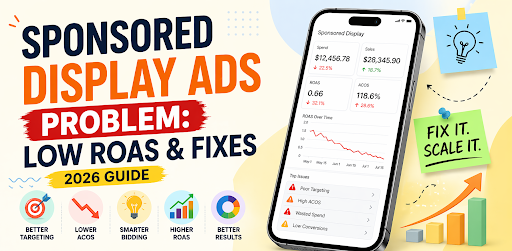
Refreshing your Amazon dashboard shouldn’t feel painful. Yet, there it is. Red numbers replacing what used to be profit. Spend climbs higher, while sales stay flat. It feels like money is disappearing with nothing coming back.
I have seen this happen often. In Amazon ads 2026, old strategies no longer work. You can’t just set campaigns and ignore them. Competition is sharper and more aggressive now.
That’s where a sponsored display ads problem begins. I notice many sellers treat these ads like search campaigns. But they are different. They depend on behavior, visuals, and targeting signals.
The good news is this can be fixed. I’ve seen small changes improve results fast. Stop guessing and follow the data. Fix the leaks, and your ads can become profitable again.
Why Are Amazon Sponsored Display Ads Getting Low ROAS?
Ads cannot fix a weak product page. Your ad brings visitors in, but the page decides if they stay or leave. If the experience feels off, they exit quickly and rarely return. I often see sellers rush into sponsored displays without checking the basics first.
Retail readiness comes first. Your price must be competitive, reviews should build trust, and images need to be clear and convincing.
Look at the Battery and Beauty niches. In Beauty, the “Value Before” ROAS sat at 0.94. That usually means the product page failed to convert. Success starts with conversion-focused listing optimization and a comprehensive Amazon SEO.
Every category sets its own standard. I notice battery buyers focus on specs and reliability, while Beauty shoppers look for results and emotion.
The Profit-Ready Conversion Standards
Success is not a guess. It comes down to strong Buy Box health and solid social proof. By focusing on key benchmarks, brands can move from struggling listings to profitable ones. Here’s how I measure that transformation once those standards are in place.
Metric | Before Optimization (Red Flag) | After Optimization (Success Goal) |
ACoS | > 30–40% | 18–22% (Solid) |
ROAS | < 2.0x | 6.0x – 8.0x (Top Tier) |
CVR | < 10% (Critical) | 15–20% (Healthy) |
CTR | < 0.3% | > 1.0% (Strong) |
Rating | < 4.0 Stars | 4.5+ Stars |
Buy Box Health | Under 90% | 98% – 100% |
Small, precise changes fix the foundation so you stop chasing cold leads. By analyzing low ROAS at the ASIN level, I cut waste and keep what works. The takeaway is simple: you don’t need a bigger budget to fix Sponsored Display ads. You need a smarter plan backed by the right data.
Real-World Case Study
Even strong brands can have hidden budget leaks. A battery brand looked solid on the surface, but an Amazon ad audit showed they were missing major profits. My team tightened their targeting and refreshed their creative with a results-focused PPC approach.
The Battery Niche Transformation
A leader in the Battery Niche had a decent setup but was missing out on significant profits. I used results-oriented Amazon PPC management services to tighten their targeting and refresh their creative approach.
Metric | Value Before | Value After | Result |
ACoS | 19% | 12% | 36% Decrease |
ROAS | 5.26 | 8.33 | 58% Increase |
CVR | 3.54% | 8.74% | 146% Increase |
Impressions | 994,821 | 1,199,980 | Higher Reach |
Small, targeted updates to their lifestyle images and lookback window helped them stop chasing cold leads. They shifted spend to shoppers ready to buy now. By analyzing low ROAS at the ASIN level, I cut waste and kept what worked.
The Rescue Mission: Beauty Niche Case Study
Some brands come in crisis mode. A beauty brand had an ACoS of 106.91%, losing money on every sale. I used campaign diagnostics to spot the “reach” trap and shifted them to a conversion-focused strategy.
Metric | Value Before | Value After | Result |
ACoS | 106.91% | 29.11% | 72% Decrease |
ROAS | 0.94 | 3.43 | 264% Increase |
CPC | $2.41 | $1.87 | Cheaper Clicks |
Impressions | 454,557 | 1,340,186 | 3x More Reach |
I turned things around with a smart launch strategy and a full listing overhaul. By the end, their ROAS had tripled. The lesson is simple: you don’t need a bigger budget to fix Sponsored Display ads. You need a better plan backed by the right data.
8 Common Sponsored Display Ads Mistakes That Kill ROAS
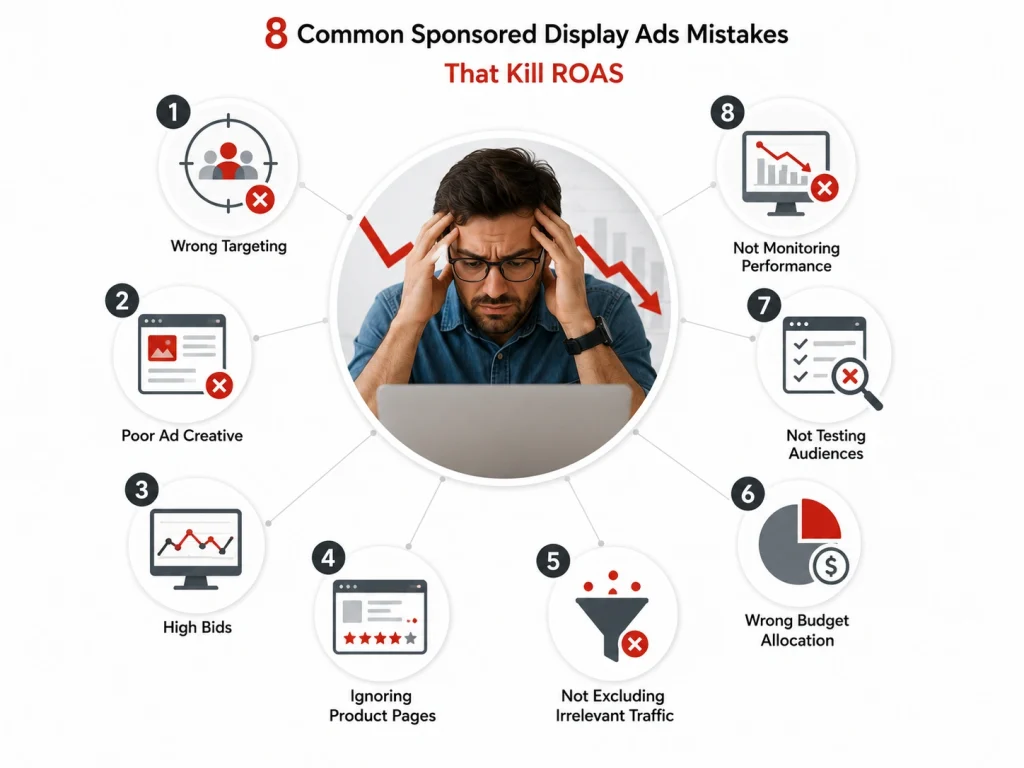
Finding the problem is only part of the process. I often see sellers with small leaks inside their campaigns that go unnoticed. These leaks slowly drain the budget over time, even when everything looks stable on the surface. From what I’ve seen across many audits, the same sponsored display ads problem keeps showing up again and again.
Spotting them is not enough. The real cost comes from ignoring them. Each mistake quietly reduces performance and eats into profit. Fixing these gaps early makes a big difference. Up next are the biggest ROAS killers and how they slowly take away your returns if left unchecked.
1. The "Big Competitor Trap" and Offensive Targeting
Choosing the wrong fight is the fastest way to lose money. Many sellers try to run offensive targeting against the biggest brand in their niche.
If you sell a new battery and you target a brand with 50,000 reviews, you will fail. The customer sees your ad, clicks it, and then realizes you aren’t the market leader. They go back to the giant.
The Strategic Penalty: You pay for the click, but the competitor gets the sale. This creates a “comparison bounce.” Your budget disappears while your competitor’s ranking goes up. In the Beauty niche, I saw a CTR of 0.30% because the brand was targeting giants it couldn’t beat.
Diagnosis: Check your targeting report. If you see Competitor ASINs with high spend and zero sales, you are in a trap. Use a strategic Amazon product launch to find smaller, weaker targets that you can actually beat on price or features.
2. Defaulting to vCPM (View-Based) Bidding
Amazon loves “impressions,” but you love sales. View-based bidding is often the default setting. This tells Amazon to show your ad to as many people as possible. It doesn’t care if they click or buy. It only cares about Viewable impressions. While this is great for big brands like Nike, it is a nightmare for small sellers.
The Strategic Penalty: You get massive reach but tiny sales. Your ACoS will look like a phone number. In the Beauty niche data, the ACoS was 106.91% because of Reach optimization. The brand was paying for eyeballs, not orders.
Diagnosis: Look at your bidding strategy. If it says “Optimize for Reach,” change it immediately. Switch to results-oriented PPC management to prioritize conversion over vanity metrics.
3. The "Similar to Advertised Products" Cannibalization
Amazon has a “smart” feature that shows your ads on products “similar” to yours. Often, this means your ad shows up on your own listings. This is Brand cannibalization. You are essentially paying Amazon for a customer who was already looking at your product.
The Strategic Penalty: You pay for a click that would have been a free organic sale. This eats your profit margin. It makes your Organic sales look like ad sales, which hides the true cost of your marketing.
Diagnosis: Run a Matched Target report. If your own ASINs appear in the target list, you are bidding against yourself. Use specialized Amazon account support to set up proper exclusions and keep your margins safe.
4. Creative Fatigue and "The Blob" Effect
Display ads are visual. If your ad looks like every other ad, it becomes “The Blob.” Customers stop seeing it. This is Creative fatigue. A simple product shot on a white background doesn’t stop the scroll on mobile.
The Strategic Penalty: Your Click-through rate drops below 0.20%. Amazon sees that no one likes your ad. Then, they raise your CPC to make up for the lack of clicks. You pay more for less attention.
Diagnosis: Compare your CTR to the Battery niche goal of >1.0%. If you are lagging, you need high-end product photography to create assets that actually pop.
5. Mismanaged Lookback Windows in Remarketing
Timing is everything in sales. If you show an ad for a battery to someone who bought one yesterday, you are wasting money. They don’t need another one yet. This is a failure of the Lookback window.
The Strategic Penalty: You spend money on “cold leads” or people who already solved their problem. Your ROAS stays low because the audience isn’t in a “buying mode.”
Diagnosis: Analyze your Views remarketing, and Purchase remarketing data. If you see high spend on old audiences with no sales, your window is too wide. Shorten it to 7 or 14 days for impulse buys.
6. Broad Category Targeting Without Refined Filters
Targeting a whole category is like shouting in a stadium. Most people aren’t listening. Category targeting is too broad for most budgets. If you sell premium, high-end batteries, you don’t want to show up for people looking for the cheapest option.
The Strategic Penalty: You get “curiosity clicks” from people who will never pay your price. Your conversion rate tanks. In our Beauty niche example, the CVR was a low 11.94% before I refined the targets.
Diagnosis: Check if you have Price filters or Rating refinements active. If not, you are casting too wide a net. Use Negative brand targeting to stay away from the discount shoppers.
7. High-Traffic, Low-Intent Placements
Not all ad spots are equal. Ads on the home page have high traffic but low intent. People are just browsing. Ads on a competitor’s checkout page have high intent. Low-intent traffic is a silent killer.
The Strategic Penalty: Your Placement reports show high spend on “Top of Page” or Off-Amazon ads with zero ROAS. You are paying for “discovery” when you should be paying for “decisions.”
Diagnosis: Pull your placement report. If off-site spend is high but sales are low, you can use Amazon DSP for Amazon to help you manage where your ads live.
8. Neglecting Negative Product Targeting
Some competitors are just too good to fight. If a competitor has a better price, better reviews, and faster shipping, stop showing your ad on their page. You will lose every time. Without Negative targeting, you keep donating clicks to them.
The Strategic Penalty: You subsidize your competitor’s growth. Every dollar you spend on their page is a lead you handed them. This is a massive ASIN exclusion failure.
Diagnosis: Find ASINs with 20+ clicks and 0 sales. These are your budget vampires. Kill them.
Struggling with Amazon Sponsored Display Ads? BrandsBro helps fix poor targeting, weak creatives, low CTR, and wasted ad spend with a clear optimization strategy.
We review your campaign, improve audience targeting, and help you get better results. Book a free discussion today.
Audience Deep Dive: Interests vs. Remarketing (The Intent Gap)
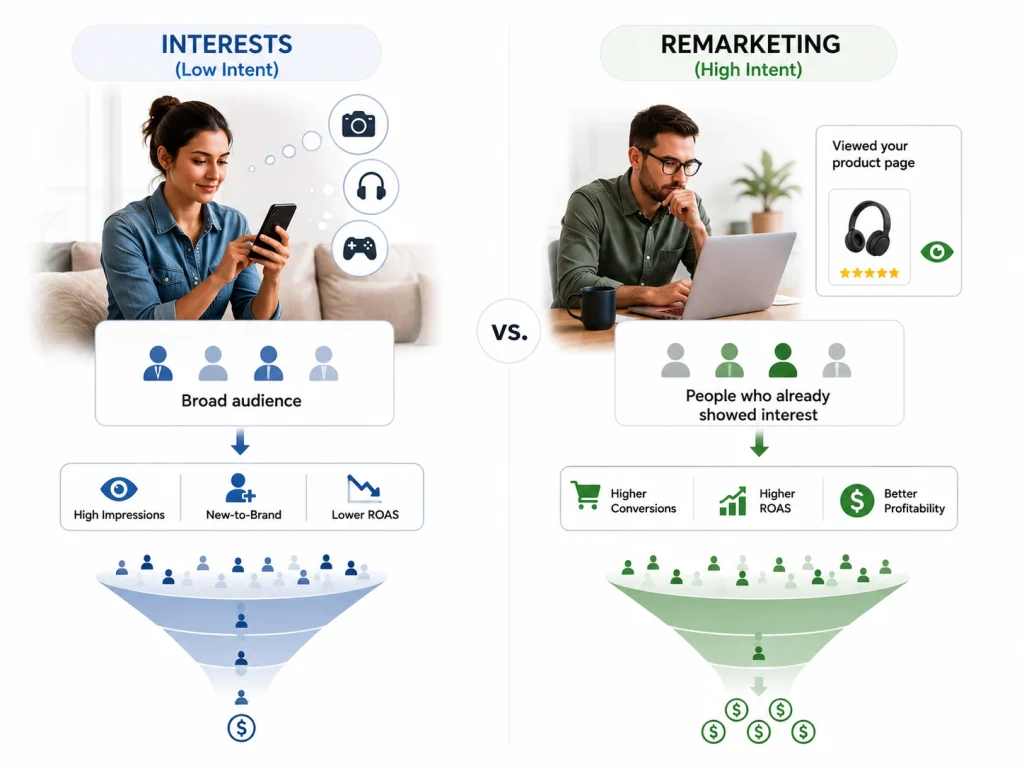
Choosing an audience in Sponsored Display comes down to two options: Contextual and Audiences. Most sellers fail because they don’t understand the Intent Gap between them. This is what I have seen for the past 11 years.
Audience targeting, especially Interests, is broad. Amazon looks at long-term behavior, sometimes over months, so you often reach people who are just browsing. Contextual targeting, like Product Targeting, is different because it reflects real-time intent. If someone is viewing a battery charger, intent is high. If they only have an interest in electronics, they are still early in the process.
From placement data, Audience Interests usually deliver lower ROAS. It can look strong because impressions are high and new-to-brand numbers increase, but it is often less profitable. For stronger performance, focus on Views Remarketing.
This targets people who already visited your product page but didn’t buy, making it the highest-intent audience available.
Placement Multipliers: Controlling the Real Estate
Amazon gives you different spots for your ads. You might land on the top of the search results or right under the “Add to Cart” button. You can actually tell Amazon how much you are willing to pay for each spot. These are called placement multipliers.
And for many, the “Product Detail Page” placement is the most valuable. This is where you steal a competitor’s customer at the very last second. But if you aren’t bidding enough, you’ll end up in the “Bottom of Search” where no one looks.
Using advanced ads management to set these multipliers ensures you win the best spots without overpaying for the bad ones.
Amazon placement optimization means checking your performance by location. If your detail page ads have a 5.0 ROAS and your search ads have a 1.0 ROAS, shift your budget.
Navigate to your campaign settings, find the “Adjust bids by placement” section, and increase your Detail Page bid by 20–30%.
How to Improve ROAS on Amazon Sponsored Display Ads
Now you know what is broken. Let’s talk about how to fix low ROAS right now. At Brand’s Bro, my team and I don’t wait for months to see improvement. We make immediate, surgical fixes that can shift performance within hours.
You don’t need to overhaul everything at once. You just need to move the right levers. Start with bidding logic. Most sellers find this is the fastest way to unlock profit.
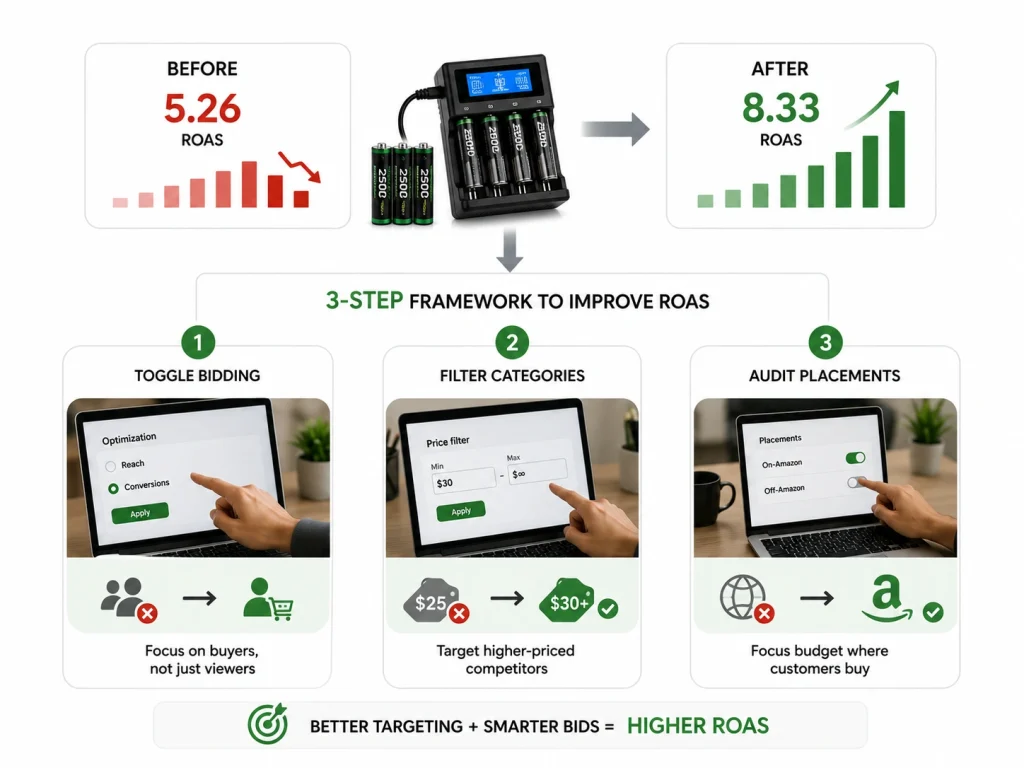
In our Battery Niche example, we pushed ROAS from 5.26 to 8.33 just by making precise bidding adjustments instead of broad changes.
The goal is efficiency, making every dollar work harder than the last. Using Amazon PPC 2026 tactics helps move you from guessing to knowing. Here’s the 3-step framework to stop the issues:
- Toggle Bidding: Go to your campaign settings. Change your optimization from “Reach” to “Conversions.” This forces Amazon to find buyers, not just viewers.
- Filter Categories: Apply price filters. If your product is $25, only target competitors priced at $30 or higher. This makes you the “better deal.”
- Audit Placements: Turn off “Off-Amazon” placements if your ROAS is below 1.0. Focus your money where the customers are already holding their credit cards.
Designing High-ROAS Visuals For Creative Fixes
You only have two seconds to grab a customer’s eye. If your ad is boring, you are invisible. Lifestyle imagery is the secret sauce of Sponsored Display. It shows the product in action. It tells a story.
But headlines matter too. Custom headlines should focus on the “Win.” Instead of saying “Long Lasting Battery,” try “Never Have a Dead Remote Again.” This is how you win the emotional battle.
And for the visual side, you need a pro touch. Customers trust high-quality images. Trust leads to clicks. Clicks lead to sales.
The "5-Second Rule" for Headlines
When you write headlines, keep it simple and make sure they pass the 5-Second Rule:
- Problem/Solution: “Batteries that actually last. Guaranteed.”
- Feature-First: “10-Year Shelf Life. Ready when you are.”
- Incentive: “Save 10% on the #1 Rated Battery.”
I found this simple shift. Using lifestyle photos showing the battery in real use, like toys or tools, can make ads clearer and double CTR.
Video for Sponsored Display: The 2026 Engagement King
Still using only static images? You are leaving money on the table. Amazon PPC 2026 is moving toward movement. Video in the Sponsored Display slot is currently one of the most underused tools in the Amazon arsenal. It breaks through “Ad Blindness” because the human eye is wired to track motion.
But here is the catch. You can’t just use a TV commercial. The first three seconds must show the product’s main benefit. If it’s a battery, show it powering a device instantly. If it’s beauty, show the texture of the cream.
Visual ad performance sky-rockets when you use “Subtitled Video.” Most people browse with the sound off. If your video doesn’t make sense without sound, it fails. Add bold, simple text overlays that highlight your Customer value proposition.
The "Double-Tap" Strategy: The Expert Fix for Funnel Synergy
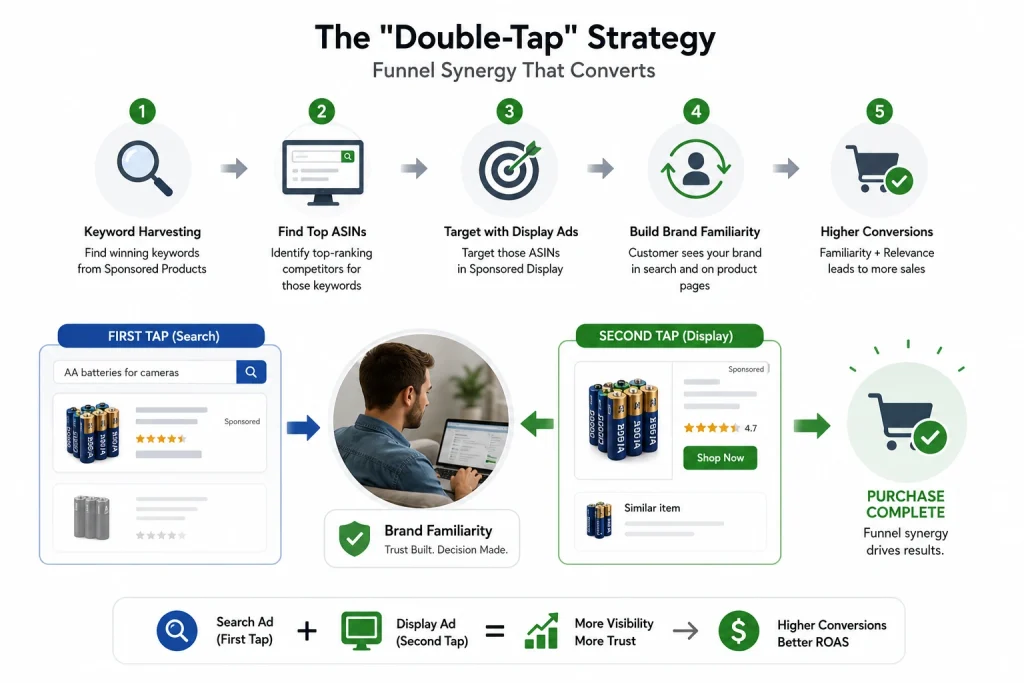
Your ads should talk to each other. Keyword harvesting from your Sponsored Products campaigns is a gold mine for Display targeting. If a keyword like “AA batteries for cameras” is winning in search, find the ASINs that rank for that term. Target them in your Display ads.
This creates Funnel synergy. You are hitting the customer from two sides. They see you in search, then they see you on the product page. It builds “Brand Familiarity.”
But the click is only the start. You need persuasive content for Amazon to close the sale once they land on your page. If the ad and the landing page match, the customer feels safe. Safe customers buy.
Advanced Optimization: Amazon Marketing Cloud (AMC) & Dayparting
Data is your unfair advantage. With Amazon Marketing Cloud, you can see the full customer journey and how many times a customer saw your ads before buying. I made use of this to understand the real value of my display spend instead of guessing.
Then there’s dayparting. Your ROAS isn’t the same at 2 PM as it is at 2 AM. In most niches, late-night clicks are just browsing. Not people who are ready to buy. They end up costing you money instead of driving sales.
Sample Dayparting Schedule (Battery Niche)
Here’s a simple dayparting schedule I use for the battery niche to adjust bids based on customer intent throughout the day.
Time Window | Intent Level | Action Required |
6 AM – 9 AM | High (Early Shoppers) | Increase Bids 10% |
10 AM – 4 PM | Average (Desktop Users) | Maintain Baseline |
6 PM – 10 PM | Peak (Mobile Home Use) | Increase Bids 25% |
12 AM – 5 AM | Very Low (Window Shoppers) | Decrease Bids 50% |
AMC data analysis proves that path-to-purchase is never a straight line. Often, a “low ROAS” display ad is the first touchpoint that leads to a high-profit search sale later. Don’t cut a campaign just because its direct ROAS is low; check the “Halo Effect” first.
The NTB and TACoS Framework (Measurement Beyond ROAS)
Don’t live and die by ROAS alone. A low ROAS can be okay if you are getting New-to-brand customers. These are people who have never bought from you before. They have “Lifetime Value.”
You also need to watch your Total ACOS (TACoS). This measures your ad spend against your total sales. If your TACoS is going down while your ad spend is steady, your ads are driving organic growth. That is the ultimate win.
Look at our Beauty niche success. The ROAS went from 0.94 to 3.43. But the real win was the ACoS dropping from 106% to 29%. I made the brand profitable again. I did this by driving traffic through branded storefront designs that encouraged people to purchase multiple items.
Why Are My Amazon Sponsored Display Ads Not Showing?
Amazon Sponsored Display ads may not show if the campaign is inactive, under review, out of budget, or blocked by product eligibility issues. Before changing bids or targeting, first check the basic campaign status. Many advertisers waste time optimizing when the real issue is simply a paused campaign, ended schedule, or unavailable product.
Another common reason is low bids. Sponsored Display ads compete for placements across Amazon and partner inventory. If your bid is too low compared with competitors, your campaign may receive very few impressions or no delivery at all. This is especially common in competitive categories.
Your product detail page can also affect ad visibility. If the product is out of stock, missing the Buy Box, has poor retail readiness, or violates Amazon advertising rules, Sponsored Display ads may not serve properly. A weak listing can limit both ad delivery and conversion.
Targeting can also be too narrow. If you only target a small group of ASINs, a limited audience, or low-traffic categories, Amazon may not find enough shoppers to show your ad. To fix this, test broader contextual targeting, increase bids, review campaign status, and confirm the product is eligible.
Sponsored Display CPC vs CPM: Which One Should You Use?
Sponsored Display CPC means cost per click. You pay only when a shopper clicks your ad. This option is usually better when your goal is sales, traffic, or product page visits. If you want measurable performance and direct conversions, CPC is the safer starting point.
Sponsored Display vCPM means viewable cost per thousand impressions. You pay based on ad views, not clicks. This works better for brand awareness, reach, retargeting, and upper-funnel campaigns where the goal is visibility rather than immediate sales.
For most Amazon sellers, CPC is better for product targeting, competitor ASIN targeting, and remarketing campaigns focused on ROAS. It gives you clearer control because spend is tied to shopper action. If clicks are expensive but conversion rate is strong, CPC can still work well.
Use vCPM when you already understand your audience and want to stay visible across the buying journey. However, vCPM can waste budget if your creative is weak or your audience is too broad. If you are new to Sponsored Display, start with CPC, study the data, then test vCPM for awareness campaigns.
How to Read Sponsored Display Reports Before Making Changes
Before changing Sponsored Display campaigns, read the reports properly. Do not pause campaigns only because ACOS looks high after a few clicks. Look at impressions, clicks, CTR, CPC, spend, sales, conversion rate, ROAS, and new-to-brand data together. One metric alone can mislead you.
If impressions are low, the problem is usually delivery. Check bids, budget, audience size, product eligibility, and targeting. If impressions are high but clicks are low, the problem is usually creative, placement, audience match, or product image appeal.
If clicks are high but sales are low, the problem is usually the listing or offer. Review your product price, reviews, images, title, coupon, Buy Box, delivery promise, and competitor alternatives. Sponsored Display cannot fix a weak product page.
Use reports to separate campaign problems from listing problems. A low CTR means shoppers are not interested in the ad. A low conversion rate means shoppers clicked but were not convinced to buy. Once you understand the real issue, you can adjust bids, targeting, creative, or product detail page with less guesswork.
Frequently Asked Questions (FAQs)
You are likely tired of second-guessing every choice in your dashboard. It is exhausting to watch your hard-earned profit vanish into a black hole of clicks. You deserve a clear path to growth without the constant fear of losing money. Let’s solve those doubts.
vCPM bidding prioritizes reach over direct sales. This means you pay for views, not clicks. If your goal is immediate profit, switch to CPC bidding. This ensures you only pay when a shopper shows real interest. It stops the silent budget bleed in your account.
Defensive targeting protects your space, but it can lead to brand cannibalization. You might pay for a click from a customer who was already buying. Use this strategy sparingly. Focus on cross-selling related items rather than bidding on the exact same product you are advertising.
Low CTR usually means your creative is suffering from ad blindness. Standard white-background images often fail in display placements. Use lifestyle imagery to stand out. A high-contrast visual stops the scroll. It forces the shopper to look at your offer instead of a competitor’s price.
Audit your reports for ASINs that eat your budget without making sales. Add these to your negative targeting list. This prevents your ad from appearing on pages where you cannot win. It is the fastest way to prune waste and save your precious ad spend.
For most products, a 7 or 14-day lookback window works best. Longer windows often waste money on shoppers who have already bought elsewhere. Shorter windows focus your spend on people who are still in the buying mood. This keeps your conversion rates high and healthy.
Don’t compare display to search. A solid ROAS for Sponsored Display usually sits between 2.5 and 4.0. Because these ads find shoppers earlier, they convert lower. If yours is under 2.0, you have a targeting leak. Aim for a 3.0 to maintain healthy profit growth.
Ready to Win? Get Your Free Audit & Roadmap
Amazon PPC in 2026 is not about spending more. That usually goes wrong quickly. Spend rises, results stay flat, and suddenly the account feels harder to control than it should.
What stands out is how often the simple fixes get skipped. The accounts that recover are not the ones doing complex tricks. They are the ones that stick to basics and repeat them until things stabilize.
Cut wasted ASINs first. Fix weak targeting next. Tighten bids where money is leaking. Improve creatives so clicks are actually worth paying for. Then keep an eye on TACoS, since it quietly shows the real performance underneath everything else.
If the terms feel too complicated, I can help you take care of it end-to-end. A sponsored display ads problem does not need overthinking. It needs clear steps and steady execution.
