
You built something real. A product people want. A service worth recommending. But if someone searches for it in your city and cannot find you, none of that matters. The sale goes to whoever shows up first.
That is how local search works in 2026. The top three results on Google Maps collect the calls, the bookings, and the walk-ins. Below those three, click rates drop to near zero. A buyer who is ready to spend right now picks from the top. Only the top.
We have watched this play out across hundreds of businesses in the USA, Canada, the UK, and Australia. Local search rankings are not abstract metrics. They are phone calls, walk-ins, and revenue walking through the door.
At Brand’s Bro, we have spent over 11 years building local and regional visibility for businesses that depend on being found. Our team has run local SEO campaigns for more than 350 clients, from single-location retailers to multi-site brands competing across four countries.
We have managed paid search budgets exceeding $150 million in total ad spend. That volume, running alongside our organic local work, gives us a data set most agencies never see.
Our client results speak for themselves. A cleaning company in the USA came to us with an inconsistent citation profile and a Google Business Profile that had barely been touched since it was claimed. Their NAP data was mismatched across dozens of directories. No review strategy existed.
We fixed the foundation, rebuilt the citation structure, and launched a focused local SEO strategy. Within four months, their map pack visibility jumped by 312%. Monthly call volume doubled.
A law firm in the USA had a similar gap. Their local search presence was thin, and their GBP categories were wrong. After rebuilding their local SEO stack and launching a review generation system, they moved from page two into the top-three map results. New customer inquiries rose 178% in three months.
These outcomes did not come from guesswork. They came from using the best local SEO tools and knowing how to deploy them as a connected strategy.
In this guide, we share the 11 best local SEO tools we have tested across real client campaigns. Some are free. Some are paid. All of them have moved rankings in the real world.
We evaluated each tool on six criteria:
- Rank tracking accuracy for local map pack positions
- Google Business Profile integration and management capability
- Citation building and NAP consistency management
- Review monitoring and reputation management features
- Ease of use and reporting quality
- Pricing and value for different business sizes
What Is a Local SEO Tool?
A local SEO tool is software that helps businesses rank higher locally. It covers Google Maps and the local pack. These platforms make your business visible when someone nearby searches for your services.
Tools for local SEO focus on three signals that matter most locally: proximity, relevance, and prominence. They manage what Google weighs when choosing which businesses to display.
The core capabilities these tools address are:
- Google Business Profile management. Your GBP controls how your business appears in the local pack. Claiming, optimizing, and keeping it active matter most for local search visibility.
- Citation building and NAP consistency. Your business name, address, and phone number must match across all directories. Any mismatch weakens the trust signal Google uses to rank you.
- Local rank tracking. You need to see your Google Maps ranking at the zip-code level. A broad city average is not enough.
- Review management. Consistent positive reviews are both a ranking factor and a conversion driver. Managing review generation and response at scale requires a dedicated tool.
- Localized content support. Tools that help you find the geographic keywords your customers search for.
Any business with a physical location depends on local search visibility. Retailers, law firms, healthcare providers, and franchise brands all compete in this space. The right platforms turn that visibility into a measurable growth channel. This applies to tools for local service SEO businesses.
Why Local SEO Tools Matter More in 2026
Local SEO tools matter more in 2026 than ever before. AI-driven search engines like Google Gemini and ChatGPT now favor local, conversational queries. Brands without strong local signals do not show up in those results.
Here are five reasons the stakes are higher now.
Conversational AI search has changed discovery. People no longer just type “dentist Chicago.” They ask full questions. Google’s AI pulls together business profile data, review sentiment, and citation signals. Traditional broad SEO alone will not place you in those results.
The local pack still captures the highest-intent traffic. More than 93% of local searches trigger the Google Local Pack. Those top-three map results attract roughly 42% of all clicks on the page. Businesses outside the pack are largely invisible to buyers ready to act.
Generic city-plus-service pages no longer rank. Google now identifies and discounts thin, templated local content. The best local SEO tools help businesses research hyper-local keywords. They also reveal how nearby competitors structure their content.
Reviews have become a major ranking factor. A steady stream of authentic reviews signals trust to search algorithms. Managing review generation and response manually does not scale. Dedicated tools make this process systematic.
Local searches convert at a far higher rate. Close to 50% of mobile searchers visit a business within 24 hours of a local search. Up to 80% of local searches end in a transaction. That conversion rate makes local search one of the highest-ROI channels available.
What Should You Look for in a Local SEO Tool?
SEO tools for local SEO in the USA needs to cover five things well. Those are Google Business Profile management, local rank tracking, review monitoring, citation consistency, and competitor reporting. Missing any one of these leaves a gap that nearby competitors will exploit.
The five capabilities that matter most are:
- GBP integration. The tool needs to connect directly to your Google Business Profile. It should manage hours, posts, photos, and categories across all locations.
- Local rank tracking. A good tool tracks keyword performance at the zip-code or neighborhood level. This shows you where your actual visibility gaps are.
- Review management. A centralized dashboard helps you monitor and respond to reviews in one place. This is the only way to manage reputation at scale.
- Citation management. Automated detection and correction of NAP inconsistencies across major directories. Inconsistent data is one of the most common reasons local rankings stall.
- Competitor and analytics reporting. Data showing how your local search performance compares to nearby competitors. Without this context, it is hard to know whether your rankings are improving.
Beyond features, the right tool also depends on your scale. A single-location business needs different capabilities than a 30-location franchise brand. The tools in this guide each solve specific, real problems across these use cases.
Quick Comparison: 11 Best Local SEO Tools at a Glance
The best local SEO tools become clearer when you see the full picture side by side. Before going deep on each one, here is a summary of the key data points.
Tool | Starting Price | Ideal For | Top Feature | Our Rating |
Free | All local businesses | GBP management + Insights | ★★★★★ | |
$39/month | Agencies and multi-location brands | Citations + reputation management | ★★★★★ | |
~$30/month (add-on) | Teams using Semrush for organic SEO | Directory sync + map tracking | ★★★★★ | |
$24.99/month | Geo-grid map pack tracking | Geographic rank visualization | ★★★★☆ | |
Free / $33/month | Citation research and building | Citation finder + competitor comparison | ★★★★☆ | |
$199/yr | Enterprise multi-location brands | Real-time knowledge graph sync | ★★★★☆ | |
$99/month | Keyword research + local content strategy | Local keyword data + backlink analysis | ★★★★☆ | |
$39/month | Small businesses focused on GBP growth | GBP task-based optimization | ★★★★☆ | |
$16/month | Entry-level citation distribution | Listing distribution + duplicate detection | ★★★☆☆ | |
$299/month | Review-first businesses | Review generation across 200+ platforms | ★★★★☆ | |
$39/month | Budget geo-grid tracking with scheduling | Grid tracking + GBP post scheduling | ★★★★☆ |
Each tool below was evaluated on real client campaigns. These are not based on feature-page marketing claims. Here is a quick scan before we go deep:
- Google Business Profile – the essential free foundation for every local business
- BrightLocal – best all-in-one local SEO tool for agencies and multi-location brands
- Semrush Local – best for combining traditional SEO with local SEO in one platform
- Local Falcon – best for visual geo-grid rank tracking on Google Maps
- Whitespark – best for citation building and citation gap analysis
- Yext – best for enterprise-scale knowledge graph and directory management
- Ahrefs – best for local keyword research and competitive backlink analysis
- Localo – best local SEO tool for small businesses focused on GBP performance
- Moz Local – best entry-level citation distribution tool
- BirdEye – best for review generation and reputation management at scale
- Local Viking – best value geo-grid tracker with GBP post scheduling
11 Best Local SEO Tools for 2026
The right local SEO tool depends on what problem you need to solve first. The tools below are ranked by practical impact. Here is what each one does and who it is for.
1. Google Business Profile - The Non-Negotiable Free Foundation
Price: Free | Ideal for: Every local business with a physical location or a defined service area
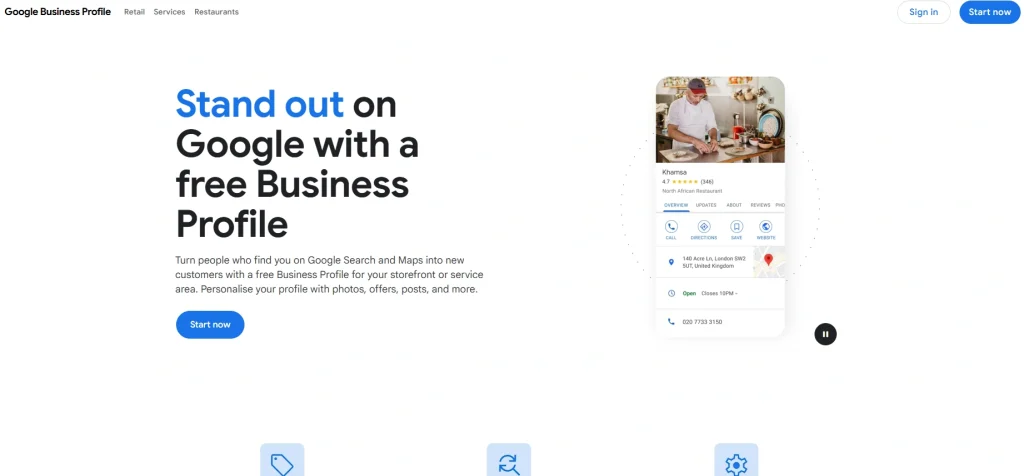
Google Business Profile is the most important free local SEO tool available. It is the direct connection between your business and Google’s local results.
Quick Snapshot
No tool on this list matters until your GBP is fully optimized. Your profile controls your business name, address, hours, categories, photos, and reviews. It feeds the signals Google uses to decide who shows up in the top three. GBP is free, powerful, and the foundation every other tool builds on.
Key Features
- Profile management and real-time updates. You can update hours, add photos, publish posts, and respond to reviews from one dashboard. Changes appear on Google Maps within hours of submission.
- Built-in Insights for performance tracking. GBP Insights shows how many people searched for your business and how they found you. It also tracks what actions they took. This is first-party data that no third-party tool can replicate.
- Review collection and response tools. Your team can request reviews and respond to feedback directly from the profile. Reviews directly influence your map pack ranking.
- Google Posts for direct content publishing. Offers, events, and updates can be published as posts that appear on your listing. Active posting is a small but consistent ranking signal.
- Q&A section management. Customers ask questions on your profile publicly. Managing this section shapes how potential buyers understand your business.
What Works Well
- Free forever with no subscription or licensing cost. No other tool delivers more local search value at zero cost.
- Direct connection to Google’s ranking algorithm. Your GBP is a first-party signal that Google reads directly. Its completeness, accuracy, and activity level are strong ranking inputs.
- Review and Q&A management without a separate tool. Basic reputation management on Google does not require a paid platform.
- Insights data shows real customer behavior patterns. Keyword searches, direction requests, and call actions reveal what is actually driving interest.
Where It Falls Short
- No competitor tracking or ranking benchmarks. GBP Insights shows your own performance but provides no visibility into competitor activity.
- Limited rank tracking detail. You cannot track your local pack position by keyword or zip code through GBP alone.
- No citation management across other directories. GBP does not monitor your business data across Yelp, Yellow Pages, or Tripadvisor.
Our Take
GBP is not optional. It is the foundation. Every other local SEO tool on this list works better when your GBP is active.
2. BrightLocal - Best All-in-One Local SEO Platform
Price: From $39/month | Ideal for: Local SEO agencies, multi-location businesses, brands that need citation and reputation management in one place
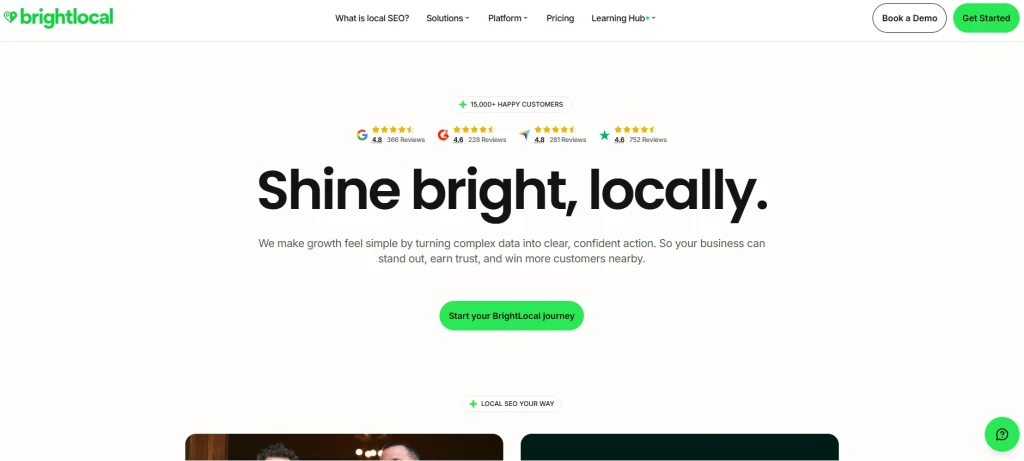
BrightLocal is the most complete platform for running a full local SEO program. It handles citation tracking, review monitoring, rank tracking, GBP auditing, and client reporting. All from one dashboard.
Quick Snapshot
BrightLocal was built for local SEO specifically. That separates it from broader platforms that add local features as an afterthought. Everything in the platform was designed around the realities of local search. If you manage local SEO for multiple locations, this is the closest one-stop solution available.
Key Features
- Local Search Rank Tracker with city and zip-code precision. BrightLocal tracks your local pack, local finder, and organic rankings separately. This level of granularity is critical for understanding your exact visibility gaps.
- Citation Tracker and NAP audit tool. The platform scans hundreds of directories for your business listings. It flags where your NAP data is missing or inconsistent. The platform also provides specific recommendations for correcting inconsistencies.
- Reputation Manager for centralized review monitoring. Reviews from Google, Yelp, Facebook, and other platforms appear in a single dashboard. Your team can respond to reviews without leaving BrightLocal.
- Google Business Profile audit with optimization scoring. BrightLocal grades your GBP against best practices and surfaces specific items to fix. This is particularly useful for auditing under-optimized profiles.
- White-label reporting for agencies. Agency users generate branded reports with custom logos, messaging, and scheduling. This is one of the strongest agency features available in any local SEO tool.
The Strengths
- Purpose-built for local SEO without feature bloat. Every capability in BrightLocal has a clear local SEO application. You are not paying for tools you will not use.
- Citation management depth is unmatched at this price. The Citation Tracker surfaces NAP inconsistencies across a large directory database. The audit detail is more thorough than general SEO platforms offer.
- Reputation management at scale without a separate tool. For agencies managing 10 or 20 client profiles, the review dashboard saves significant time.
- White-label reporting is the strongest in its category. Branded client reports are data-rich, visually clean, and easy to automate.
The Limitations
- No backlink analysis or organic keyword research tools. You still need Ahrefs or Semrush for keyword research and link analysis.
- The interface has a learning curve for new users. The platform is feature-dense, and understanding how all the tools connect takes time during onboarding.
- Citation building is a pay-as-you-go add-on. Building new citations through BrightLocal costs extra per listing beyond the subscription.
Our Take
BrightLocal is the strongest single platform for running a complete local SEO operation. It is our default recommendation for agencies and multi-location businesses.
3. Semrush Local - Best for Combining Local and Organic SEO
Price: From ~$30/month as an add-on | Ideal for: Teams already using Semrush for organic SEO who want to add local tracking and citation management
Semrush Local brings listing management, local rank tracking, and review monitoring into the Semrush ecosystem. The biggest advantage is having local and organic SEO data in one place.
This is especially useful for brands running Shopify SEO, WooCommerce SEO, or BigCommerce SEO campaigns. Semrush Local lets you see how your local rankings connect to your broader keyword strategy. You do not need to buy a second platform to do it.
Quick Snapshot
If your team already uses Semrush for organic SEO, this add-on makes sense. It costs less than buying a second platform with overlapping features.
Key Features
- Listing Management that syncs to 150+ directories automatically. Semrush Local distributes and updates your business information across major directories. This reduces NAP inconsistencies at scale without manual submissions.
- Map Rank Tracker for local pack monitoring. You can track keywords at the city or zip-code level. See your map pack position change over time.
- Review Management dashboard for Google and Facebook. Aggregate and respond to reviews from both platforms in one interface. Monitoring happens without logging into separate platforms.
- Competitive analysis using Semrush’s existing keyword database. Compare your local rankings against competitors using the same research tools. You already use these for organic campaigns.
- GBP audit and optimization recommendations. Semrush Local scans your profile and flags specific improvements.
Where It Shines
- Combines local and organic insights without a second platform. All the data sits in one place. This reduces context-switching and improves strategic alignment.
- Automated listing distribution to 150+ directories. Manual submission across this many platforms would take days.
- Competitive intelligence at the local keyword level. Identifying which local keywords competitors rank for is a direct content strategy input.
- Lower effective cost for existing Semrush users. The add-on costs far less than buying a dedicated local SEO tool separately.
The Trade-offs
- Local features are secondary to the core platform. BrightLocal has more depth in citation management and local-specific reporting.
- Base Semrush subscription required. You cannot access Semrush Local without a paid Semrush plan. This raises the effective cost significantly for businesses that only need local tools.
- Review management covers fewer platforms than BrightLocal. Semrush Local pulls from Google and Facebook only.
Our Take
Semrush Local is the best option for teams already running organic SEO campaigns through Semrush. For businesses needing only local SEO tools, BrightLocal offers more depth at a lower cost.
4. Local Falcon - Best for Visual Geo-Grid Rank Tracking
Price: From $24.99/month | Ideal for: Businesses and agencies that need precise, visual Google Maps rank tracking by neighborhood or zip code
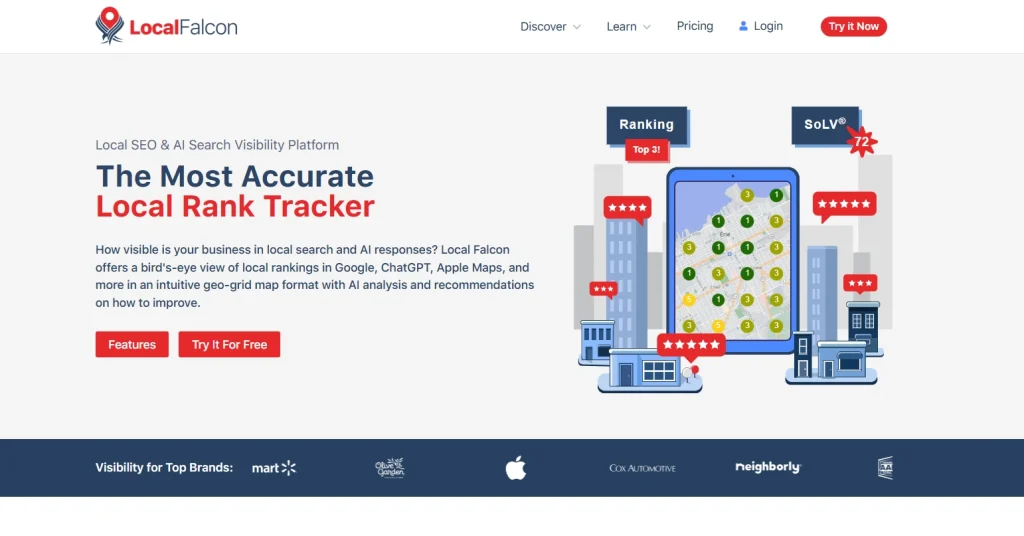
Local Falcon is the leading geo-grid rank tracking tool for local SEO. It shows exactly where your business ranks across a city, block by block. You get a visual picture of your entire local search footprint.
Quick Snapshot
Local Falcon answers a question that most rank trackers cannot answer. Where exactly on the map does your business show up? Traditional rank trackers give you one ranking for a keyword in a city. Local Falcon gives you a heat map of rankings across dozens of geographic points. A business might rank first within a mile of its location. It might not appear at all three miles away. Local Falcon reveals that gap.
Key Features
- Geo-grid scanning that shows rankings at specific map coordinates. Local Falcon places a grid over your target area. It checks your ranking at each grid point. The visual heat map is immediately clear and actionable.
- Competitor geo-grid comparison. Run the same grid scan against a competitor. See where they outrank you across the map.
- Historical data tracking for measuring improvement. Local Falcon saves past scan results. You can compare your current footprint to previous periods.
- Multi-location tracking for agency workflows. Agency users can manage scans across many client profiles from one account.
- Automated scan scheduling. Set scans to run on a regular cadence and receive automated reports. This removes the need for manual rank checks.
What Works Well
- The most visual, intuitive rank tracking tool for Google Maps. The geo-grid heat map communicates ranking performance at a glance. Even clients unfamiliar with SEO can read it instantly.
- Reveals ranking gaps that traditional trackers miss. Ranking first in the city center but disappearing outside that radius is a common problem. Local Falcon surfaces it.
- Competitor scanning adds strategic depth. Knowing a competitor ranks strongly in a specific zip code helps you prioritize. You can then focus your citation building and content investment in that zone.
- Automated scheduling saves time for agencies managing many accounts. Running weekly scans manually across 15 client profiles is not scalable. Automation makes it manageable.
Where It Falls Short
- No citation management or review tools. Local Falcon is a rank tracker only. It does not help with directory listings or NAP consistency.
- Credit-based pricing can add up at higher scan volumes. Heavy users managing many locations can burn through credits fast.
- No organic rank tracking. Local Falcon tracks Google Maps positions only. Organic keyword rankings still require a separate too
Our Take
Local Falcon is the best tool for understanding your Google Maps rankings locally. It works best alongside BrightLocal or Semrush Local in a complete local SEO stack.
5. Whitespark - Best for Citation Building and Citation Audits
Price: Free tools available; paid plans from $33/month | Ideal for: Businesses that need to build or clean up citations, agencies doing citation work for clients
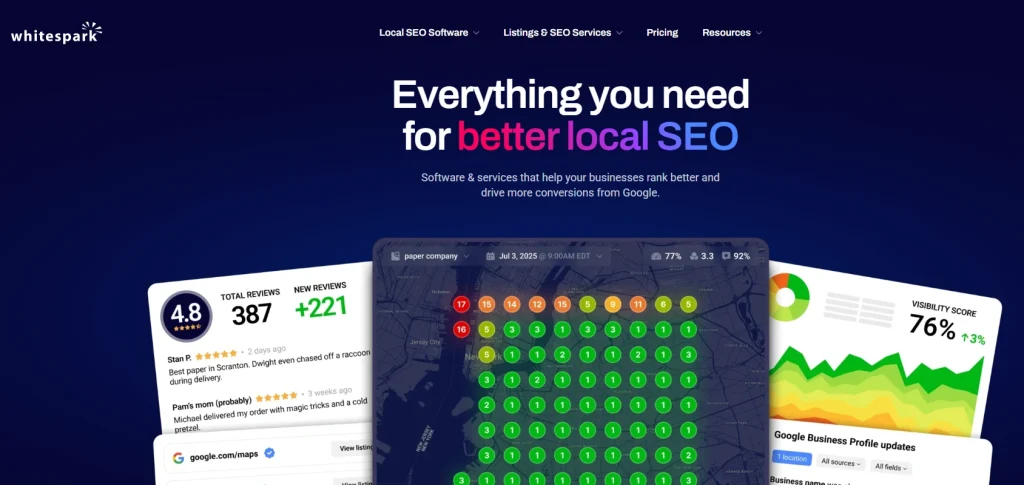
Whitespark is the gold standard for local citation research, building, and auditing. It has been used by local SEO professionals for over a decade. Its Citation Finder remains the most thorough tool in the industry for this specific task.
Quick Snapshot
Whitespark built its reputation by solving the citation problem better than anyone else. Its Local Citation Finder identifies which directories your competitors appear in that you do not. For any business with inconsistent citation data, Whitespark is the first tool to bring in.
Key Features
- Local Citation Finder with direct competitor comparison. You input your business and a competitor. The tool generates a list of directories where they have citations that you are missing. This drives citation strategy rather than guesswork.
- Citation building service with manual directory submissions. Whitespark’s team builds citations on your behalf. Manual submissions are more accurate than automated tools that occasionally populate incorrect data.
- Reputation Builder for review generation campaigns. The platform includes tools for sending review requests via email and SMS. Review collection and citation management sit in the same platform.
- Local Rank Tracker for map pack and organic positions. Track your keyword positions in Google Maps, the local pack, and organic results. You can filter by city or zip code.
- Free Google Review Link Generator. A simple free tool that creates a direct link to your Google review submission form. This link can go in email signatures, invoices, and on your website.
What Works Well
- The most thorough citation research available for local SEO professionals. The Citation Finder’s database is one of the largest in the industry. Competitor comparison is particularly valuable in competitive markets.
- Manual citation building service offers accuracy over speed. Whitespark’s service reduces the risk of incorrect data entering directories.
- Free tools lower the barrier for small businesses. The review link generator and free citation searches deliver real value at zero cost.
- Review generation and citation management in one platform. Having two core local SEO functions together reduces the number of subscriptions needed.
Where It Falls Short
- The interface is older than competing platforms. Whitespark’s UI has not kept pace with BrightLocal or Semrush in design and user experience.
- Citation building is slower than automated tools. For businesses needing rapid large-scale citation distribution, platforms like Semrush Local or Yext are faster.
- Reporting is less polished than full-stack platforms. Agencies producing client reports typically need to supplement with a separate reporting tool.
Our Take
Whitespark is the best citation tool for local SEO professionals who need depth and accuracy. Pair it with BrightLocal for broader local SEO management.
6. Yext - Best for Enterprise-Scale Knowledge Graph Management
Price: From $199/year | Ideal for: Enterprise brands, franchise networks, and multi-location businesses managing dozens to hundreds of locations
Yext is an enterprise platform that manages business information across 200+ publisher websites. It does this through a single, centralized knowledge graph. It is designed for brands that need every location’s data updated in real time.
Quick Snapshot
Yext takes a different approach to citation management. Instead of submitting to directories, Yext maintains a live data connection to its publisher network. Update your hours in Yext and it pushes to Google, Bing, Apple Maps, and Yelp. For enterprise brands managing many locations, this is a significant operational advantage.
Key Features
- Knowledge graph that syncs to 200+ publishers in real time. Yext’s publisher network covers virtually every major directory and mapping service. Updates go live without waiting for manual approvals or slow crawl cycles.
- Location-specific landing page creation at scale. Yext can generate locally relevant landing pages for every business location. This helps enterprise brands build the local web presence needed for strong map rankings.
- Centralized review management across its publisher network. Businesses monitor and respond to reviews from supported platforms from one dashboard.
- Detailed analytics for local performance tracking. Yext tracks search impressions, clicks, direction requests, and customer calls across all locations. This all appears in one reporting view.
- AI-powered site search tools for large brand websites. These features help customers find the right location or product on your website. This supports conversion once local traffic arrives.
Top Advantages
- Real-time data sync to a massive publisher network. This is Yext’s primary advantage. For multi-location brands, having updates live across 200+ publishers within hours is a major advantage. It reduces the risk of outdated data hurting rankings.
- Centralized management of dozens of locations reduces human error. It also cuts the cost of keeping data current across the board.
- Locally-optimized landing pages at scale. Few tools generate location-specific pages as cleanly as Yext does for large brands.
- Enterprise-grade support and account management that smaller platforms do not offer.
Points to Watch
- Yext pushes your business information to dozens of obscure, low-traffic directories. Because search engines rarely crawl or index these hidden pages, they provide zero actual SEO value to your website.
- Publisher listings revert when you cancel. Yext maintains your listings through its live connection. When you stop paying, your data management reverts to whatever existed before. This creates platform dependency.
- Not the right tool for businesses with one to three locations. The automation and enterprise features that make Yext powerful are unnecessary for small local businesses.
Our Take
Yext is the right investment for enterprise brands and franchise networks managing many locations. For single-location businesses and small brands, the cost and complexity are not justified.
7. Ahrefs - Best for Local Keyword Research and Competitive Analysis
Price: From $99/month | Ideal for: Businesses and agencies that need deep keyword research, competitive backlink analysis, and local content strategy support
Ahrefs is not a dedicated local SEO tool. But it is one of the most powerful tools in any local SEO stack. It provides the keyword and competitive intelligence needed to build locally-relevant content that actually ranks.
For brands running Amazon SEO or Magento SEO campaigns, Ahrefs is often already part of the stack. Extending it into local keyword research adds value without adding a new platform to learn.
Quick Snapshot
Ahrefs excels at three things that feed directly into a strong local SEO strategy. First, finding what people in specific locations actually search for. Second, identifying what content competitors rank for locally. Third, analyzing the backlink profiles of top-ranking local businesses. If your local SEO roadmap includes content creation and link building, Ahrefs is essential.
Key Features
- Keywords Explorer with geographic filtering for local markets. You can search for keywords and filter results by country, state, or city. This surfaces what people in your target market actually search for locally.
- Site Explorer for competitive backlink analysis. Analyze any local competitor’s backlink profile. Identify which local websites, associations, or publications are linking to them.
- Content Gap analysis to find ranking opportunities. Ahrefs compares your site’s keyword rankings to competitors. It shows keywords that they rank for locally but you do not.
- Site Audit tool for technical SEO issues. The crawl surfaces technical problems like broken links, missing title tags, and duplicate content.
Rank Tracker for monitoring keyword positions over time. Track your local keywords and see how content changes affect your rankings. This also helps you measure whether link-building and citation work are improving rankings.
The Upsides
- Local keyword data at a depth most tools cannot match. Ahrefs’ keyword database is one of the largest available.
- Competitor backlink analysis reveals local link-building opportunities. Seeing that a competitor earns links from a local association or publication is actionable intelligence.
- Content Gap tool drives local content strategy. Finding keywords that competitors rank for locally reveals where to create new pages.
- Trusted globally for data quality and consistency. Ahrefs is one of the most reliable platforms for SEO data.
The Downsides
- No citation management or GBP integration. Ahrefs does not handle the local-specific tasks of directory listings and profile management.
- Higher starting price than most local-only tools. At $99/month, Ahrefs costs more than most tools on this list.
- Steeper learning curve than local-focused platforms. Small business owners without SEO experience may find it overwhelming at first.
Our Take
Ahrefs is the best tool on this list for local keyword research and competitive intelligence. Pair it with BrightLocal or Semrush Local to cover both strategy and local management.
8. Localo - Best Local SEO Tool for Small Businesses
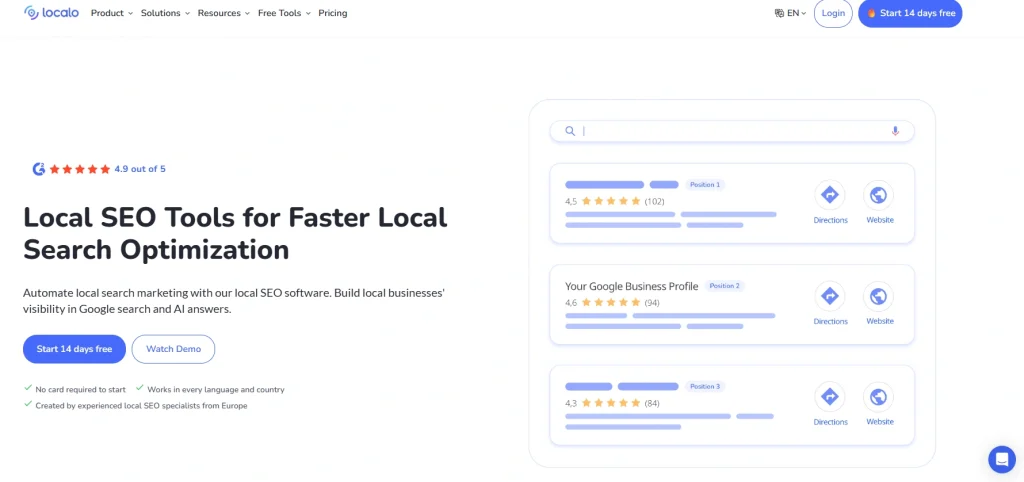
Price: From $39/month | Ideal for: Small business owners who want to improve their Google Maps ranking without deep technical SEO knowledge
Localo is designed for small business owners who want to rank higher on Google Maps. It focuses on GBP optimization and guides users through specific, daily improvements. No technical background is needed.
Quick Snapshot
Localo simplifies GBP optimization into a task-based workflow. The platform tells you what to do each day to improve your ranking. This makes it one of the most accessible local SEO tools for small businesses available. It is one of the fastest ways to see GBP improvements without hiring a consultant.
Key Features
- Daily task recommendations for GBP improvement. Localo generates a prioritized list of actions based on your current profile performance. Tasks include adding photos, publishing posts, requesting reviews, and updating business attributes.
- Local rank tracker for Google Maps visibility. The tracker shows your position in the local pack for target keywords. It tracks improvement over time against a clear baseline.
- GBP health score and audit report. Localo grades your profile and highlights specific elements that need attention. This helps improve your map pack ranking.
- Competitor monitoring for nearby businesses. You can see how your profile compares to competitors in the same area.
- AI-generated content suggestions for GBP posts. Localo uses AI to suggest post content based on your business type. This makes it easier to maintain an active profile without writing posts from scratch.
Clear Strengths
- Simple, task-based interface that non-SEO users can follow. Small business owners improve their local rankings by following the daily task list. No technical SEO knowledge needed.
- Best starting point for businesses with no existing local SEO strategy. If your GBP has been untouched since claiming, Localo is the clearest path forward.
- AI post suggestions reduce the time needed for GBP maintenance. Regular GBP posts are a ranking signal. Localo’s AI suggestions cut the time needed to keep the profile active.
- Affordable compared to most paid local SEO tools. At $39/month, Localo is one of the best-value options for small businesses.
Room to Grow
- Limited citation management functionality. Localo focuses on GBP optimization and does not handle citation building in depth. BrightLocal or Whitespark offer far more thorough NAP consistency management.
- Not built for agencies or multi-location management. Localo is designed for single-business use. Agency users managing multiple client accounts will find it insufficient for that workflow.
- Less data depth than enterprise platforms. The reporting in Localo is simpler than what BrightLocal or Semrush Local provides.
Our Take
Localo is the best starting point for small business owners focused on Google Maps ranking. It is practical, affordable, and genuinely useful as a local SEO tool for small businesses.
9. Moz Local - Best Entry-Level Citation Distribution Tool
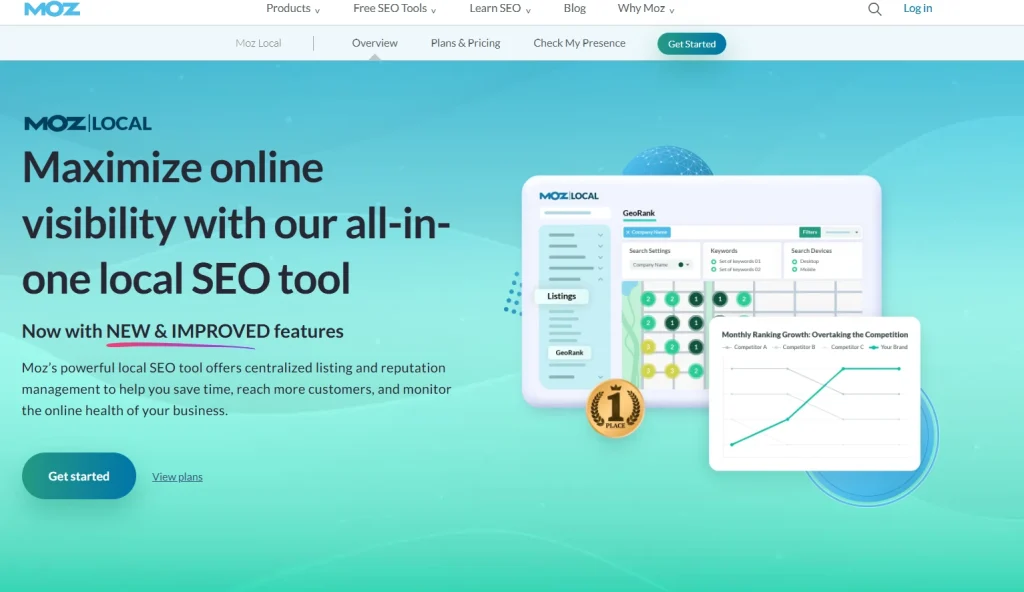
Price: From $16/month per location | Ideal for: Single-location small businesses that need basic citation distribution and listing management at a low price
Moz Local is the most affordable paid option for businesses that need structured citation management. It handles distribution to major directories with a simple interface for local listings.
Quick Snapshot
Moz Local is not the most feature-rich platform here. But it does the core job of citation distribution reliably. And it does it at a price that small businesses can justify. For brands just starting out, the $16/month entry point makes listing management accessible.
Key Features
- Listing distribution to major directories. Moz Local pushes your business information to Google, Facebook, Bing, Foursquare, and other platforms. This is the primary function of the tool.
- Duplicate listing detection and cleanup. The platform scans for duplicate or conflicting listings. Finding and removing these is something many small businesses overlook.
- Review monitoring dashboard for Google and Facebook. Reviews from both platforms appear in one interface. Basic review monitoring comes included without a separate subscription.
- Profile completeness score with recommendations. The platform grades how complete your listing is and surfaces specific items to fix.
- Basic analytics for listing performance tracking. Impression data and customer action tracking give you a useful view of listing performance.
Strong Points
- The most affordable paid citation management tool on this list. At $16/month per location, Moz Local is accessible to businesses with tight budgets.
- Simple interface with a low learning curve. Setup takes less than an hour, and ongoing management is minimal.
- Duplicate detection protects citation consistency automatically. Duplicate listings can hurt local rankings when ignored.
- Good gateway tool for businesses new to paid local SEO tools. It covers the basics well and builds familiarity with listing management.
Weak Points
- Less powerful than BrightLocal for agencies and multi-location businesses. Moz Local lacks the white-label features and citation management depth that agencies need.
- Review monitoring covers fewer platforms than competitors. Moz Local only monitors Google and Facebook. Businesses with a presence on Yelp or TripAdvisor need a more capable review tool.
- No geo-grid rank tracking. Moz Local does not show hyper-local map rankings by neighborhood or zip code.
Our Take
Moz Local is a reliable entry point for businesses that need citation management on a budget. Move to BrightLocal when your business scales or your local SEO needs become more complex.
10. BirdEye - Best for Review Generation and Reputation Management
Price: From $299/month | Ideal for: Businesses where online reputation directly drives revenue: retail, home appliances, fashion, and hospitality.
BirdEye is a dedicated reputation management and customer experience platform. It is built for businesses that need to generate reviews at scale. It manages feedback across many platforms and turns reviews into a conversion and ranking advantage.
Quick Snapshot
BirdEye goes beyond basic review monitoring. It automates asking customers for reviews across Google, Facebook, and 200+ other platforms. For businesses where review volume directly affects new customer acquisition, BirdEye is a meaningful investment.
Key Features
- Automated review generation across 200+ platforms. BirdEye sends review requests via SMS and email automatically after a customer interaction. This produces a steady, consistent stream of reviews without manual follow-up.
- Centralized review response dashboard. Reviews from every supported platform appear in one place. Your team responds to feedback without logging into Google, Yelp, Facebook, and other platforms separately.
- Competitive benchmarking against nearby businesses. BirdEye shows how your review volume, star rating, and response rate compare to competitors. This comparison is filtered by area and category.
- Customer messaging and survey tools. BirdEye includes tools to collect structured feedback through surveys and direct messaging channels.
- Sentiment analysis and review reporting. BirdEye analyzes review content to surface recurring themes, positive patterns, and potential service issues.
What It Does Well
- The best automated review generation system on this list. BirdEye’s automated request system is the most effective for generating a consistent flow of reviews.
- Covers more review platforms than any other tool here. With 200+ integrations, BirdEye reaches review sources that most other platforms miss.
- Competitive benchmarking adds strategic context. Knowing your review velocity relative to nearby competitors is directly actionable for local search strategy.
- Purpose-built for businesses where reviews are a revenue driver. Retail and fashion brands see a direct link between review volume and new customer acquisition.
What to Watch
- The starting price of $299/month is significantly higher than most local SEO tools. BirdEye is not a budget option and requires a clear ROI model.
- No citation management or local rank tracking. BirdEye is a reputation platform. You still need BrightLocal, Whitespark, or a similar tool to handle citations and rankings.
- The messaging and survey tools are useful for customer service but not for local SEO. Businesses paying only for review management are buying more than they need.
Our Take
BirdEye is the best choice for businesses where review generation is a growth priority. Pair it with a citation tool to cover the full local SEO spectrum.
11. Local Viking - Best Value Geo-Grid Tracker with GBP Scheduling
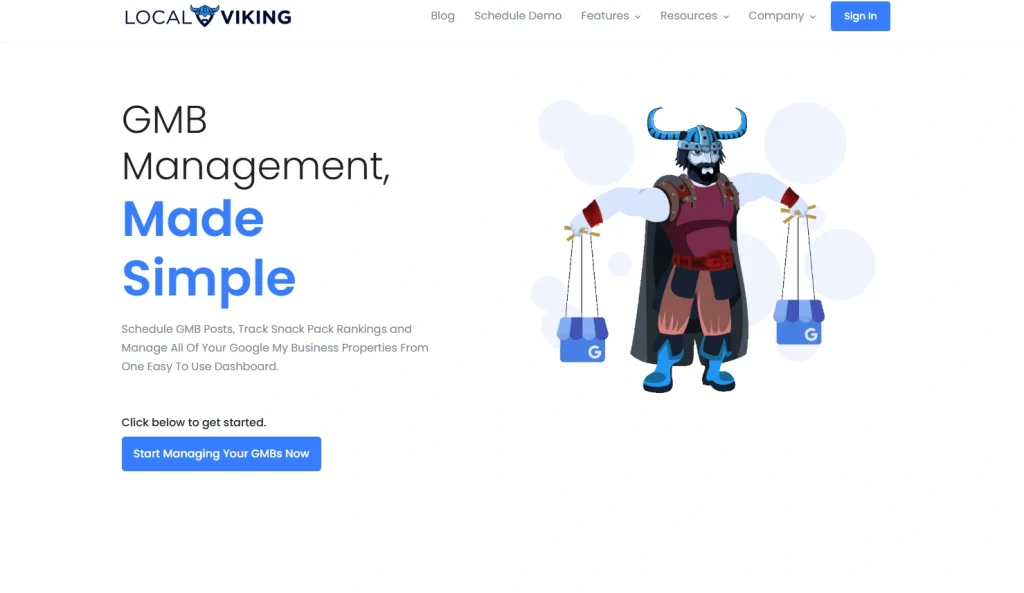
Price: From $39/month | Ideal for: Agencies and small businesses that need affordable geo-grid rank tracking combined with GBP post scheduling
Local Viking is a geo-grid rank tracking and GBP management tool. It combines map pack position tracking with GBP post scheduling. This makes it a practical two-in-one tool for budget-conscious businesses.
Quick Snapshot
Local Viking provides geo-grid visibility into Google Maps rankings at an accessible price point. The built-in GBP post scheduler adds value that Local Falcon does not offer. This makes Local Viking more well-rounded for businesses that want rank tracking and content management together.
Key Features
- Geo-grid rank tracking for Google Maps visualization. Like Local Falcon, Local Viking shows your map rankings across a geographic grid of your target area. The heat map output reveals where your business is visible and where it is not.
- GBP post scheduler for content planning. You can schedule Google Business Profile posts in advance. This keeps your profile active without daily manual attention. This is a meaningful differentiator over Local Falcon.
- Agency-friendly dashboard for multi-client management. The platform supports multiple client profiles from one account. This makes it practical for local SEO agencies working with small business clients.
- Historical scan data for tracking progress over time. Past grid scans are saved so you can compare your current footprint to previous periods. This helps demonstrate improvement to clients.
- Competitor geo-grid scanning. You can run grid scans against competitor profiles. This shows where they have stronger map visibility.
Clear Wins
- Comparable geo-grid tracking with added GBP post-scheduling. The $39/month starting price is one of the most affordable geo-grid options available.
- GBP post scheduling is a real differentiator over Local Falcon. Having rank tracking and content scheduling in the same platform saves on tool costs.
- Good fit for agencies managing multiple small business clients. The multi-client dashboard at this price makes Local Viking practical for local SEO freelancers.
- Historical data enables meaningful progress reporting. Consistent scan data over time shows whether your Google Maps visibility is actually moving.
Clear Limits
- No citation management or review monitoring. Local Viking handles rank tracking and scheduling only. BrightLocal or a similar platform is still needed for citations and reputation management.
- Less polished interface than Local Falcon. Local Viking is functional, but its user experience is not as refined as Local Falcon’s.
- Businesses that need a single all-in-one tool will need complementary platforms alongside it.
Our Take
Local Viking is the best value geo-grid tracker on this list. Combine it with BrightLocal or Whitespark to build a cost-effective local SEO stack.
Free Local SEO Tools vs Paid Local SEO Tools
Free local SEO tools are great for solo businesses and tight budgets. They handle baseline tasks well and get your business on the map for free. Paid local SEO tools are built for scale and competitive markets. They automate complex tasks, provide granular rank tracking, and manage large directory listings.
Here is how both approaches compare across the capabilities that matter most:
Capability | Free Tools | Paid Tools |
Rank Tracking | Direct insights from Google’s own Insights tool – no third-party needed | Geo-grid mapping by neighborhood or zip code for deep visibility |
Citation Management | Manual submission gives you full accuracy control over each listing | Automated distribution and cleanup across 100+ directories in minutes |
Review Management | Native Google review tools with direct platform authority and zero cost | Centralized dashboard across Google, Yelp, Facebook, and more |
Website Auditing | Covers the basics and identifies the most common small business issues | Deep technical audits and competitor gap analysis at scale |
Competitive Intelligence | Good for surface-level awareness of how nearby businesses appear | Full competitor tracking and benchmarking with historical data |
For single-location businesses just starting out, free local SEO tools provide enough to get going. The priority at this stage is claiming your GBP, collecting reviews, and getting listed. Free tools do all of that well.
For businesses expanding to multiple locations or competing in saturated markets, paid tools are necessary. The auto
How to Build a Local SEO Stack on Any Budget
The most effective approach to local SEO is not choosing a single tool. It is building a stack where each tool handles a specific part of the workflow. No overlapping features. No wasted spend.
Here is how to think about it at each budget level.
Under $30/month: Start with Google Business Profile (free) and add Moz Local at $16/month. This covers GBP optimization, basic citation distribution, and listing accuracy. Use Whitespark’s free tools to handle citation gap analysis.
$30 to $100/month: Add BrightLocal at $39/month for citation management, review monitoring, and local rank tracking. At this budget, you have a solid foundation for competing in most local markets.
$100 to $200/month: Add Ahrefs at $99/month for keyword research and content strategy. Pair BrightLocal with Local Viking for geo-grid rank visibility. This stack covers most of what a competitive local SEO program needs.
$200+ per month: The full stack adds BirdEye for review generation at scale. Enterprise brands with many locations should evaluate Yext for knowledge graph management.
The core principle is simple. Each tool in your stack should solve a problem that no other tool already solves. Paying for two tools with overlapping citation management is wasted spend.
AI Tools for Local SEO: What Is Actually Worth Using in 2026

AI tools for local SEO have moved from marketing buzzword to genuine workflow tool. The AI features that are actually worth using fall into four areas.
Automated review response drafts. BirdEye, BrightLocal, and several other platforms now use AI to draft review responses. Human review is still needed before posting. But the time saved across high-volume review workflows is real.
GBP post content generation. Platforms like Localo use AI to suggest post content based on your business category. For small business owners struggling to keep their GBP active, this helps enormously.
Local keyword clustering and gap analysis. AI-powered tools within Ahrefs and Semrush identify semantically related local keywords that human researchers miss. This is particularly useful when building location-specific content at scale.
Competitive sentiment analysis from reviews. Platforms like BirdEye use natural language processing to analyze competitor reviews. They surface recurring themes, negative patterns, and service gaps. Knowing a competitor frequently gets complaints about slow response time is actionable intelligence. You can use it for both service delivery and marketing positioning.
AI is not yet ready to replace human judgment in a few key areas. GBP category selection, citation decisions, and local content strategy still require real market knowledge.
Common Local SEO Tool Mistakes
Local SEO tools are only as effective as the strategy behind how you use them. Several common mistakes can undermine your results even when you are using the right platforms.
Tracking rankings at the city level instead of the geo-grid level. A business can rank first in the city center. But it might not show up in neighborhoods where customers actually live. Geo-grid tools like Local Falcon and Local Viking reveal this gap. City-level tracking hides it entirely.
Building new citations on top of inconsistent existing data. Adding new directory listings on top of inaccurate existing data amplifies the problem. Audit your citations with BrightLocal or Whitespark first. Fix all NAP mismatches before building new ones.
Collecting reviews in bursts rather than at a consistent pace. A sudden spike of 20 reviews followed by months of silence signals manipulation. A steady stream of three to five reviews per month builds far more trust. Occasional large batches do the opposite.
Not revisiting your GBP primary category. Most businesses choose a primary category once and never change it. Your primary category is one of the strongest signals Google uses for local rankings. Wrong category selection limits visibility even when everything else is optimized.
Treating local SEO as a one-time setup. Local search rankings shift constantly as competitors build citations, generate reviews, and publish new content. Consistent ongoing management produces compounding results. A single setup without ongoing attention produces diminishing returns.
Missing local schema markup on the website. Your GBP profile is important, but your website also needs structured data. Missing schema markup prevents your business from earning rich snippets in search results.
What's the Best Local SEO Tool for You?
The best local SEO tools depend on what you are trying to solve first. In general, your choice comes down to budget, location count, and your biggest visibility gap. Here is a direct match of common situations to the right starting point.
Best for Beginners
Google Business Profile and Localo. GBP is free and non-negotiable. Localo guides you through improving your profile with a daily task list. No SEO background required. Together, these two give you the foundation for local search visibility without complexity or high cost.
Best Budget Choice
Moz Local at $16/month or Whitespark at $33/month, combined with GBP, covers the basics. You get citation management and basic listing optimization for under $35/month. This is a workable foundation for businesses not ready for full-stack platforms.
Best All-Rounder
BrightLocal is the best single platform for most agencies needing a complete local SEO toolset. It handles citations, reviews, rank tracking, and GBP auditing from one dashboard. White-label reporting makes it a strong operational tool for agencies as well.
Best for Scaling Agencies
Semrush Local paired with BrightLocal covers both organic and local SEO for demanding client accounts. Add Local Falcon or Local Viking for geo-grid precision. Add BirdEye if review generation at scale is part of the service offering. This stack handles the full local SEO workflow for competitive markets.
How Brand's Bro Helps You Win Local Search
Local search is not just about having the best local SEO tools. It is about knowing how to combine them into a strategy that drives revenue.
At Brand’s Bro, we have helped businesses across the USA, Canada, the UK, and Australia. We build local SEO programs that produce results that compound over time. Our team has managed campaigns for dairy firms, plumbing companies, restaurants, auto repair shops, accounting practices, real estate agencies, and local boutiques. We know what separates the brands that dominate local search from the ones left behind.
Our local SEO services include:
- Full GBP audit and optimization. We review every element of your Google Business Profile and rebuild it around the right categories. This produces map pack rankings in your specific market.
- Citation audit and structured cleanup. We find every NAP inconsistency and fix it across directories. Then we build new citations that strengthen your location signals.
- Review generation strategy and implementation. We build the systems your team needs to generate authentic reviews at a consistent pace. We stay within platform guidelines at all times.
- Local content strategy and page development. We develop and publish locally-relevant content that supports both map pack and organic rankings. This targets the geographic areas you serve.
- Ongoing rank tracking and reporting. We track your geo-grid rankings, review velocity, and citation health on a regular basis.
How We Tested and Scored the Best Local SEO Tools
We tested local SEO tools based on accuracy, usability, feature depth, scalability, reporting, customer support, and overall value. Each platform was reviewed using realistic local business and agency workflows.
We examined how effectively each tool tracks local keyword rankings, identifies citation problems, monitors customer reviews, audits Google Business Profile listings, and generates client-ready reports.
Higher scores were given to tools that provided accurate data, clear recommendations, useful automation, and simple dashboards. Tools with confusing interfaces, limited integrations, or hidden costs received lower scores.
Final ratings considered both performance and affordability. However, the best local SEO tool depends on your number of locations, reporting needs, budget, and required features.
Local SEO Tool Feature Comparison: Citations, Reviews, Geo-Grid Tracking, GBP and Reporting
The best local SEO tools usually combine citation management, review monitoring, geo-grid rank tracking, Google Business Profile management, and automated reporting.
Citation tools help businesses find incorrect names, addresses, and phone numbers across directories. Review management features monitor new feedback, send review requests, and support faster responses.
Geo-grid tracking shows how rankings change across different areas of a city. Google Business Profile tools may also manage posts, photos, categories, business information, and performance data.
Reporting features are especially important for agencies. Look for customizable dashboards, scheduled reports, white-label branding, competitor tracking, and integrations with Google Analytics and Search Console.
Local SEO Tool Pricing Explained: Per Location, Keyword, Scan, Credit and Seat
Local SEO tool pricing is commonly based on locations, tracked keywords, geo-grid scans, usage credits, or user seats.
Per-location pricing works well for small businesses but becomes expensive for multi-location brands. Keyword-based plans charge according to the number of search terms tracked.
Geo-grid tools may charge per scan or use credits based on grid size and scanning frequency. Larger grids and daily scans consume more credits.
Seat-based pricing affects agencies with multiple team members. Before subscribing, calculate the complete monthly cost, including add-ons, reporting limits, citation fees, and additional locations.
Frequently Asked Questions About Local SEO Tools
Local SEO tools help your business show up in local search. These answers help you understand the basics before you choose a tool.
What does a local SEO tool do?
A local SEO tool helps businesses improve visibility in location-based search results and on Google Maps. It can manage Google Business Profiles, track local rankings, build citations, and monitor customer reviews.
Are local SEO tools different from general SEO tools?
Yes, general SEO tools like Ahrefs cover broad keyword research and backlink analysis. Dedicated local SEO tools cover citation management, GBP optimization, and geo-grid rank tracking that general platforms do not handle well.
How long does it take to see results from local SEO tools?
Most businesses can see early improvements in local visibility within four to eight weeks after fixing key issues. Strong map pack rankings in competitive areas usually take three to six months of consistent optimization.
How much do local SEO tools cost?
Entry-level tools start at $16 to $20 per month. Mid-range platforms like BrightLocal and Semrush Local run $39 to $99 per month. Enterprise platforms like Yext start around $199/year, while BirdEye starts around $299/month.
Do these tools work for service area businesses?
Yes, most local SEO tools work well for service area businesses that visit customers instead of serving them at a storefront. They can help hide a physical address, set service areas, and manage visibility across nearby locations.
Can I run my entire local SEO program from one tool?
Some platforms, such as BrightLocal, cover many local SEO tasks in one place. However, many businesses still use two or three tools because each platform may be stronger in a specific area.
What is the most important free local SEO tool?
Google Business Profile is the most important free local SEO tool for most businesses. It is the foundation for showing up in Google Maps and local search results.
What should I focus on with a very limited budget?
Start by claiming and fully optimizing your Google Business Profile. Then focus on getting more customer reviews and fixing any incorrect business details across online directories.
Where do these tools make the biggest difference for small businesses?
Local SEO tools make the biggest difference by improving Google Business Profile visibility, fixing NAP inconsistencies, and supporting review growth. These areas often have the fastest impact on local rankings and customer trust.
Local Search Rewards the Businesses That Show Up Consistently
Local visibility is not built in a weekend. It is built through consistent attention to the signals that matter: an active, accurate Google Business Profile, citation data that matches across every directory, a steady stream of authentic reviews, and content that speaks to the specific neighborhoods and service areas where your customers live.
The 11 best local SEO tools covered in this guide each solve a specific part of that equation. None of them does it alone. But the right combination, used consistently over time, turns local search from an unpredictable mystery into a channel you can plan around.
Brand’s Bro has built these stacks for businesses across four countries. Strong local search results tend to compound over time. Strong rankings hold. They grow with each new review, each new citation, each new page of locally-relevant content. Unlike paid traffic, which stops the moment the budget stops, organic local search visibility builds into something durable.
If your business depends on being found locally, the tools and strategies exist to get you there. Brand’s Bro is ready to build that program with you.
