
You publish content consistently. You optimise your pages. You follow SEO best practices. Yet when you search for your target keywords, your website is nowhere to be found.
That gets frustrating fast. For many businesses, this is one of the most common SEO problems.
You put time, effort, and budget into content creation, but organic traffic stays flat while competitors keep showing up on page one.
At some point, most business owners end up typing the same thing into Google. They wonder, why is my website not ranking on Google?
It usually comes after weeks or months of effort with very little to show in search results.
The reality is that Google search rankings rarely come down to a single issue.
In 2026, search algorithms assess hundreds of on-page, off-page, and technical SEO signals. Strong content alone is not enough. Technical issues can limit visibility, while a technically sound website may still struggle without authority, backlinks, and trust.
Others may have solid technical SEO but fail because the content does not match what users are actually searching for. This is exactly why auditing ranking problems requires a structured approach.
At BrandsBro, we have audited websites across e-commerce, SaaS, professional services, wellness, and consumer product industries. One clear pattern shows up again and again. It is rarely a lack of effort. Instead, critical SEO issues are often hidden beneath the surface.
In one case, we found a website that had published more than 300 articles over two years but saw little organic growth. We identified crawl issues, duplicate content, and poor content organisation. After fixing these problems, organic traffic increased by 67% within six months.
We’ve seen similar results with e-commerce brands that had trouble ranking their product and category pages. After improving search intent, internal linking, and page experience, many stores saw strong gains in rankings and revenue.
It turns out, even high-quality content can fail when technical barriers prevent Google from properly crawling, understanding, or evaluating a website. At the same time, technically strong websites can still underperform when their content does not align with search intent or show low expertise.
That is why ranking issues should be treated as audit challenges rather than permanent setbacks.
Today, we’ll break down the exact SEO issues preventing your rankings, from technical indexing errors and content quality gaps to authority and any search intent mismatches.
Why Your Website Is Invisible on Google: Top 5 Reasons
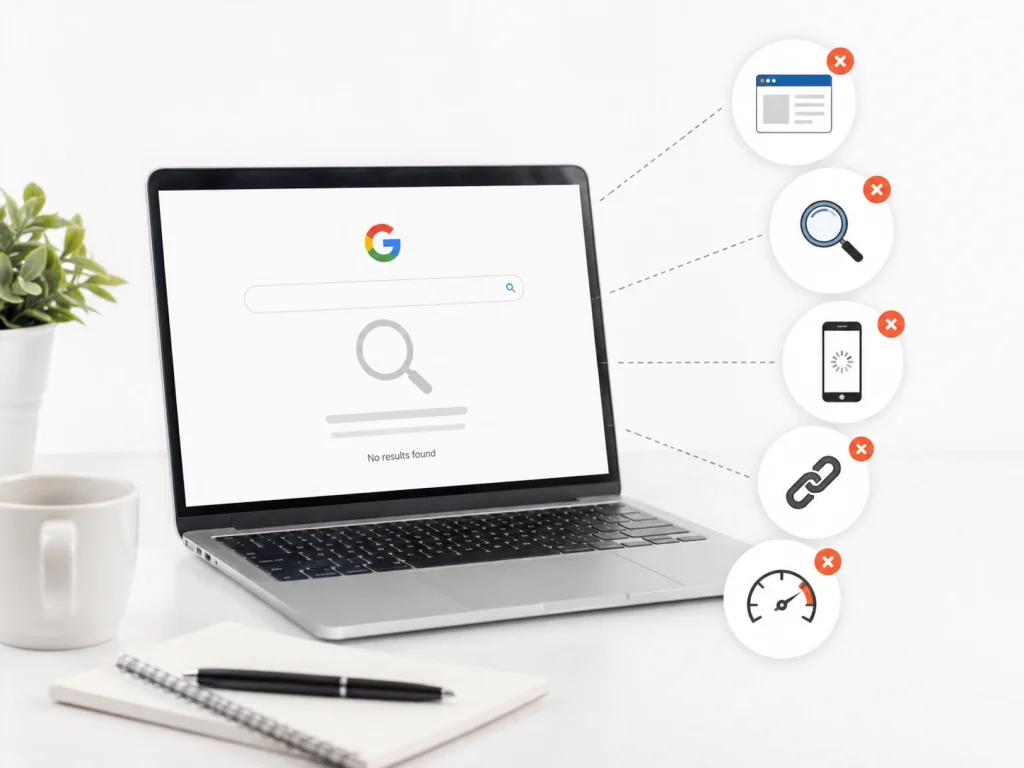
Pouring your heart into a website only to find it invisible really hurts. You deserve to be found by the people you sell to. Let’s identify exactly why your site is hiding and how to fix it:
1. Google Indexing Errors
If Google cannot find your website, it cannot rank it. This is especially common with new websites or sites experiencing technical SEO issues.
The Fix: Verify your site in Google Search Console, submit your XML sitemap, and check for crawl errors. Request indexing for your most important pages, strengthen internal linking, and earn quality backlinks to help Google discover and prioritize your content faster.
2. Technical Blocking
Sometimes websites accidentally prevent search engines from accessing their content. A misconfigured robots.txt file or a “noindex” tag can stop Google from crawling and indexing pages.
The Fix: Review your robots.txt file and check for any unintended noindex tags. Remove anything blocking important pages and make sure Google can crawl your website properly.
3. Thin or Low-Quality Content
Google favours content that provides clear value and answers users’ questions. Pages with little information, outdated content, or poor relevance often struggle to rank.
The Fix: Improve weak pages by adding useful, detailed information that matches search intent. Update title tags and meta descriptions, and consolidate overlapping content into stronger, more comprehensive resources.
4. Lack of Authority
Even well-optimised websites can struggle to rank if Google doesn’t view them as trustworthy. Backlinks from reputable websites remain one of the strongest authority signals. However, you must prove that you have expertise in your field.
The Fix: Focus on earning high-quality backlinks through guest posting, digital PR, industry partnerships, and listings in trusted directories. The more credible sites that reference your content, the stronger your authority becomes.
Understanding How Google Ranking Actually Works
Google uses a simple three-step process to organise the web. First, automated bots “crawl” or discover your pages. Next, Google “indexes” that information, storing it in a massive database.
Finally, the algorithm “ranks” those pages when a user types a query. It happens in milliseconds. Understanding this path helps you see exactly where your site might be falling short.
The Google Algorithm
It’s basically a way for Google to know your content and place it. And it’s getting updated regularly. The algorithm doesn’t just read keywords anymore. It looks for intent. Google uses AI to understand the why behind a search. So, if you use SEO tools with AI integration, you know your exact gaps for AGO and GEO.
It prioritises original, helpful content written by people for people, rather than pages built to game the system. Your ranking rests on three main pillars:
- Quality & Intent: Does your content answer the user’s problem? We call this E-E-A-T (Experience, Expertise, Authoritativeness, and Trustworthiness).
- Authority: Backlinks act as votes of confidence from other sites.
- Experience: Your site must be fast and mobile-friendly.
Pillar | Goal |
Relevance | Answer the user’s intent |
Authority | Build trusted links |
Experience | Ensure fast, mobile-friendly design |
If you check these boxes, you speak Google’s language. Even if you are using Shopify, WordPress, Magento, or any other platform, these fundamentals stay the same.
The algorithm does not care what CMS you build on. It cares whether your pages serve the searcher. Focus on these signals, and you will stop gaming the system and start winning it.
Domain Authority & Page Authority
Domain Authority predicts the ranking potential of your entire website. It gives you a quick snapshot of your competition. Page Authority does the same, but only for one specific page.
Many beginners panic over these scores. They assume Google uses them to rank sites. It does not.
These are third-party metrics created by SEO software. Google never looks at these numbers when deciding where to place your content.
Stop obsessing over these scores. Focus on real-world value instead. If your content is truly helpful, the traffic will find you regardless of any vanity metric.
On-Page SEO Mistakes That Keep You Stuck
Your on-page setup decides how far your content can go. Even if your technical SEO is solid, messy pages can still hold you back.
If search engines cannot clearly understand your content, your search rankings will be limited. Cleaning up your pages often makes a bigger difference than people expect.
Keyword Targeting Failures: Chasing the Wrong Ones
A common SEO mistake is going after keywords that are too broad or too competitive. Many websites target high-volume terms because they look attractive, but they often bring little or no traffic if the competition is too strong.
A better strategy is to understand keyword types and use them more realistically:
Head keywords (short-tail):
Broad terms like “shoes.” They have high search volume but very unclear intent and extreme competition, making them very hard to rank for.
Body keywords (mid-tail):
More specific terms like “men’s running shoes.” These have moderate volume and competition and are better targets as your site grows.
Long-tail keywords:
Very specific phrases like “best men’s running shoes for flat feet.” These have lower search volume but clear intent and much easier ranking opportunities. They also tend to convert better.
Before targeting a keyword, check its difficulty and the current search results. If the first page is filled with strong sites like Amazon or Forbes, ranking will be difficult no matter how good your content is.
Instead, focus on gaps your competitors are missing and match keywords to user intent, whether they want to learn, compare, or buy. When you choose keywords based on difficulty, relevance, and intent, your traffic becomes more consistent and easier to grow.
Keyword Stuffing Issues
Keyword stuffing is outdated and ineffective. Repeating the same keywords too often makes content awkward and hard to read. It can also reduce trust with both users and search engines.
Write naturally first, then refine. If a sentence feels forced, it usually is. Remove unnecessary keyword repeats and keep the language simple. Clear content always performs better than over-optimised text.
Content Quality Over Content Quantity: Thin Content
Thin content is content that provides little value to users because it lacks depth, originality, or useful information.
It can also appear in long articles when sentences are vague, repetitive, or filled with filler that adds no real insight, creating thin sentences. Search engines favour pages that clearly answer user intent.
So each page should be focused, detailed, and meaningful. Strong content combines depth, clarity, and purpose to build lasting authority.
Title Tags, Meta Descriptions & Header Hierarchy
Page structure helps search engines understand your content. A clear title tag tells both users and Google what the page is about. Meta descriptions may not directly impact rankings, but they do influence clicks.
Use your main keyword naturally in the title. Inside the page, keep headings structured and consistent. H1 is always used in the title and is for the main topic, while H2 and H3 break the content into sections. Avoid skipping levels so everything flows logically. Good structure improves readability and SEO performance.
Internal Linking: The Underrated Ranking Signal
Internal links help connect your content across your website. They guide users and help search engines understand relationships between pages. Use clear and relevant anchor text so readers know what to expect.
A hub and spoke structure works well for organising related topics. It helps distribute authority and improves crawling efficiency. Even small improvements in internal linking can strengthen overall rankings.
External Linking
External links show that your content is supported by reliable sources. They add context and increase credibility for both users and search engines.
These links do not weaken your SEO. Instead, they help establish trust and relevance. Only link to high-quality, relevant sources that genuinely support your content.
These on-page fixes may seem small on their own, but together they create a stronger foundation. Once your pages are clear, structured, and useful, your site becomes much easier to rank.
Off-Page SEO: Why No One Is Vouching for Your Site

You can have a fast website and perfectly optimised pages, but if no one outside your site is talking about or linking to you, Google may struggle to trust your content.
Think of it like a job application. On-page SEO is your resume. It shows what you can do. Off-page SEO is your reference. It proves it. If your site isn’t ranking, weak off-page SEO is often the missing piece.
Backlinks
Backlinks are still one of Google’s strongest ranking signals, but quality matters more than quantity. A single link from a trusted website can be more powerful than hundreds of low-quality ones. To build a strong backlink profile, it helps to understand the main types of links and how they work.
Basic Backlinks
These are simple, easy-to-get links that help establish your website’s presence. They don’t carry strong ranking power, but they make your backlink profile look natural.
- Directory citations: Listing your business on platforms like Google Business Profile, Yelp, or industry directories.
- Social profiles: Adding your website link to your LinkedIn, X, Instagram, or other profiles.
- Comments and forums: Participating in discussions on platforms like Reddit and sharing links only when they are genuinely helpful.
Advanced Backlink
These require more effort but deliver stronger, high-authority links that can significantly improve rankings.
- Digital PR: Sharing insights, data, or expert opinions with journalists through platforms like HARO, leading to links from news sites.
- Skyscraper technique: Improving existing popular content, then reaching out to sites linking to it and offering your better version.
- Unlinked mentions: Finding places where your brand is mentioned without a link and requesting one be added.
- Podcasts and webinars: Appearing as a guest and earning backlinks from show notes or episode pages.
- Guest posts: Writing articles for relevant blogs where you can include a link in your author bio or content.
- Resource link building: Creating in-depth guides or tools and getting them listed on authoritative resource pages.
Key Backlink Types
If no one is linking to your site, it usually means the content isn’t yet worth referencing. Focus on creating valuable resources and using advanced strategies to earn links that truly improve rankings. Not all links pass the same value.
- Dofollow: Passes authority and directly impacts rankings.
- Nofollow: Does not pass authority but can still bring traffic.
- Sponsored or UGC: Used to mark paid or user-generated links for transparency.
Note: Always stay away from spammy links or toxic links. We use Moz for it, but you can use any other SEO tool you want.
Brand Authority and Trust
Google wants to rank trusted brands, not just websites. This is where E-E-A-T comes in. It stands for Experience, Expertise, Authoritativeness, and Trustworthiness.
Google looks at your reputation across the web, not just on your own site. Strong trust signals include:
- Brand mentions on reputable websites
- Expert authors with professional profiles and credentials
- References from trusted industry sources
If your business has little presence outside its website, Google has fewer signals to trust it. Building your reputation across multiple platforms helps strengthen your authority.
Social Media Helps More Than You Think
Social media is a direct ranking factor, but it can still support SEO.
When people share your content on LinkedIn, X, Facebook, and other platforms, it reaches a larger audience. That exposure can lead to:
- More website visits
- More brand awareness
- More backlinks from bloggers, journalists, and industry websites
Social media creates visibility. Visibility often leads to links.
Technical SEO Issues That Kill Your Rankings & Google Indexing
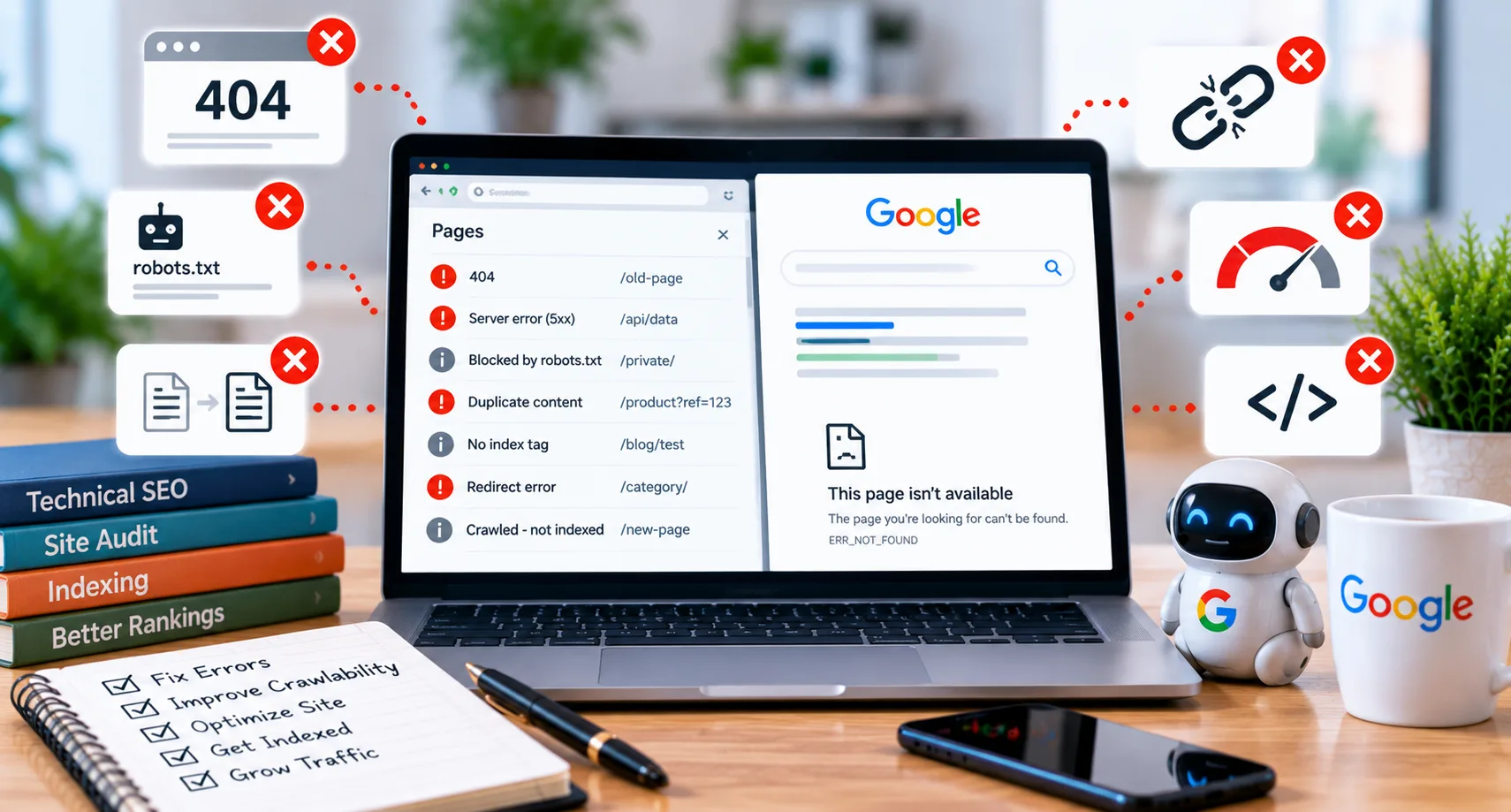
You can have great content, but it will not rank if search engines cannot properly access or understand your site. Technical SEO is the foundation that supports everything else.
If it is broken, your search visibility drops, no matter how good your pages are. Fixing these issues often brings quick improvements.
Crawlability Problems
When you go for an audit of your website’s technical part, you have to focus on the crawl budget first. Here are the crawl budget errors and what you need to fix.
- Zombie page: There are some pages which do not add proper value and increase crawl budget. You have to remove them and submit them to GSC to remove them.
- Responsive: Find out the pages or posts which don’t come with a mobile-friendly design. You will find them on GSC.
- JS and CSS file: Make sure that your website doesn’t overload CSS and JS files. Because they increase the crawl budget.
Google needs to find your pages before it can rank them. If your site has crawlability issues, important content may never get indexed.
Start by checking Google Search Console for crawl errors. A messy site structure wastes crawl budget on almost every page. Orphan pages are a common issue because they have no internal links pointing to them.
Fix broken links that lead nowhere. Remove or update redirect chains that slow down crawling. Keep your XML sitemap clean and updated so Google knows what to index.
When your site is easy to crawl, your important pages get discovered faster and more consistently.
Page Speed & Core Web Vitals: The Silent Ranking Killer
Speed matters more than most people think. If your site is slow, users leave before they even see your content. Google measures performance using Core Web Vitals:
- LCP (Largest Contentful Paint): How fast your main content loads
- INP (Interaction to Next Paint): How quickly your site responds
- CLS (Cumulative Layout Shift): How stable your page layout is
If these metrics are poor, rankings can drop even with good content.
Improve speed by compressing images, reducing heavy scripts, and using reliable hosting. A fast site builds trust and keeps users engaged.
Mobile-Friendly Responsive Design Errors
Most users browse on mobile devices, so your site must work well on small screens. Google now uses mobile-first indexing, meaning it evaluates your mobile version first.
If your mobile experience is poor, rankings suffer. Check for common issues like:
- Small or unreadable text
- Buttons too close together
- Layouts that break on smaller screens
A clean mobile design improves usability and helps your SEO across all devices.
Misconfigurations in robots.txt
The robots.txt file acts as a gatekeeper, telling search engines which areas of your site they can and cannot access. A small mistake here can accidentally block your most important pages from ever appearing in search results.
While you shouldn’t block essential rendering resources like CSS and JS files (which Google needs to see your page correctly), the most common robots.txt errors actually involve restricting access to the wrong directories.
For example, you might accidentally block your entire wp-admin folder, specific product categories, or parameter-heavy URLs that you actually want Google to crawl.
Make sure you are not accidentally disallowing key sections of your site. Always include the path to your XML sitemap at the bottom of the file; this helps Google find your important pages much faster. A quick audit of your robots.txt rules can prevent serious search visibility issues.
Canonical Tag Mistakes
Duplicate content can confuse search engines and split your ranking power across multiple URLs. Canonical tags solve this by telling Google which version of a page is the primary one.
If your canonical tags are wrong, Google may ignore the page you actually want to rank, wasting your SEO efforts. Here is how to fix and prevent canonical issues:
- Self-referencing tags: Guarantee every page has a canonical tag that points to itself. This prevents scrapers or URL parameters (like UTM tags or session IDs) from accidentally creating duplicate versions that steal your ranking power.
- Consolidate duplicates: If you have identical or highly similar pages (like a print-friendly version or a product page with a sorting parameter), set the canonical tag on those duplicate pages to point back to your primary, canonical URL.
- Audit with tools: Use Screaming Frog or Google Search Console to scan your site for missing canonicals, conflicting tags (e.g., a page pointing to another page that points back to it), or tags pointing to broken URLs.
A simple check of your canonical setup ensures all your link equity and indexing power are funnelling to the right place.
Some Good Local SEO Practices For Better Ranking
For local businesses, off-page SEO relies heavily on citations and business listings. Google looks for consistent information about your business across the web, especially your:
- Business name
- Address
- Phone number
Inconsistent details can reduce trust and hurt local rankings. To improve local SEO you have to:
- Claim and optimise your Google Business Profile
- Keep your business details consistent across all directories
- Earn links from local organisations, news sites, and community websites
For local businesses, a link from a trusted local source can be extremely valuable.
Content Strategy: Writing What Google Wants to Rank
Good content is not just writing words on a page. It connects what people are searching for with the answers they need.
If you ignore search intent, your content gets lost, no matter how well it is written. A clear strategy helps you create pages that actually rank and bring steady traffic.
Search Intent Mismatch: The No. 1 Content Mistake
Most content fails because it answers the wrong question. This is called search intent mismatch, and it is one of the biggest ranking problems. Every search has a purpose:
- Informational: Users want to learn something
- Commercial: Users are comparing options
- Transactional: Users are ready to buy
Before writing, always check what the user actually wants. If someone is searching to buy, they do not need background information. They need clear options or a product page.
When your content matches intent, users stay longer, and Google trusts your page more.
Content Depth & Topical Authority
Short or shallow content rarely performs well anymore. Google prefers pages that fully cover a topic.
To build stronger authority, organise your content into topic clusters. Create one main pillar page and support it with related articles. This helps both users and search engines understand your expertise.
Look for content gaps in your niche. If competitors are missing key information, that is your opportunity. When you answer all related questions, you become a trusted source in that space.
Freshness & Content Updates
Old content can lose rankings over time. Google prefers updated and relevant information.
Instead of always creating new posts, update existing ones. Add new data, improve examples, and refresh outdated sections. This often brings faster results than starting from scratch.
Make content updates part of your routine. When your pages stay current, they stay competitive.
Now that your content is aligned with search intent and structured for authority, the next step is building a consistent strategy for long-term growth.
The 30-Day Ranking Recovery Solution
You need a clear map to climb back up the rankings. This 30-day plan turns confusion into a systematic process. Follow these steps, and you will see progress in your data. Here is a master plan table for the next 30 days for a faster ranking recovery:
Week | Focus Area | Key Actions | Expected Outcome |
Week 1 | Technical Audit | GSC review, crawl test, CWV fix, indexing check | All pages indexable, no critical errors |
Week 2 | Content Optimization | Keyword refresh, title/meta rewrite, intent alignment | Improved CTR, better intent match |
Week 3 | Authority Building | Guest post outreach, directory listings, internal link audit | 3-5 quality backlinks acquired |
Week 4 | Monitor & Iterate | Rank tracking, analytics review, and content refresh | Baseline metrics established |
Week 1: Technical Audit & Quick Fixes
Start by digging into your site’s health. Use Google Search Console to find errors that prevent indexing. Run a crawl test to identify broken links or speed killers. Fix your Core Web Vitals to improve speed.
Week 2: Content Optimisation Sprint
Look at your low-performing pages now. Rewrite your title tags and meta descriptions to boost clicks. Audit your keywords to ensure they match user intent. Refresh outdated information to keep your rankings stable.
Week 3: Link Building & Authority Building
Focus on external validation. Reach out to partners for guest post opportunities. Add your site to relevant directory listings. Audit your internal links to ensure authority flows to the right pages.
Week 4: Monitoring & Iteration
Check your progress against your baseline. Review your rank tracking software to see what moved. Analyse your traffic analytics. If something worked, double down on it next month.
Free & Paid Tools to Audit Why Your Website Isn't Ranking Manually
You do not need expensive tools to understand why your site is not ranking. A simple SEO audit can be done using free platforms that give you real insights. These tools help you see what search engines see, so you can fix the right problems instead of guessing.
Tool | Free Features You Get |
Google Search Console | Core indexing & search data |
PageSpeed Insights | Performance & Core Web Vitals |
Screaming Frog | In-depth technical site crawl |
Ahrefs Webmaster Tools | Backlink & health monitoring |
Ubersuggest | Keyword & content ideas |
GTmetrix | Speed optimization analysis |
Each tool gives you a different feature you need. Google Search Console shows how your site appears in search and highlights indexing issues. Screaming Frog helps you scan your site for technical problems like broken links or missing tags. Ahrefs Webmaster Tools gives you a clear view of your backlinks and overall site health.
For speed, PageSpeed Insights and GTmetrix show what is slowing your site down. Ubersuggest helps you understand if your keyword strategy is weak or missing opportunities.
Do not overthink the data. Start with one tool, find the biggest issue, and fix it first. SEO improves through small, consistent fixes, not jargon-filled reports.
Is Your Website Not Indexed or Simply Not Ranking High Enough?
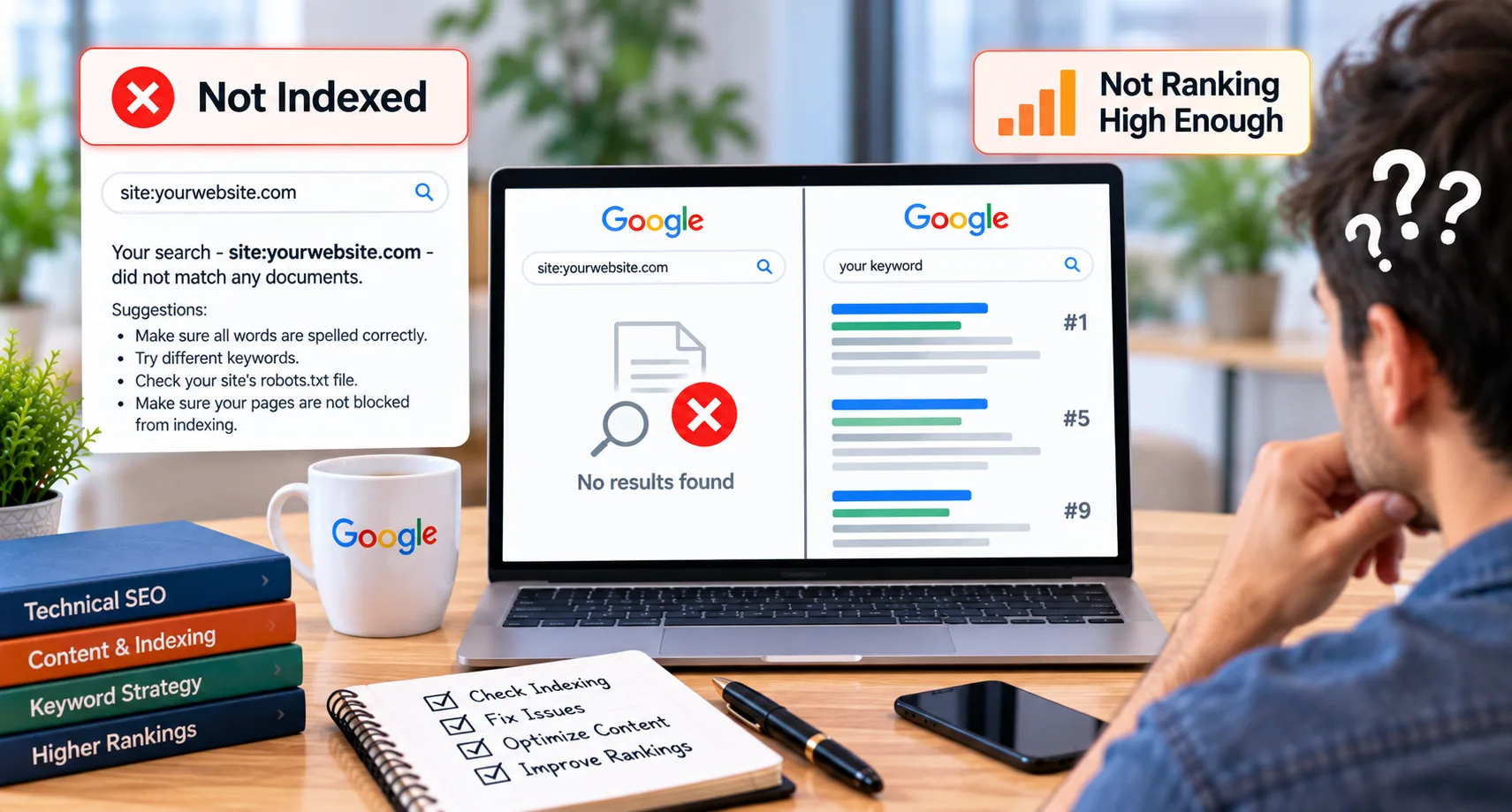
A page that is not indexed cannot appear in Google Search. A page that is indexed but ranks poorly is known to Google but lacks enough relevance or authority to compete.
Check the URL using Google Search Console’s URL Inspection tool. If it is not indexed, review robots.txt, noindex tags, canonical tags, sitemap inclusion, crawl errors, and internal links.
If the page is indexed, assess keyword targeting, search intent, content quality, backlinks, page speed, and competitor strength. Indexing issues need technical fixes, while ranking issues require stronger SEO signals.
How to Diagnose Ranking Problems Using Google Search Console
Google Search Console helps identify why a page is losing visibility. Open the Performance report and compare clicks, impressions, click-through rate, and average position over three to six months.
Filter the report by page and query. High impressions with few clicks may indicate a weak title or meta description. Falling positions can signal outdated content, stronger competitors, or poor search intent alignment.
Use URL Inspection to confirm indexing and crawl status. Then improve content depth, internal links, structured data, mobile usability, and keyword relevance based on the problems found.
Keyword Cannibalization: Are Your Pages Competing Against Each Other?
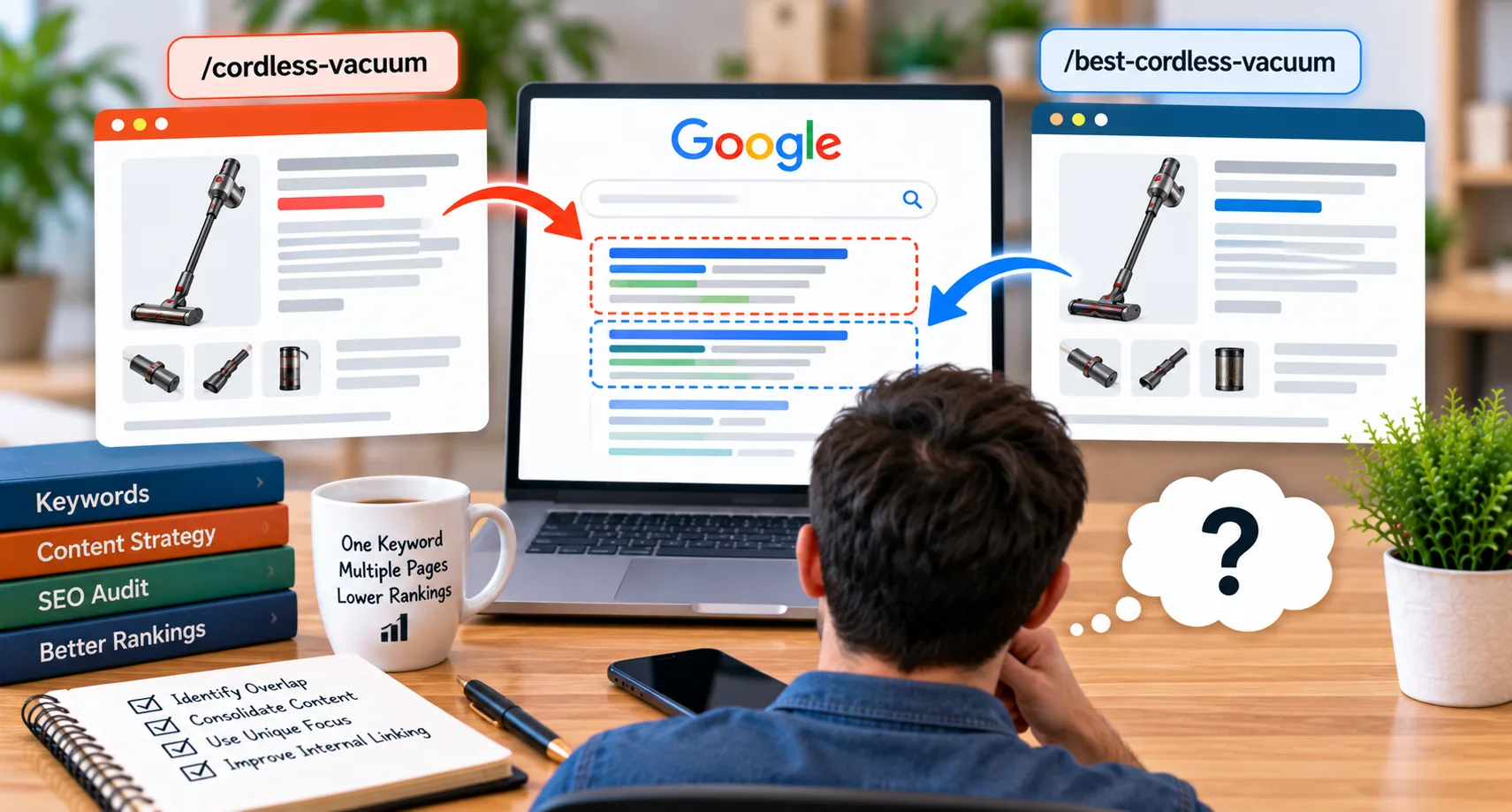
Keyword cannibalization occurs when multiple pages target the same keyword and search intent. Google may struggle to select the best page, causing unstable rankings and divided authority.
In Google Search Console, filter by a target query and review every URL receiving impressions. Multiple ranking pages may indicate overlapping content, although different pages can rank safely when they serve different intents.
Merge similar pages, redirect weaker URLs, or give each page a distinct purpose. Strengthen the preferred page with internal links and descriptive anchor text so Google can identify the main result.
Frequently Asked Questions (FAQs)
You probably have questions about your situation. SEO optimisation can feel confusing, but it becomes clearer with the right guidance. Here are answers to common concerns so you can move forward with confidence:
How long does it take for a new website to rank on Google?
It usually takes three to six months to see real movement. Google needs time to trust your domain. Keep publishing quality content and building links steadily during this phase. Patience is your best asset when starting a new site from scratch.
Can a low-DA website rank on Google?
Yes, absolutely. Google ranks content, not domain scores. If your article provides the best answer for a specific question, you can outrank big sites. Focus on long-tail keywords where you can compete, then build your reputation from there.
Why did my website ranking suddenly drop?
Sudden drops often mean a technical error or a core algorithm update. Check your Search Console for manual actions. See if you lost backlinks or if your site speed tanked. Also, ensure your content is still relevant to current search trends.
Does Google penalise duplicate content?
Google does not issue a manual penalty for duplicate content. However, it will choose one version to show and ignore the rest. This creates keyword cannibalisation, where you compete against yourself. Always use canonical tags to tell Google which version matters.
How do I know if Google has indexed my site?
Type "site:yourdomain.com" into the Google search bar. The results will show every page Google currently has in its database. If you see zero results, your site is not indexed. Check your robots.txt file or noindex tags immediately.
Does Google penalise AI-generated content?
Google doesn’t punish content just because AI wrote it. It punishes content that provides no real value. Whether you use AI tools or write manually, the standard remains the same: does your page solve a specific problem? If your content feels thin, you struggle.
Do I really need backlinks to rank?
Backlinks act as votes of confidence. While you can rank for low-difficulty, long-tail keywords without them, competitive niches require authority. They prove your site is a trusted source. Focus on earning links naturally by creating high-quality, shareable resources. Don’t buy links.
Fix Your Website Ranking On Google Fast
You’ve made it through the guide, but the real work starts now. Why your website is not ranking on Google often comes down to a few core issues, like technical SEO errors, weak content, or a lack of quality backlinks.
The good news is these problems are fixable when you approach them step by step.
Fixing Google ranking issues is not about shortcuts; it’s about consistency and structure. A proper SEO audit combined with improved content can quickly change your visibility. Instead of getting overwhelmed by algorithms, focus on small, steady improvements.
Follow a clear recovery plan, prioritise the biggest gaps first, and build momentum over time.
Every fix you make adds up. Start with one change today, and your site will slowly move toward stronger rankings and more consistent traffic.
